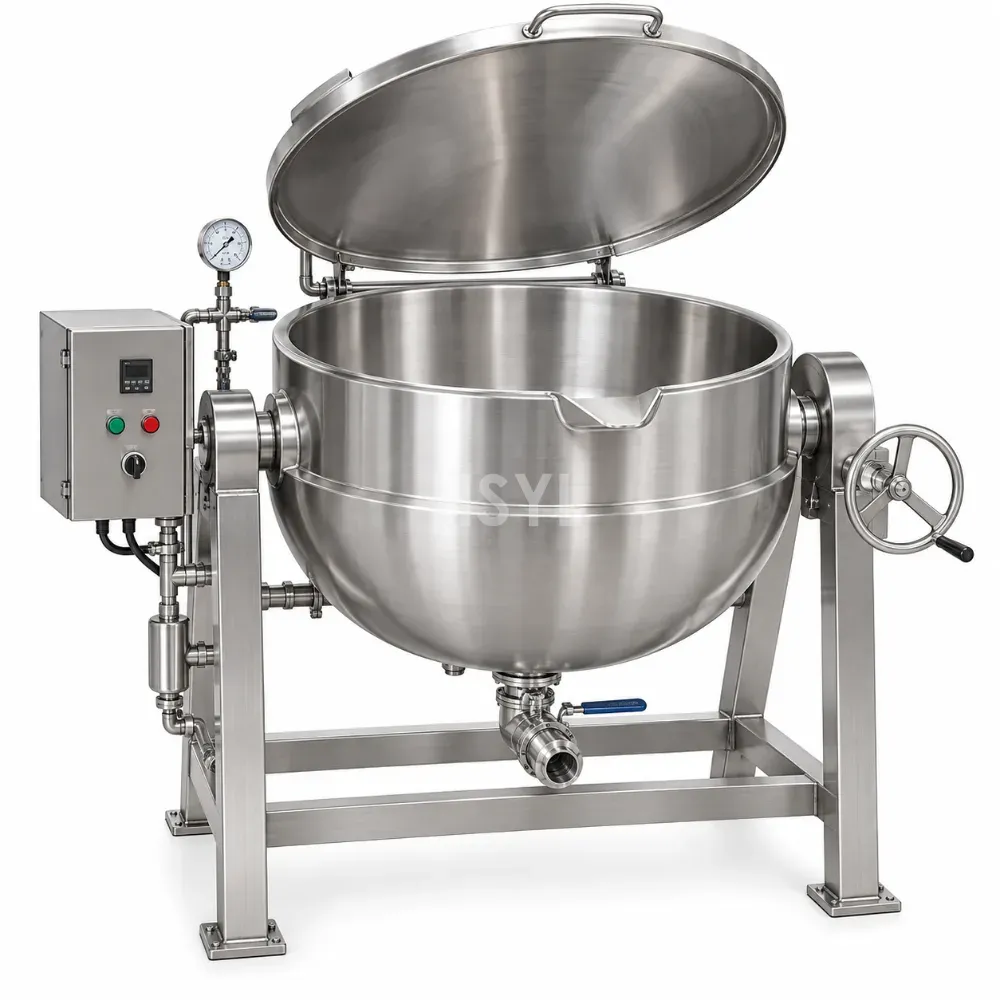
 Steam Jacketed Kettles for High-Volume Batch Cooking
Steam-jacketed kettles are used where large batches of soups, sauces, stews, stocks and other pumpable or stirrable products must be heated uniformly and discharged safely. The kettle should be selected from usable batch volume, product viscosity, steam conditions, agitation requirement, tilting/discharge method and cleaning workflow.
HSYL central-kitchen engineering content currently uses 200–500 L steam-jacketed tilting kettles as a planning range, with 0.3–0.4 MPa steam pressure and SUS316 inner bowls referenced for acid-sensitive foods such as tomato sauces. These are planning references, not a substitute for the final project specification.
Available Equipment & Model References
Use the table as a shortlist. The signed quotation and current model specification sheet remain the controlling documents for dimensions, utilities, accessories and order scope.
| Equipment | Product Code | Project Fit / Configuration Summary | Product Page |
|---|---|---|---|
| Commercial Steam-Jacketed Tilting Kettle 100L | CK-SJK-100 | Φ700 mm inner bowl, 100 L nominal; 0.58 m² heat transfer area; 3/4" steam/condensate; 0.55 kW agitator; restaurant and hotel banquet prep. | View model |
| Commercial Steam-Jacketed Tilting Kettle 200L | CK-SJK-200 | Φ800 mm inner bowl, 200 L nominal; 1.12 m² heat transfer area; 3/4" steam/condensate; 0.75 kW agitator; canteen soups, stocks and stews. | View model |
| High-Volume Steam-Jacketed Tilting Kettle 300L | CK-SJK-300 | Φ900 mm inner bowl, 300 L nominal; 1.42 m² heat transfer area; 1" steam/condensate; 1.1 kW agitator; central kitchen sauces and bulk cooking. | View model |
| Industrial Steam-Jacketed Tilting Kettle 500L | CK-SJK-500 | Φ1100 mm inner bowl, 500 L nominal; 2.00 m² heat transfer area; 1" steam/condensate; 1.5 kW agitator; cook-chill commissary production. | View model |
| Heavy-Duty Steam-Jacketed Tilting Kettle 600L | CK-SJK-600 | Φ1200 mm inner bowl, 600 L nominal; 2.30 m² heat transfer area; 1" steam/condensate; 1.5 kW agitator; high-throughput meal batching. | View model |
Standard Engineering & Parameter Matrix
Standard design parameters for HSYL commercial steam-jacketed tilting kettles (verified engineering benchmark):
| Model | Capacity | Bowl Diameter | Bowl Depth | Heat Transfer Area | Steam / Condensate Port | Agitator Power | Working Steam Pressure |
|---|---|---|---|---|---|---|---|
| CK-SJK-100 | 100 L | Φ700 mm | 450 mm | 0.58 m² | 3/4” / 3/4” | 0.55 kW (36 r/min) | 0.09–0.35 MPa |
| CK-SJK-200 | 200 L | Φ800 mm | 530 mm | 1.12 m² | 3/4” / 3/4” | 0.75 kW (36 r/min) | 0.09–0.35 MPa |
| CK-SJK-300 | 300 L | Φ900 mm | 630 mm | 1.42 m² | 1” / 1” | 1.1 kW (36 r/min) | 0.09–0.35 MPa |
| CK-SJK-500 | 500 L | Φ1100 mm | 730 mm | 2.00 m² | 1” / 1” | 1.5 kW (36 r/min) | 0.09–0.35 MPa |
| CK-SJK-600 | 600 L | Φ1200 mm | 780 mm | 2.30 m² | 1” / 1” | 1.5 kW (36 r/min) | 0.09–0.35 MPa |
How to Specify the Right Configuration
| Decision | What to Confirm |
|---|---|
| Working volume | Size from usable product volume per batch and leave process headspace; do not select directly from nominal vessel volume. |
| Product viscosity | Soups, sauces and viscous products can require different agitation, scraper or mixing systems. |
| Steam conditions | Confirm available steam pressure, quality, flow capacity, condensate return and control valve arrangement. |
| Product-contact material | SUS304 suits many food processes; more aggressive/acidic products can justify SUS316 product-contact surfaces. |
| Discharge method | Tilting, bottom outlet or pump transfer should match the receiving container and downstream process. |
| Cleaning & safety | Plan access, drainability, operator guarding, isolation and CIP/manual cleaning around the actual recipe. |
Typical Applications
- Soups and broths
- Tomato and cheese sauces
- Stews and curry bases
- Hotel and canteen batch cooking
- Cook-chill central kitchens
- Retail deli and commissary production
Engineering & Procurement Notes
- HSYL steam-jacketed tilting kettles span standard capacities from 100 L to 600 L, with hemispherical inner bowls from Φ700 mm to Φ1200 mm.
- Engineering design operates at standard low-to-medium steam pressures of 0.09–0.35 MPa (up to 0.40 MPa high-pressure certified options available on request).
- For acidic products such as tomato puree, barbecue sauces or citrus-based glazes, food-contact inner bowls can be specified in acid-resistant AISI 316 stainless steel with electropolished finish.
- Tilting mechanism options include manual worm-gear handwheel or automated hydraulic 90° power tilt for seamless integration with mobile receiving totes or pump sumps.
Information Required for an Accurate RFQ
- Application, menu or ware type and the peak operating duty.
- Required capacity or batch/rack/production schedule.
- Available utilities: voltage, phase, frequency, gas/steam/water data where relevant.
- Installation space, access route and floor plan if available.
- Destination market and any required compliance/documentation scope.
- Required quantity, accessories, spare parts and target project schedule.
Related HSYL Resources
Request a Technical Proposal
Send HSYL the operating requirement before selecting a model from price alone. The engineering review connects the equipment to the required capacity, site utilities, layout, workflow and destination conditions.