Direct Answer / Key Takeaway: Compare continuous-feed commercial food processors, batch bowl cutters, and combination prep machines across RPM shear physics, kg/hr output, and 5-year TCO.
Within our Commercial Kitchen Equipment Selection Hub, one of the costliest specification errors we audit in hotel commissaries, hospital dietary kitchens, and central meal-prep plants is assigning the wrong mechanical cutting head to a culinary task. Attempting to dice 200 kg of root vegetables inside a high-speed batch bowl cutter turns crisp produce into oxidized slurry within 15 seconds, while feeding herb oil emulsions or dense meat mixtures through a gravity chute clogs centrifugal discharge housings and overloads single-speed induction motors. This engineering specification guide evaluates continuous-feed vegetable prep machines, vertical batch bowl cutter mixers, and 2-in-1 combination units across blade metallurgy, VFD torque profiles, food preparation equipment line integration, and 5-year labor ROI.
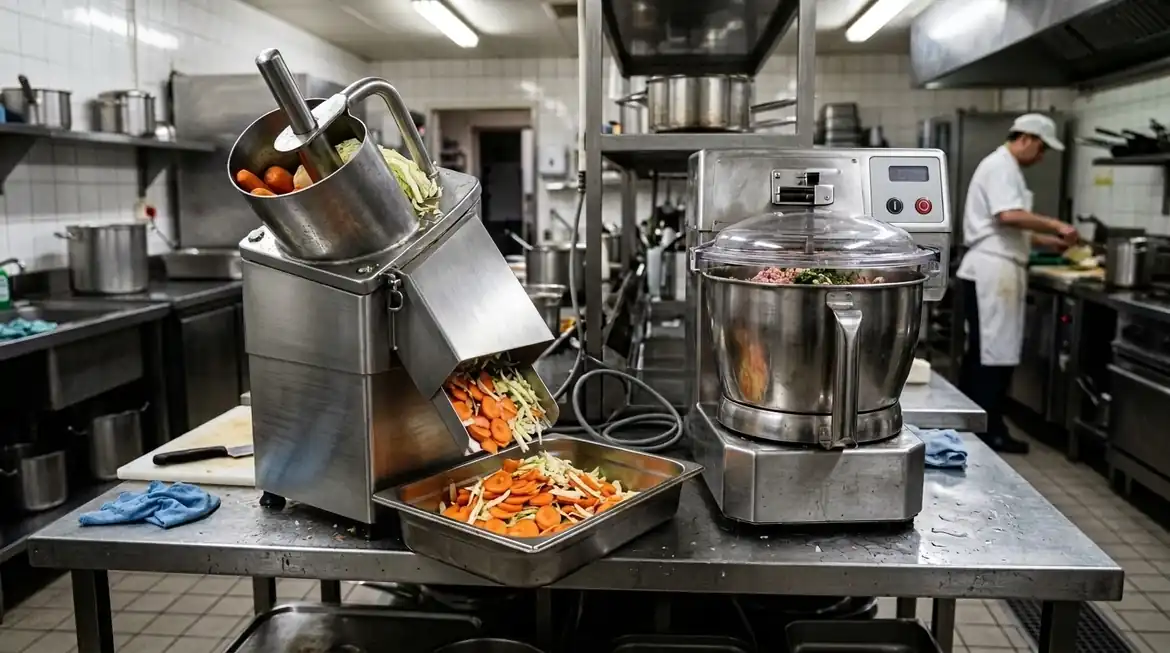
Key takeaway: Selecting between a continuous-feed commercial food processor and a batch bowl cutter is dictated by cellular shear geometry and hourly mass throughput: continuous-feed disc processors slice, julienne, and dice 150 to 3,500 kg/hr at low rotational speeds (300–550 RPM) without crushing plant cell walls, whereas enclosed batch bowl cutters (5L–12L) run high-velocity S-blades at 1,500–3,000 RPM to chop, puree, and emulsify high-viscosity sauces, pâtés, and meat batters.
Mechanical Kinematics: Continuous-Feed Shear vs. Enclosed Batch Bowl Vortex
Although both machines frequently share a similar planetary or direct-drive motor footprint, their internal fluid mechanics, blade tip velocities, and product residence times are diametrically opposite.
Continuous-Feed Processor (Centrifugal & Conveyor Disc Architecture)
In a continuous-feed processor—commonly specified from our Commercial Vegetable Cutters & Dicers lineup—whole or pre-trimmed produce is loaded through an ergonomic crescent hopper (for cabbages and potatoes) or a cylindrical cylindrical tube (for cucumbers, carrots, and celery). A lever-activated pusher or an automated polyurethane (PU) conveyor belt guides the raw ingredient against a horizontally or angularly rotating cutting disc spinning at 300 to 550 RPM.
- Single-Pass Zero-Residence Cutting: The ingredient contacts the hardened knife edge for less than 0.08 seconds before centrifugal force and an angled ejector plate discharge the cut pieces directly into an external Gastronorm pan or 200L Euro-bin.
- Cellular Integrity & Extended Shelf Life: Low-RPM slicing with razor-honed blades shears cleanly through plant parenchyma cells rather than tearing vascular fibers. This cuts enzymatic browning (polyphenol oxidase activation) and purge water loss in packaged salads by 35%–50% over a 72-hour cold-chain holding window.
- Three-Dimensional Cubic Dicing: Dedicated centrifugal root dicers (such as the YL-VC-800) combine a horizontal slicing knife, a rotating cross-cut spindle, and a stationary dicing grid to produce precise 4mm to 20mm cubes in a single continuous pass at 600–1,000 kg/hr.
Batch Bowl Cutter Mixer (High-Speed Vertical Vortex Architecture)
A batch bowl cutter mixer—selected from our Commercial Food Processors & Bowl Cutters range—retains all solid and liquid ingredients inside a sealed, removable AISI 304 stainless steel bowl (typically 5L, 8L, or 12L capacity). At the base of the central vertical drive shaft, a dual-wing S-shaped blade assembly rotates at 1,500 to 3,000 RPM (or 300–3,000 RPM on Variable Frequency Drive models).
- Controlled Residence Time & Particle Size Reduction: Because ingredients remain captive inside the bowl for 15 to 180 seconds, the vertical curvature of the bowl walls forces the product upward and back down into the path of the spinning S-blade (the toroidal vortex effect). An integrated lid-mounted manual wiper arm scrapes clinging paste from the upper walls back into the cutting zone.
- High-Shear Emulsification: At 3,000 RPM, micro-serrated S-blades generate intense hydrodynamic shear that disperses oil droplets to <5 microns within an aqueous phase, creating stable mayonnaise, hollandaise, garlic aioli, and fine sausage farce without phase separation.
- Thermal Friction Constraint: Continuous operation at 3,000 RPM transfers mechanical kinetic energy into sensible heat, raising batter temperatures by 1.5°C–2.5°C per minute. For heat-sensitive herb pestos (which oxidize and turn brown above 38°C) or meat emulsions (where fat smears above 14°C), variable-speed VFD control (300–800 RPM initial incorporation) is mandatory.
Engineering Specification Matrix: Bowl Cutters vs. Combo Units vs. Continuous Cutters
To prevent undersizing motor torque or selecting incompatible blade tooling, the engineering matrix below benchmarks HSYL's core food preparation configurations across batch capacity, hourly output, RPM envelopes, and electrical rough-in requirements.
| Engineering Parameter | Batch Bowl Cutter Mixer (YL-FP-5 / YL-FP-8) | Heavy-Duty VFD Bowl Cutter (YL-FP-12) | 2-in-1 Combination Processor (YL-FP-COMBO) | Continuous-Feed Prep & Dual-Head (YL-VC-300 / YL-VC-1000) |
|---|---|---|---|---|
| Primary Culinary Function | Chopping, mincing, nut pastes, coarse purees, dressings | Fine emulsions, meat farce, hospital dysphagia diets, pâtés | Dual duty: batch pureeing + continuous vegetable slicing/dicing | High-volume slicing, shredding, julienne, cubic dicing, leafy cutting |
| Bowl Volume / Hourly Output | 5.0 L (2.2 kg/batch) / 8.0 L (3.8 kg/batch) | 12.0 L Bowl (6.0 kg max liquid/paste batch) | 6.0 L Bowl + 150–300 kg/hr Continuous Head | 150–300 kg/hr (YL-VC-300) / 800–1,500 kg/hr (YL-VC-1000) |
| Rated Motor Power | 0.75 kW (1.0 HP) / 1.1 kW (1.5 HP) | 1.8 kW (2.4 HP) High-Torque Inverter Drive | 1.5 kW (2.0 HP) Dual-Range Drive | 0.75 kW (Countertop) / 2.2 kW Dual-Inverter (Conveyor) |
| Rotational Speed (RPM) | 1,500 / 3,000 RPM (Dual Speed + Pulse) | 300 – 3,000 RPM Stepless Variable VFD | 300–550 RPM (Disc Mode) / 1,500–1,800 RPM (Bowl Mode) | 380 RPM (Disc) / Dual VFD 100–850 RPM (Conveyor Sickle) |
| Standard Cutting Tooling | Smooth or Micro-Serrated 420J2 S-Blade | Twin-Level 420J2 S-Blade Hub + Lid Scraper Wiper | S-Blade + 5 Discs (Slice 2/4mm, Grate 3/7mm, 10mm Dice) | Interchangeable 4Cr13 / 9Cr18Mo Discs (1–20mm Slice/Dice/Shred) |
| Electrical Supply Standard | 220V/1Ph/50Hz or 110–120V/1Ph/60Hz | 220–240V/1Ph or 380V/3Ph/50–60Hz | 220–240V/1Ph/50–60Hz | 220V/1Ph (YL-VC-300) / 380V/3Ph (YL-VC-800/1000/1500) |
| Dynamic Brake Stop Time | < 1.8 Seconds upon lid release | < 2.0 Seconds electromagnetic brake | < 1.5 Seconds reed-switch cut-off | < 0.5 Seconds pusher/hopper magnetic interlock |
| Recommended Kitchen Scale | 20 – 150 Covers/Meal (Bistros, Hotel Pastry) | 150 – 600 Covers/Meal (Hospitals, Sauce Plants) | 50 – 250 Covers/Meal (Multi-Menu Restaurants) | 300 – 10,000+ Covers/Meal (Canteens, Central Kitchens) |
Regulatory Compliance, Machine Guarding, and Sanitation Mandates
High-speed rotary blades represent one of the highest mechanical hazard categories in commercial foodservice, while hollow blade hubs are prime harbingers of Listeria monocytogenes biofilms if improperly sealed. Procurement engineers must verify compliance across three international regulatory frameworks:
- Sanitation & Food-Zone Cleanability (NSF/ANSI Standard 8): Governing commercial powered food preparation equipment, NSF/ANSI 8 mandates that all splash-zone and food-contact components (cutter bowls, continuous-feed hoppers, ejector plates, and blade hubs) be detachable without hand tools for high-temperature warewashing. In addition, the vertical motor shaft entering the bottom of a batch bowl must feature a raised chimney seal (minimum 45mm above the static liquid line) with a double-lip NBR or Viton shaft seal so liquid purees cannot seep down into the motor bearings.
- Electrical & Dynamic Braking Safety (UL 763 & IEC/EN 60335-2-64): Commercial food processors must incorporate dual non-contact magnetic reed switches on both the bowl/hopper locking base and the upper lid/pusher arm. Under EN 60335-2-64 and UL 763, opening the lid or lifting the pusher lever by more than 4mm must immediately sever contactor coil power and engage an electromagnetic dynamic motor brake, halting the blade from 3,000 RPM to 0 RPM in under 2.0 seconds.
- Operator Point-of-Operation Guarding (OSHA 29 CFR 1910.212): Feed chute geometry on continuous-feed processors must prevent an operator's fingers from reaching the rotating slicing disc. Cylindrical feed tubes must have an internal throat depth exceeding 150mm with a diameter ≤58mm, while wide crescent hoppers must wire the magnetic interlock directly to the hinged pusher lever so the disc cannot spin while the hopper throat is uncovered.
Blade Metallurgy, Tooling Geometry & Allergen Changeover Protocols
The longevity of a commercial food processor depends on two components that rarely appear in superficial distributor brochures: the Rockwell hardness of the cutting edge and the mechanical coupling between the motor shaft and the blade hub.
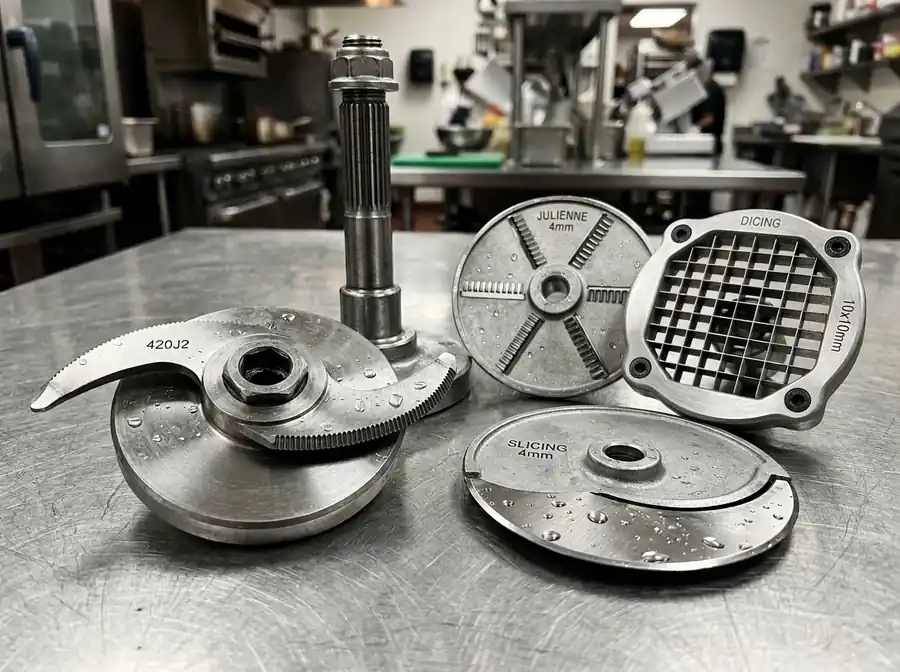
Austenitic Housing vs. Martensitic Blade Metallurgy
- AISI 304 (18/8 Austenitic Stainless Steel) Bodies & Bowls: While 1.5mm–2.0mm AISI 304 provides superior corrosion resistance against acidic tomato salsas, citrus dressings, and chlorinated sanitizers, austenitic steel cannot be heat-treated to hold a razor edge.
- 420J2 & 9Cr18Mo (Martensitic High-Carbon Stainless Steel) Blades: All HSYL S-blades and slicing disc knives are stamped and CNC-ground from high-carbon martensitic stainless steel (420J2 or 9Cr18Mo), vacuum heat-treated and cryogenically tempered to 54–58 HRC (Rockwell Hardness C). This hardness prevents edge rolling when chopping frozen protein blocks, fibrous lemongrass, or hard Parmesan rinds.
- Hexagonal & Splined Stainless Drive Shafts: Cheap light-duty processors use nylon or plastic drive gear couplings that strip within 6 months of heavy dough kneading or root dicing. HSYL specifies CNC-machined hexagonal or multi-splined solid stainless steel drive shafts coupled to sealed, fan-cooled asynchronous induction motors (or belt-driven planetary gearboxes on the YL-VC-800) with thermal overload auto-reset protection.
Choosing Smooth, Micro-Serrated, or Coarse-Serrated S-Blades
- Smooth Edge S-Blade: Standard for fresh herbs (parsley, cilantro, basil), onions, and soft vegetables where clean cellular shearing without bruising is critical.
- Micro-Serrated (Fine-Tooth) S-Blade: Engineered for high-stability liquid emulsions (mayonnaise, vinaigrettes, smooth hospital dysphagia purees) where thousands of micro-teeth create intense cavitations.
- Coarse-Serrated S-Blade: Built for abrasive, high-impact workloads including grinding roasted nuts into praline paste, crushing ice, kneading pastry dough, and chopping semi-frozen meat trimmings.
HACCP Allergen Segregation & ATP Cleaning Verification
Because batch bowl cutters process high-risk allergens—such as peanuts, tree nuts, sesame tahini, egg-yolk mayonnaise, and shellfish pastes—cross-contact inside hollow blade hubs is a critical audit point. Kitchens handling multiple allergen profiles should purchase dedicated color-coded extra cutter bowls and S-blade assemblies, following the station changeover protocols detailed in our Commercial Kitchen Allergen Control & Tool Segregation Guide. After disassembling the removable silicone lid gasket and S-blade cap, sanitation teams should validate protein removal on the lower hub seal using the swab methods outlined in our Commercial Kitchen Equipment Cleaning Verification & ATP Evidence Guide.
Five-Year Total Cost of Ownership (TCO) & Prep Labor Payback Analysis
Unlike thermal equipment where utility energy dominates lifecycle cost, a commercial food processor draws minimal electricity (0.75 kW to 2.2 kW, costing less than $180–$450 per year). Instead, prep labor hours and raw ingredient yield loss account for 91% of the 5-year TCO equation. Below is a verified 5-year operational cost comparison for a central catering kitchen processing 180 kg of mixed vegetables and 25 kg of sauces/dressings per day (350 operating days/year; kitchen prep labor modeled at $16.50/hour loaded wage; raw produce yield loss valued at $1.80/kg).
| 5-Year Cost & Labor Metric (350 Days/Year) | Manual Knife Prep + Light Blender (Baseline) | 2-in-1 Combo Processor (YL-FP-COMBO, 6L + 300 kg/h) | Dedicated Line: YL-VC-800 Dicer + YL-FP-8 Bowl Cutter |
|---|---|---|---|
| Initial Equipment CAPEX | $420 (Chef knives, mandolines, light bar blender) | $1,150 (Single motor base + 6L bowl + 5 discs) | $2,480 ($1,520 YL-VC-800 + $960 YL-FP-8) |
| Daily Prep Labor Time (180 kg Veg + 25 kg Sauce) | 6.5 Man-Hours / Day (30 kg/hr manual cutting) | 1.4 Man-Hours / Day (Sequential bowl + disc mode) | 0.65 Man-Hours / Day (Simultaneous parallel prep) |
| 5-Year Cumulative Prep Labor Cost ($16.50/hr) | $187,687 (11,375 total labor hours) | $40,425 (2,450 total labor hours) | $18,768 (1,137.5 total labor hours) |
| 5-Year Trim & Crush Yield Loss (315,000 kg Produce) | $34,020 (6.0% uneven butt-end & trim waste) | $14,175 (2.5% disc clearance waste) | $8,505 (1.5% precision 3D centrifugal cut) |
| 5-Year Electricity + Replacement Blades/Seals | $1,150 (Frequent light blender burnouts & sharpening) | $1,420 ($620 power + 3 replacement disc/blade sets) | $1,980 ($980 power + biennial knife grid replacement) |
| 5-Year Total Cost of Ownership (TCO) | $223,277 | $57,170 (Payback in 14 Days) | $31,733 (Payback in 23 Days) |
Upstream Pre-Processing Integration for Central Commissaries
To achieve the 800 to 3,500 kg/hr continuous output ratings of our floor-standing vegetable cutters without bottlenecking manual peeling and washing stations, central kitchens should link three machines in sequence: upstream root soil removal and skin peeling via our Commercial Abrasive Potato Peelers, ozone-sanitized agitated rinsing in our Commercial Vortex & Bubble Vegetable Washers, and direct conveyor transfer onto the YL-VC-1000 or YL-VC-1500 dual-inverter cutter.
Discuss Your Vegetable Cutting & Emulsifying Line Specs with HSYL Engineers
Send HSYL your daily produce prep volume (kg/hr), target cut geometries (slice, julienne, dice, or fine emulsion), and electrical supply specs. Our engineering team matches cutting disc kits, hopper architectures, and motor torque ratings to your commissary workflow. Contact HSYL for Food Preparation Equipment Specification Support.