Direct Answer / Key Takeaway: Find pizza production bottlenecks across shaping, topping, baking and packing. Use queue records and a worked example before buying more oven capacity.
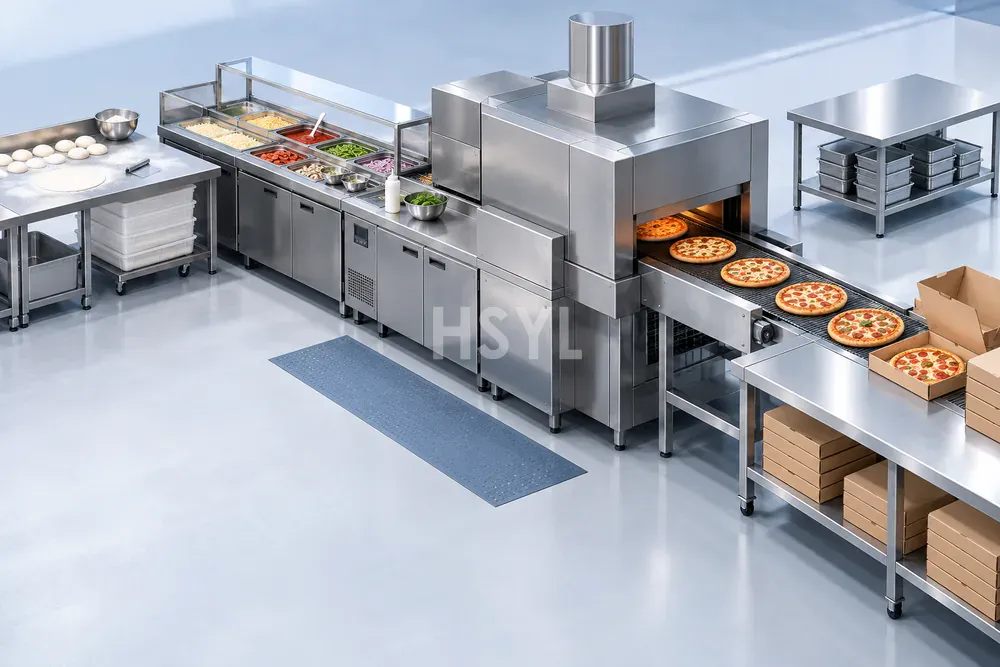
A queue beside the pizza oven does not necessarily mean the oven is too small. The queue may have started at dough preparation, ingredient replenishment, order checking or packing. To identify pizza production line bottlenecks, follow an order from release to handover and measure the work that can actually be completed at each station during the busiest service window.
The useful output is an acceptable pizza matched to the right order and ready for collection. Counting baked bases alone hides remakes, missing items and a growing packing queue. This guide shows how to record the line, compare its stages and decide which change deserves a trial.
Start at the customer handover and work backwards
Choose a defined peak window, such as the busiest half-hour, and record its order mix. Separate large and small pizzas, complex toppings, side dishes and delivery orders. A quiet daily average is a poor description of a concentrated demand wave.
Mark the actual handover point. If one employee must cut, inspect, add sauces, close boxes and match delivery tickets, all of those tasks belong to the packing stage. Likewise, the preparation stage includes finding ingredients and replenishing containers, not only placing toppings.
| Stage | Record | Queue to watch |
|---|---|---|
| Shaping | Accepted bases and preparation time | Dough waiting for shaping |
| Topping | Order mix, replenishment and correction time | Shaped bases awaiting ingredients |
| Baking | Accepted pizzas, load pattern and interruptions | Prepared pizzas awaiting loading |
| Packing | Complete orders released | Baked pizzas awaiting checks and boxes |
A worked example: why another oven may not help
Consider an illustrative planning case, not an HSYL performance claim. During a controlled 30-minute observation, shaping completes 42 acceptable bases, topping completes 36 prepared pizzas, baking releases 40 acceptable pizzas, and packing hands over 27 correctly completed pizza units. Expressed as observation-window rates, those figures are 84, 72, 80 and 54 units per hour.
In this example, packing is the first stage to investigate. Increasing baking capacity would add more finished pizzas to the same waiting area. It would not, by itself, increase the observed packing rate. The correct trial might be a second checking position, a better box arrangement or separating courier handover from cutting and packing.
Do not treat the lowest number as a permanent equipment specification. These stages may have different starting inventories, and the observation could include an unusual order. Repeat the measurement with comparable starting queues, staffing and menu conditions before making a purchasing decision.
Measure waiting separately from working
For a sample of orders, note release time, arrival at each station, start of work and completion. This distinguishes a slow operation from an operation waiting for another resource. A topping bench may look underused because its operator repeatedly walks to a remote store, while an apparently busy oven may be waiting for complete batches.
Count the queue at consistent intervals. Record both quantity and age: five recently prepared pizzas are a different problem from five pizzas that have waited through several release cycles. Avoid building a large buffer simply to make the oven appear busy; prepared-food handling and product quality must remain within the kitchen's approved process.
Trial one change with the same demand mix
Write a narrow trial question: does relocating boxes reduce packing time, does a dedicated expediter reduce order mismatches, or does a revised ingredient replenishment routine keep the preparation position working? Keep the comparison window, staffing assumptions and menu mix visible.
Record the trial's complete-order output, longest wait, remakes and interruptions. Faster movement that produces more incorrect orders is not an improvement. Also check where the queue moves. Removing one constraint may expose the next, so a successful packing change could make topping the new limiting stage.
Translate the result into an equipment brief
Only after the trial should the kitchen request additional baking capacity. The brief should describe peak order arrivals, pizza dimensions, accepted cooking results, the loading pattern, available operators and the surrounding workstations. Include changeovers and planned cleaning rather than assuming an uninterrupted shift.
For the purchasing stage, compare the complete scope in the commercial pizza oven cost and configuration guide. A larger oven is useful when the measured constraint and the supporting line can use its capacity. The line record gives the supplier a practical problem to solve instead of an unexplained pizzas-per-hour target.