Direct Answer / Key Takeaway: Plan school packed lunch assembly equipment around approved menus, portioning, identity checks, packaging, staging and dispatch. Keep complete packs visible.
School packed lunch assembly equipment should be selected for complete, correctly identified meal packs rather than a count of open trays moving along a bench. Portioning, approved checks, closing, staging and dispatch all contribute to the production window.
Use the school's authorized menu and meal-order system as inputs. Nutrition decisions and individual dietary requirements belong to the responsible school and catering roles; the equipment study organizes how those released meals are assembled and handed over.
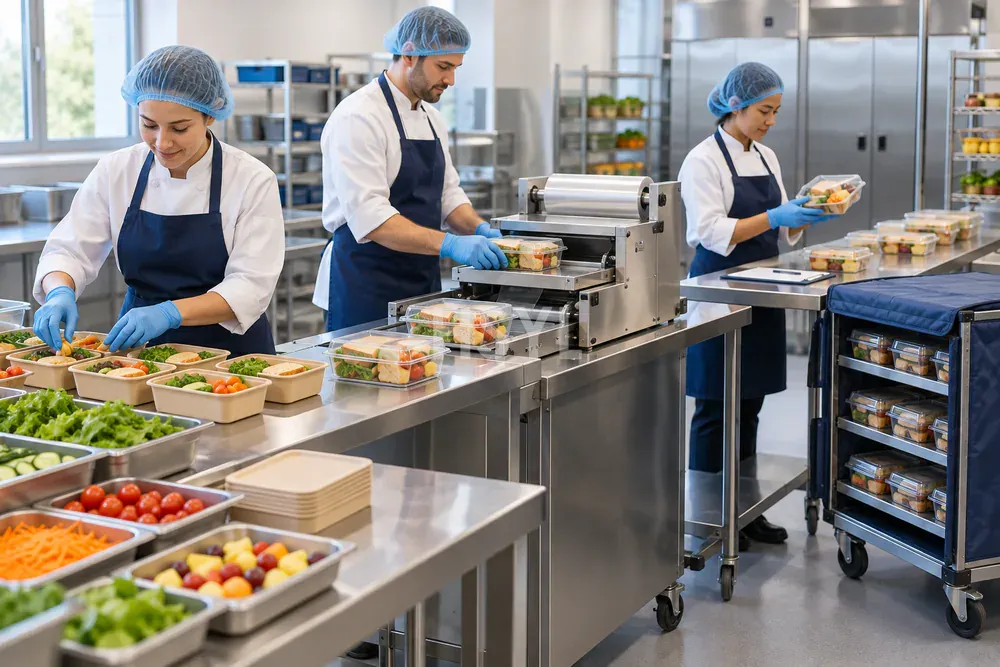
Define the complete pack
List the approved components, containers, closure arrangement and accompanying items. Identify the current recipe and order information used at assembly. Define the checks required before the pack can enter staging and what happens to an incomplete or incorrect pack.
Keep product and packaging suitability within the approved food-safety process. Obtain the applicable container and equipment information for the actual product and method rather than choosing a pack only by external dimensions.
Organize component supply
Record when each component is accepted and ready for assembly, its permitted handling condition and how it reaches the work position. Keep a refill or replacement container identifiable. A fast closing station cannot compensate for a repeated wait for one approved component.
Observe the worker's reach and movement with the site's responsible design team. Include storage of permitted packaging and the practical route of replenishment. Equipment geometry should be tested with the actual people, containers and task rather than inferred from a generic bench illustration.
Make identity and checks part of the line
Connect the meal pack to the school's released order and approved information method. Keep exceptions out of the accepted dispatch group until the responsible check is complete. A visible queue of checked packs and a separate unresolved position can help make status understandable when the site-approved layout supports it.
The Food Standards Agency guidance emphasizes current ingredient and allergen information in its stated setting. Determine the requirements that apply to the actual school service and packaging arrangement; do not infer one legal category from the name packed lunch.
Time the complete production sequence
Choose the agreed start and dispatch boundaries. Record preparation availability, assembly, checking, closure, staging entry and accepted handover. Count incomplete and corrected packs separately so apparent output does not include work that still requires a decision.
| Assembly stage | Useful observation |
|---|---|
| Component arrival | Ready quantities and refill interruptions |
| Portion placement | Accepted arrangement and handling time |
| Required checks | Released packs and exceptions |
| Closure | Packaging compatibility and complete packs |
| Dispatch | Grouped loads and accepted handover |
Include a representative mix rather than only the easiest pack. If one meal variant needs another authorized check or component arrangement, retain that work in the plan. Removing it to demonstrate maximum speed would change the service requirement.
Match staging to the departure plan
Map packing completion against the vehicle or recipient arrival. Identify the approved staging and transport conditions, containers and loading sequence. Keep early loads and later additions traceable so a complete dispatch group can be checked without opening or rearranging every pack.
Official delivery guidance provides background for protecting food and required information. The school service's approved process and applicable requirements govern its actual handover.
Send the released menu, pack format, variant mix, service window, observed line work and dispatch route with a school kitchen equipment enquiry. This gives suppliers a defined assembly task and avoids using a closing-machine speed as a claim for the whole packed-lunch service.