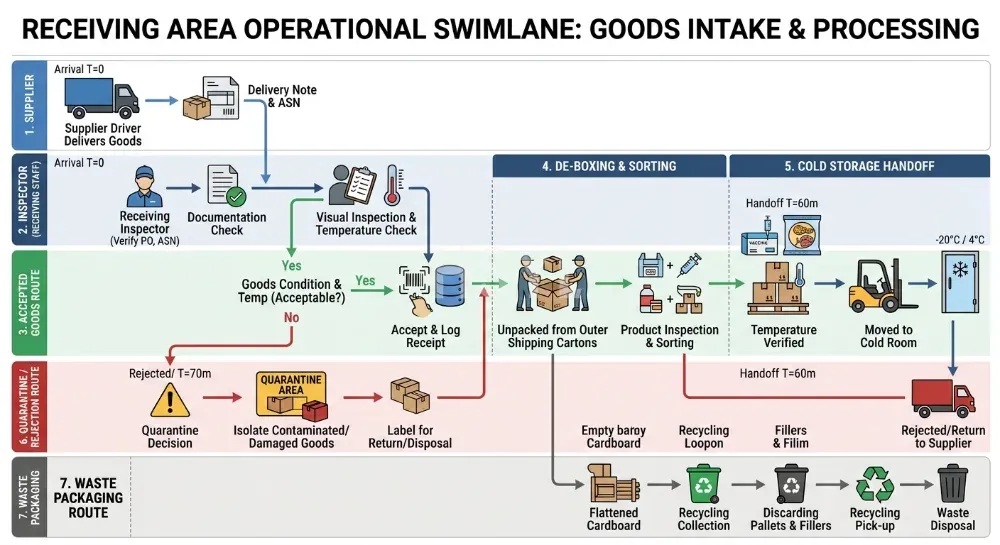
A delivery door is not a receiving area. Receiving is a decision process: goods arrive with supplier and batch information, are checked against defined criteria, and then move to accepted storage, controlled de-boxing, quarantine, return or disposal. The layout must preserve those choices during the busiest delivery overlap.
Walk one difficult delivery, not an ideal carton
Use a representative peak: two suppliers arrive close together; chilled and ambient goods share the appointment; one package is damaged; a temperature or identity check needs review; empty pallets and cartons accumulate; production staff also need the route.
Follow the shift in order:
- vehicle approaches and goods are protected during unloading;
- delivery identity and appointment are confirmed;
- quantity, packaging, traceability and condition are inspected;
- measurements or samples required by the approved procedure are taken;
- goods receive accepted, held/quarantine or rejected status;
- outer packaging is removed where the hygiene plan requires it;
- accepted goods reach the correct storage position within the controlled handoff;
- packaging, pallets, spills and returns leave by defined routes.
The FDA Food Code 2022 provides model receiving specifications for U.S. retail and foodservice operations. Treat it as a reference framework; the project must use the locally adopted rules, supplier specifications and operator food-safety plan for exact acceptance limits.
Calculate positions, not just floor area
Count the maximum simultaneous delivery units that can be unloaded, checked and staged without mixing status. Use actual pallet, trolley, crate or container dimensions and include handling clearance. Separate the space needed for inspection from the space needed for a held load awaiting a decision.
Then time the route to temperature-controlled storage. Include unloading, paperwork/identity, inspection, any de-boxing, lift or corridor delay and final put-away—not straight-line walking distance. If the approved control cannot be achieved in a peak scenario, change appointments, labour, route, staging conditions or storage access.
Make status visible and difficult to lose
Designate how accepted, held and rejected goods are identified physically and in records. A quarantine position must be controlled against accidental use and sized for credible exceptions. Define who can release or reject goods and how supplier credit/return is handled without goods drifting back into accepted flow.
Provide a stable inspection surface, suitable lighting, access to approved measuring tools, record capture and hand hygiene according to the site plan. Locate scales on a verified level surface with a cleaning and calibration/check arrangement appropriate to their role.
Control outer packaging without creating a crossing
Decide which goods are de-boxed, where, by whom and into what clean container or trolley. Show the route of cardboard, wrap, straps and pallets. The de-boxing action should not force waste packaging to cross accepted exposed food, clean containers or production traffic.
Inspect cleanability at docks, thresholds, bump rails, corners, drains where present and under fixed items. Pest-prevention, weather protection and security need to work during an open-door delivery, not only when the room is empty.
Connect receiving to storage ownership
The handoff is complete only when goods occupy an assigned position and the required information remains attached. Map ambient, chilled, frozen, allergen-controlled, chemical/non-food and quarantine destinations. Verify door and aisle clearance with the loaded handling unit. Review the route against the commercial kitchen workflow guide.
For chilled capacity, count the delivery overlap in the inventory envelope described by the commercial refrigerator sizing guide. A receiving peak can temporarily create the highest stock level even when average inventory is lower.
Prove the area with a receiving simulation
Run one normal and one exception delivery before final acceptance. Use representative handling units and records. Observe queue, inspection, measurement, status control, de-boxing, storage handoff, waste route, spill response and clean-down. Record where staff park goods or equipment when the intended position is blocked.
Issue the receiving design brief
Issue a receiving design brief with appointment profile, simultaneous units, handling dimensions, acceptance responsibilities, status/quarantine rules, approved measurements, storage time/path, equipment and utilities, packaging/waste routes, cleaning, security and failure response. The brief is the basis for layout and equipment decisions—not a generic dock-area allowance.