Direct Answer / Key Takeaway: Global compliance map for commercial kitchen equipment exporters. Understand UL 197 electrical safety, NSF/ANSI sanitation, CE Machinery & Gas Directives.
When procuring and exporting commercial cooking machinery within our Hygiene & HACCP Hub, mechanical contractors, importers, and international hotel chains must navigate a complex landscape of global regulatory certifications. Installing non-certified thermal equipment—such as commercial combi ovens, electric deep fryers, gas burner ranges, or griddles—invites severe legal penalties, immediate power disconnects by local municipal inspectors, voided commercial property insurance policies, and catastrophic electrical fire liabilities. The global commercial foodservice market is divided into distinct regulatory jurisdictions: the European Union (CE Mark with Machinery and Gas Directives), North America (UL 197 / ANSI Z83.11 with ETL/UL Sanitation), and international IEC/CB certification schemes. This technical specification guide decodes global compliance standards, component-level engineering requirements, laboratory testing procedures, and procurement verification rules.
1. The Global Certification Triad: CE vs. UL vs. ETL
A frequent point of confusion among procurement directors is the distinction between certifying agencies (testing laboratories) and the underlying regulatory standards. The table below maps the primary global certification schemes across geographical jurisdictions, safety mandates, and sanitation standards.
| Certification Scheme | Governing Jurisdiction | Primary Electrical Safety Standard | Primary Gas Appliance Standard | Mandatory Sanitation / Hygiene Standard |
|---|---|---|---|---|
| North American UL Listed (Underwriters Laboratories) | United States & Canada (OSHA / SCC recognized) | UL 197 (Commercial Electric Cooking) / CSA C22.2 No. 109 | ANSI Z83.11 / CSA 1.8 (Commercial Gas Appliances) | NSF/ANSI Standard 4 (Commercial Cooking Equipment) |
| North American ETL Listed (Intertek NRTL) | United States & Canada (OSHA / SCC recognized) | UL 197 (Identical testing benchmark to UL Listed) | ANSI Z83.11 (Identical testing benchmark to CSA) | ETL Sanitation (Tested directly to NSF/ANSI Standard 4) |
| European CE Marking (EU Directives) | European Economic Area (EEA), UK (UKCA), Middle East | Low Voltage Directive (2014/35/EU); EN 60335-2-36/37/38/42 | Gas Appliance Regulation (GAR 2016/426/EU); EN 203-1 | Machinery Directive (2006/42/EC); EN 1672-2 Hygiene Standard |
| International CB Scheme (IECEE) | Global mutual recognition across 54+ member nations | IEC 60335-1 / IEC 60335-2-36 (Commercial Cookers/Ovens) | ISO 23550 (Safety & control devices for gas burners) | ISO 22000 / Codex Alimentarius hygienic principles |
2. North American Mandates: UL 197 vs. ANSI Z83.11 vs. ETL Sanitation
In the United States and Canada, local Authorities Having Jurisdiction (AHJ)—consisting of electrical inspectors, fire marshals, and public health officers—enforce a dual-listing mandate. Every commercial cooking appliance must possess both an electrical/gas safety mark and a food sanitation mark.
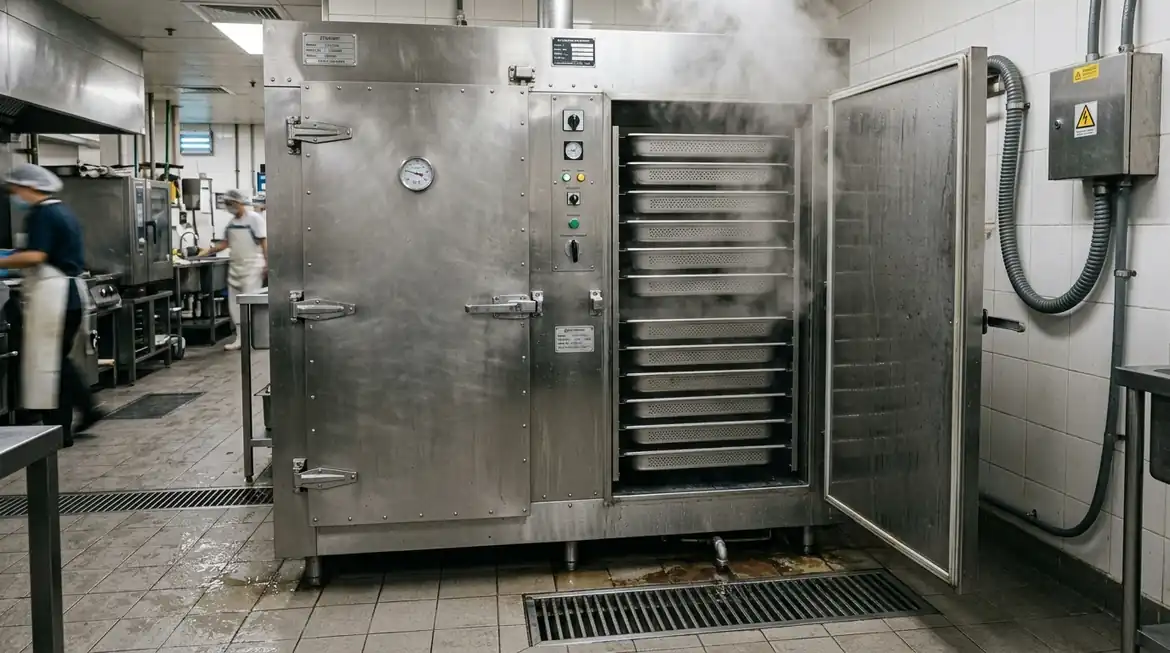
Key technical benchmarks under North American standards include:
- UL 197 High-Temperature Flammability: Internal wiring must utilize silicone-coated fiberglass or Teflon (PTFE) insulation rated for a minimum of 200°C, routed through grounded steel conduits isolated from thermal heating chambers.
- High-Limit Thermal Cutoff: Deep fryers and griddles must incorporate redundant, manual-reset high-limit thermostats (calibrated to cut power at ≤232°C / 450°F for fryers) that operate independently of digital microprocessors.
- ANSI Z83.11 Gas Safety: Gas cooking equipment must utilize CSA-certified flame failure safety valves (thermocouple or flame rectification rod) that shut off gas flow to the burner within 0.8 seconds if the flame is extinguished.
- NSF/ANSI 4 Sanitation Geometry: Cooking surfaces, grease collection drawers, and backsplash panels must feature seamless continuous welds, die-formed coved radii (minimum 6.35mm), and removable components cleanable without hand tools.
3. European CE Directives: Low Voltage, EMC, and Gas Appliance Regulations
Exporting to the European Union requires compliance with European Harmonized Standards validated by an accredited Notified Body (for gas equipment) or manufacturer Declaration of Conformity (for electrical equipment):
| EU Directive / Regulation | Applicable Standard | Key Technical Requirement |
|---|---|---|
| Gas Appliance Regulation (GAR 2016/426) | EN 203-1 / EN 203-2-1 | Combustion efficiency, NOx emission class 5 (<80 mg/kWh), 100% flame supervision |
| Low Voltage Directive (LVD 2014/35/EU) | EN 60335-2-36 (Ranges), EN 60335-2-42 (Ovens) | Creepage and clearance distances, earth bonding <0.1 Ω, IPX4 washdown protection |
| Electromagnetic Compatibility (EMC 2014/30/EU) | EN 55014-1 / EN 55014-2 | Immunity against electrical surges; zero RF interference with commercial kitchen electronics |
| Machinery Directive (2006/42/EC) | EN 1672-2 (Hygiene Requirements) | Prevention of bacterial harborage, biological cleanability, dual-channel emergency stop |
4. Critical Component-Level Certification Traceability
Equipment-level certification is impossible without certified sub-components. Factory inspectors scrutinize the Bill of Materials (BOM) to verify that critical internal components carry individual component-level certifications:
- Electric Heating Elements: Incoloy 800 or AISI 316L tubular elements must carry UL Recognized (UR) or VDE certifications, tested for continuous thermal cycling at 800°C.
- Magnetic Contactors & Breakers: Industrial contactors from premium global brands (Schneider Electric, ABB, Siemens) carrying dual UL 508 and IEC 60947 ratings.
- Digital Thermostats & Controllers: Microprocessors (Carel, Dixell, Eliwell) carrying UL Recognized Component status and CE EMC immunity ratings.
- Gas Valves & Regulators: SIT Group (Italy) or Robertshaw (USA) gas control valves certified under ANSI Z21.78 and EN 126.
5. 5-Year Compliance Audit & Maintenance TCO Analysis
While certified equipment commands an initial 15% to 25% price premium over uncertified grey-market machinery, the operational and legal risks of installing uncertified gear are catastrophic.
| Financial & Legal Risk Factor | Uncertified / Grey-Market Cooking Equipment | Dual-Certified (CE / UL / ETL Sanitation) Equipment | 5-Year Financial Variance |
|---|---|---|---|
| Municipal Health & Electrical Inspection Red-Tags | $12,000 / yr (Stop-work orders, emergency field certification) | $0 / yr (Immediate AHJ permit approval and sign-off) | -$60,000 (100% elimination) |
| Commercial Property Insurance Surcharge | $8,500 / yr (High-risk rider or policy cancellation) | $0 / yr (Standard institutional commercial insurance tier) | -$42,500 (100% elimination) |
| Electrical Fire & Gas Leak Liability | $50,000+ risk exposure (Unprotected element burnout) | $0 (Redundant high-limits and flame failure valves) | Critical catastrophic liability mitigation |
| Component Burnout & Replacement Downtime | $6,200 / yr (Frequent sub-standard contactor failure) | $1,100 / yr (Industrial Schneider/ABB switchgear reliability) | -$25,500 (82% maintenance reduction) |
| Total 5-Year Operating Risk Exposure | $133,500+ | $5,500 | Net 5-Year Savings: $128,000+ |
6. Third-Party Field Labeling and NRTL Certification Audits
If uncertified equipment arrives on an overseas job site, project managers must engage a Nationally Recognized Testing Laboratory (NRTL) for field evaluation and labeling. A field evaluation involves destructive and non-destructive laboratory testing performed on site by a senior engineer, typically costing $8,000 to $15,000 per appliance with zero guarantee of passing. Procuring equipment with pre-certified factory labeling issued by Intertek (ETL) or UL avoids field evaluation costs entirely, ensuring seamless equipment commissioning.
7. Documentation Package Required for Smooth Customs Clearance
Customs authorities across Europe, North America, and the Middle East strictly inspect commercial kitchen shipments for valid compliance documentation. To prevent demurrage fees and container rejection, the export documentation package must include: (1) Official Certificate of Conformity (CoC) bearing the testing laboratory accreditation number, (2) Complete manufacturer Declaration of Conformity (DoC) referencing harmonized standards, (3) Official English-language operating and installation manuals with electrical schematics, and (4) High-resolution photographs of the machine serial rating plate displaying voltage, phase, wattage, serial number, and certification marks.
Engineering Specification Checklist for Procurement Teams
- Ensure that electric cooking equipment destined for North America carries the ETL Listed or UL Listed mark tested specifically to UL 197.
- Verify that commercial gas ranges include flame failure safety devices on 100% of open burners, ovens, and griddles.
- Confirm that the sanitation certification references NSF/ANSI 4 (for cooking equipment) rather than generic industrial machinery standards.
- Require factory audit reports demonstrating ISO 9001 quality management and quarterly factory surveillance inspections by the certifying body.
Source Export-Certified Commercial Kitchen Equipment from HSYL
Are you an international kitchen contractor, MEP consultant, or hospitality importer requiring fully certified equipment? HSYL manufactures commercial cooking suites, ovens, and refrigeration certified to international CE, UL, and ETL Sanitation standards. Contact our international regulatory engineering team to request compliance certificates, test reports, and equipment quotes.