Direct Answer / Key Takeaway: Build a commercial pizza oven acceptance test around the ordered configuration, menu load, finished quality, continuous service and recorded deviations.
A commercial pizza oven acceptance test should answer the buyer's order-specific questions: is this the configuration purchased, can it produce the agreed pizza result under the defined duty, and what remains to be checked after installation? A short demonstration with one attractive pizza leaves most of those questions unanswered.
Define acceptance in the purchase documents before the machine is built. The test then becomes a comparison between a released requirement and recorded evidence, rather than a negotiation around whatever the demonstration happens to show.
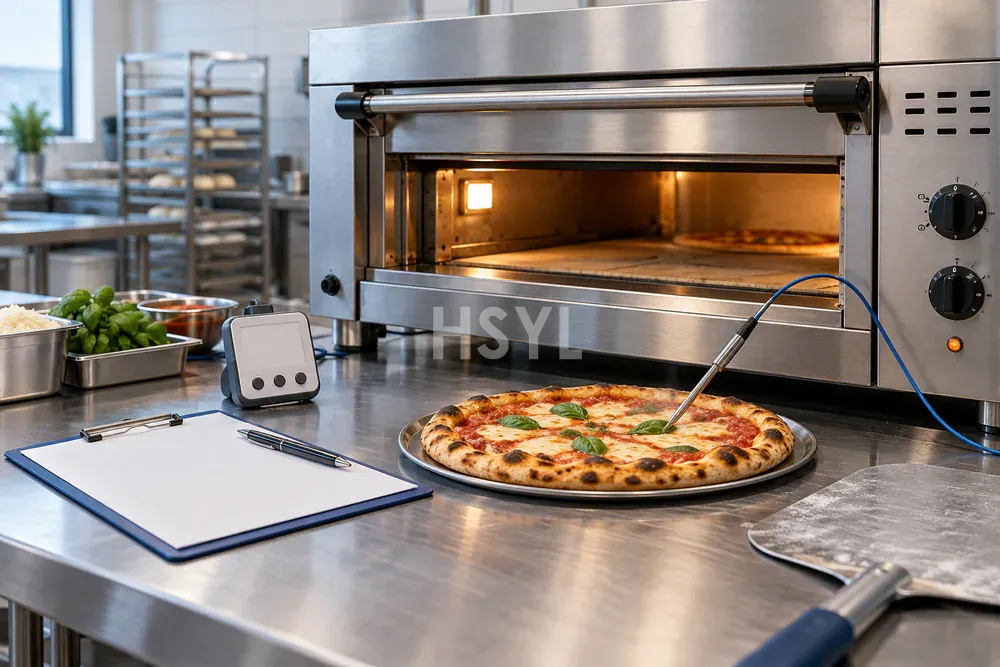
Agree the test basis before the visit
List the offered model, chamber or conveyor arrangement, controls, accessories, utility version and approved drawings. Include the pizza specification, service pattern and required handover documents. A different configuration may produce a different result even when its product name looks similar.
Separate factory checks from site checks. The factory may demonstrate functions with its available utilities, while the final kitchen still needs connection verification, ventilation coordination and commissioning under local conditions. Mark those boundaries on the test sheet; they are not automatically closed because the oven operated at the factory.
Translate the menu into measurable acceptance conditions
Specify product dimensions and initial state, preparation method, topping load, loading arrangement and agreed settings. Define what constitutes an acceptable base, edge, topping result and complete portion. The responsible production and food-safety team must approve the inspection method.
Use operating targets that describe the buyer's service. A requirement for several consecutive compatible releases is more meaningful than an isolated maximum count. Identify the operators, loading and unloading arrangements, packing boundary and interruptions included in the reported result.
| Requirement | Evidence | Disposition if incomplete |
|---|---|---|
| Ordered configuration | Model, utility version, drawings and supplied items | Reconcile the configuration before performance testing |
| Menu result | Identified samples and agreed inspection records | Record the deviation and retest the correction |
| Continuous duty | Release sequence, accepted output and interruptions | Repeat with the agreed conditions |
| Site interfaces | Connection drawings and accessible locations | Keep site-dependent checks open for commissioning |
Run the sequence the kitchen intends to use
Follow the manufacturer's approved startup and operating instructions. Record the warm-up conditions, first loading time, successive releases and completion boundary. Keep a sample identity that connects each inspection to its position and release. An overall statement that the oven passed is difficult to audit without this detail.
Include a realistic transition, such as a pause followed by the next order wave or a permitted change between cooking families. The purpose is to understand the offered process, not to improvise abnormal or unsafe operation. Any safety-function challenge must use a separately approved method carried out by competent personnel.
Inspect practical handling as well as cooking. Can the intended operator load and unload using the agreed tools? Does the work position fit the planned bench height and movement route? Are routine cleaning parts accessible through the manufacturer's approved procedure? Capture relevant photographs and observations without treating an unsafe demonstration as acceptable evidence.
Write deviations so they can actually be closed
Each deviation needs the requirement reference, observed condition, evidence, responsible owner and agreed next step. Distinguish a document omission from a product-result failure or an interface conflict. A replacement document may close the first; a performance problem generally needs an appropriate repeat test.
In an illustrative record, a buyer finds that one ordered loading accessory is absent. The entry should identify the accessory and the requirement, state whether the missing item affects the completed trial, and set the evidence required for closure. It should not be converted to an unqualified pass merely because the accessory is promised later.
Release a coherent handover package
Collect the final configuration list, approved operating instructions, cleaning information, utility drawings, agreed spare items, trial records and deviation status. Identify the checks reserved for site commissioning. The buyer should be able to understand both the demonstrated result and the remaining work without relying on informal conversation.
The general kitchen equipment FAT checklist can organize the wider document and function review. This pizza-specific plan supplies the menu and service conditions. Together, they support a purchasing decision based on traceable requirements rather than a display of unverified headline output.