Direct answer: Cleaning verification starts by naming the residue or hazard to be controlled, validating that the cleaning method works on the exact equipment and soil, and then using routine checks that are fit for that purpose. A surface that looks clean is valuable evidence, but it does not prove removal of every allergen, microorganism or chemical residue.
Commercial kitchens often buy a swab or inspection light before defining the question. That reverses the logic. “Is it clean?” may mean free of visible food, below an operator-defined allergen residue criterion, acceptably controlled for a microbiological target, or free of an unwanted chemical residue. Each objective needs its own evidence and limits.
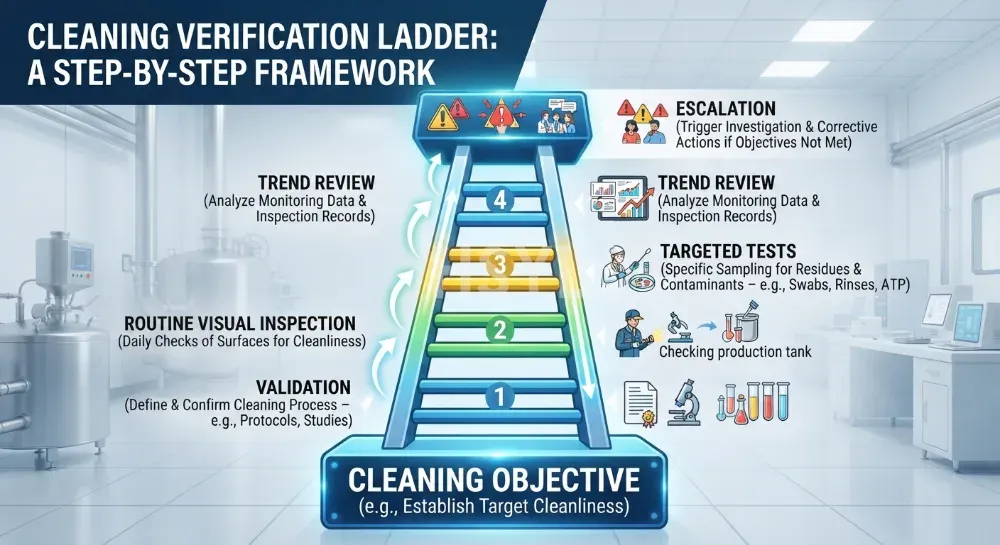
Separate four jobs that are often confused
- Cleaning procedure
- The approved sequence: preparation, disassembly, soil removal, washing, rinsing, sanitizing/disinfection where required, drying, inspection and reassembly.
- Validation
- Evidence that the defined procedure can achieve the intended control on the relevant equipment, residue and operating condition.
- Routine monitoring and verification
- Checks that the procedure was followed and remains effective in actual operation, using methods and frequency selected from risk.
- Corrective action
- What happens to the equipment, food, area and process when a check fails, including recleaning, retesting, investigation and release authority.
Codex CXC 80-2020 applies this distinction to allergen cleaning: validation is specific to the allergen, process and product matrix, while verification can combine visual observation with analytical testing where feasible and appropriate. The official allergen-management code is an evidence framework, not permission to reuse one limit or swab for every kitchen.
Build a verification ladder for each equipment family
- Define the objective. Name the product residue, allergen, microorganism, chemical or visible cleanliness condition being controlled.
- Identify the hardest relevant location. Include seams, shafts, guards, seals, hollow or overlapping parts, drains, undersides and components removed during cleaning.
- Validate the method. Use representative worst-case soil, time, temperature, concentration, mechanical action, disassembly and operator conditions approved by competent specialists.
- Select routine checks. Choose inspection, records, targeted swabs or other methods because they answer the objective—not because they are convenient.
- Set limits and action. Define pass/fail, who decides, disposition of exposed food, reclean/retest and investigation.
- Trend and revalidate. Review repeated locations, equipment wear, product changes, chemical changes and procedure deviations.
Know what common checks can and cannot tell you
| Evidence | Useful for | Important limitation |
|---|---|---|
| Visual and tactile inspection | Residue, damage, assembly and access problems | Cannot demonstrate absence of every invisible target |
| Procedure record | Time, operator, chemical, steps and accountability | A completed form does not prove the surface result |
| Rapid hygiene indicator | Defined screening or trend purpose under a validated programme | Is not automatically a pathogen or allergen test |
| Allergen-specific method | The validated target/matrix/surface combination | May not detect other allergens and can be affected by method limitations |
| Microbiological sampling | Targeted verification or investigation designed by specialists | Sampling plan, organism, timing and interpretation control the meaning |
Confirm sampling area, timing, technique, test storage, controls and interpretation with the method provider or laboratory. Avoid turning a vendor’s generic colour chart into an unreviewed food-release limit.
Use failures to improve equipment and procedure
A failed check should trigger the predefined response, not a quiet second swab. Secure the equipment, assess affected product and time window, reclean and retest as required, then investigate. Repeated failures at one seal, blade hub or frame joint can indicate worn parts, inadequate disassembly, poor access, the wrong tool or a design issue.
Feed those findings into procurement. Ask suppliers to demonstrate disassembly, show product-contact and splash zones, identify inaccessible cavities, list compatible cleaning methods and chemicals, provide part replacement instructions and support a witnessed cleanability trial. The food-contact materials guide helps organize material evidence, but cleanable construction and a working procedure must still be verified.
Make the record decision-ready
Each check should identify equipment and location, product/soil context, cleaning procedure version, date/time, operator, method and lot where applicable, result, limit, disposition, corrective action and release. Trend by location and equipment family, not only total pass rate.
Connect the programme to the Hygiene & HACCP resource hub. If heat or chemical treatment is part of a wider sanitation process, review the exact equipment and approved method rather than assuming that a commercial sterilization cabinet resolves upstream cleaning. Soil removal and treatment are distinct controls.