Cleaning a commercial deep fryer requires a method that matches the fryer and its oil-handling system. Begin with the exact model's operating manual, identify whether the task is exterior cleaning, oil filtration or a drained-tank clean, and select the tools approved for that task. A cleaning routine for an enclosed filtering system should not be copied to a fryer that is emptied by hand.
This guide helps kitchen managers prepare the method and tool list. The fryer manual supplies the operating sequence, permitted chemicals and model-specific settings. It is not a universal boil-out procedure.
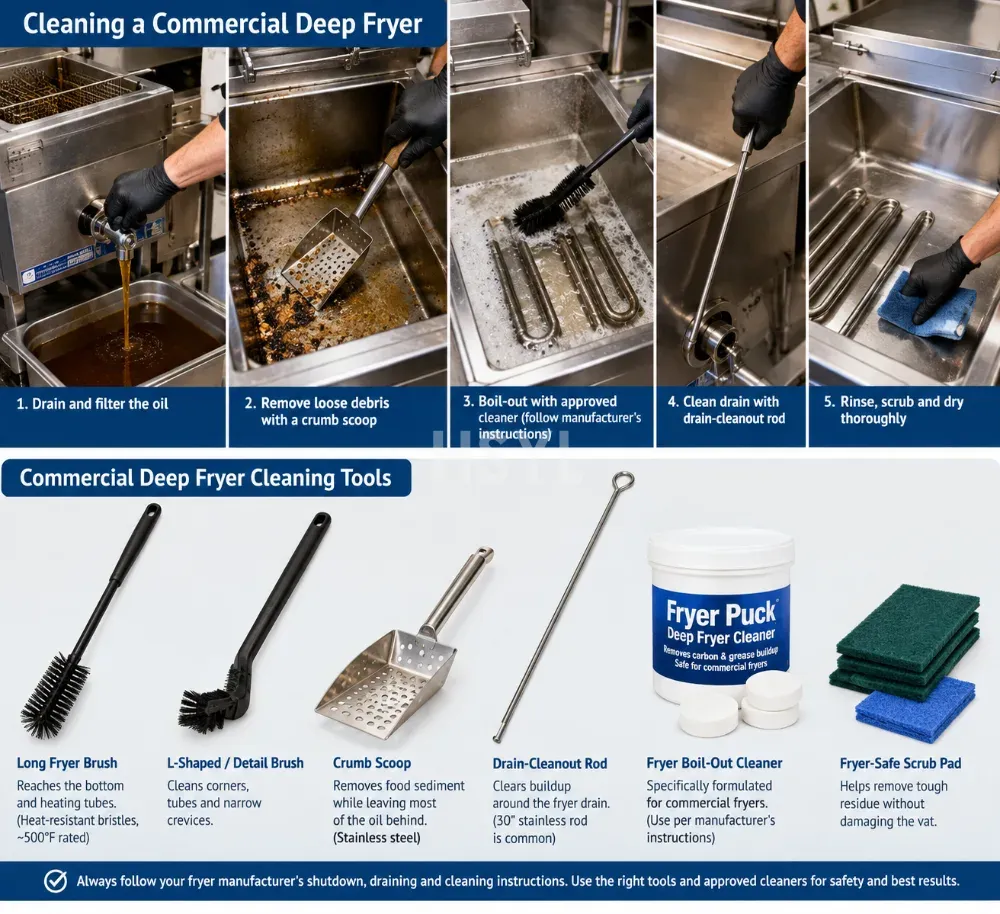
Identify the task before gathering tools
| Task | Purpose | Information to obtain first |
|---|---|---|
| Exterior cleaning | Remove grease and food deposits from accessible outside surfaces | Permitted products, surface compatibility and areas that must be kept dry |
| Oil filtration | Remove suspended debris using the specified filtering arrangement | Approved equipment, filter media, operating conditions and operator method |
| Drained-tank cleaning | Remove deposits from the empty tank and permitted removable parts | Shutdown, oil removal, cleaning, rinsing, drying and restart instructions |
| Fault repair or internal service | Address leaks, damaged components or abnormal operation | Authorized service support and the appropriate service documentation |
Filtering oil and cleaning a tank are different activities. A filtration task does not by itself show that the tank, drain or removable parts have been cleaned. Equally, a clean-looking exterior does not resolve a leaking valve or a damaged electrical component.
Plan oil handling before the cleaning window
Only trained staff should perform the assigned operation. UK HSE guidance in Catering Information Sheet 17 distinguishes manual emptying from enclosed filtering systems and uses 40°C or below for manual emptying and filtering. Treat that as a named safety reference, not as the operating setting for an automated system. Confirm the method for the actual equipment and site.
Prepare suitable protective equipment, the correct receiving or filtering equipment and a clear work area before starting. Allow the required cooling time and verify the oil condition as instructed; elapsed time alone does not establish a safe temperature. Never improvise a hot-oil container from packaging.
For an HSYL fryer, request the model-matched instructions through manuals and technical documentation. The model and serial number, drain arrangement and any filtration accessories help identify the correct information.
Commercial deep fryer cleaning tools: choose by task and compatibility
| Tool or material | What to specify | Check before use |
|---|---|---|
| Tank brush | Reach, shape and bristle material suitable for the accessible tank surfaces | The manufacturer's permitted use, working conditions and any surfaces it must avoid |
| Non-abrasive pad or cloth | A material compatible with the surface being cleaned | That it will not shed, scratch or leave unwanted residue |
| Filter media and debris tools | The type intended for the actual filtering system | Fit, condition and the operation in which each item is used |
| Approved cleaning product | The product and application permitted by the fryer manufacturer | Label directions, material compatibility, protective equipment and rinsing requirements |
| Oil receiving equipment | A container or enclosed unit suited to the approved transfer method | Capacity, stability, temperature suitability, condition and handling arrangement |
| Protective and measuring equipment | Items required by the task assessment and operating procedure | Suitability, condition and staff familiarity with their use |
A product sold as a fryer cleaning tool is not automatically suitable for every fryer. Drain tools, in particular, need the correct form and approved procedure; a blocked drain is not a reason to insert improvised wire, use a hand or force a part while oil could discharge.
Use a model-specific cleaning card
Keep the card beside the approved operating instructions. Make each field specific enough that the next trained operator does not need to infer the method.
- Equipment identity: fryer model, serial number and the manual revision used.
- Assigned task: exterior cleaning, filtration, drained-tank cleaning or a service referral.
- Preparation: required shutdown or isolation, oil-handling arrangement, work area and protective equipment.
- Approved tools and chemicals: item names, permitted application and the source of the instructions.
- Completion checks: cleanliness, removal of cleaning residues, dryness, correct reassembly and any model-specific checks.
- Handover: operator, completion time, defects found and release or service status.
Do not copy a detergent concentration, heating setting or soak time from another manufacturer's instructions. Some fryers provide a specified tank-cleaning cycle or boil-out procedure; use one only when the manual for that model permits it. Keep cleaning solutions away from hot oil and protect electrical components as instructed.
Inspect before returning the fryer to service
Complete the manual's rinsing and drying requirements before adding oil. Residual water in the tank can cause hot oil to splatter when the fryer is used. Check permitted removable parts and the drain arrangement, and complete the prescribed refill and restart sequence. Do not use heating as a shortcut for drying an empty fryer.
The equipment cleaning verification guide can help organize the inspection record. Record a defect separately from a cleaning task so a surface wipe is not mistaken for a repair.
Stop when cleaning reveals a fault
Stop the task and obtain the appropriate service assistance if you find leakage, damaged wiring, loose or damaged components, a drain that cannot be operated correctly, or uncertainty about safe isolation. Do not remove service panels, adjust gas components or bypass a safety device as part of routine cleaning.
When requesting support, provide the model and serial number, the task being attempted, clear photographs where safe to obtain, and the tool or product used. The installation and maintenance support page helps direct that discussion. Keep the fryer out of use until the responsible person has resolved the fault and authorized return to service.