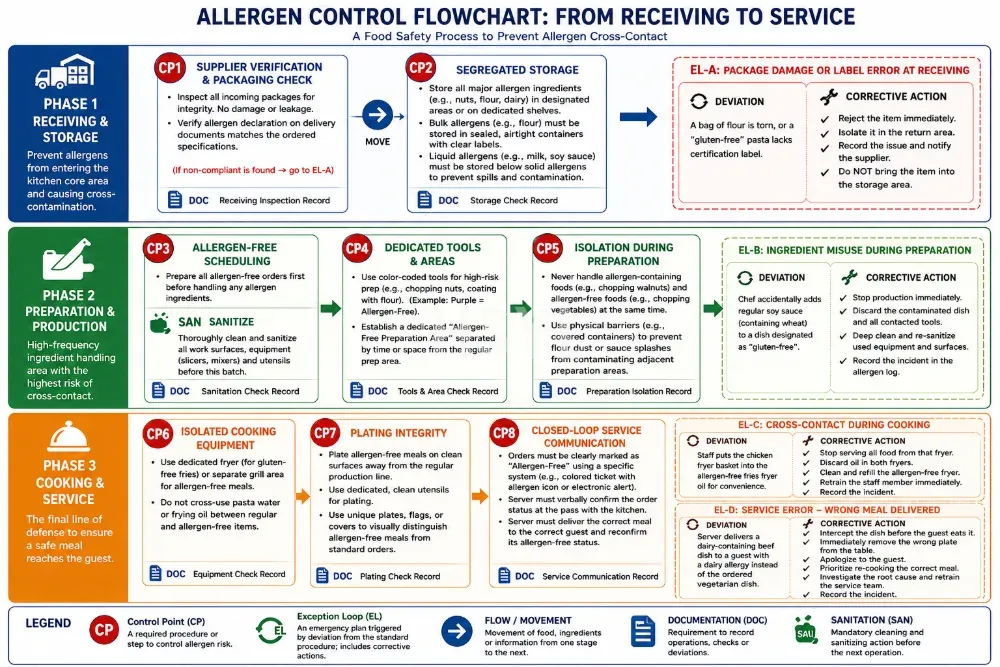
An “allergen station” sign does not control cross-contact on its own. Ingredients change, packaging is opened, tools move, production schedules slip and food passes through shared storage, preparation, cooking and service. The design task is to follow each declared allergen and allergen-sensitive order through the complete operation, including exceptions.
Map the allergen journey before choosing controls
Build the map from controlled information
Create an ingredient and menu matrix using approved supplier information and the food business’s labelling rules. Identify allergens relevant to the destination market; lists and legal duties differ by jurisdiction. Set ownership for supplier changes, substitutions, recipe updates and menu communication.
For each ingredient, trace receiving, outer-packaging removal, storage, decanting, preparation, cooking, holding, transport and service. Mark shared surfaces, airborne or splash risks where relevant, hand contact, utensils, containers, cloths and waste. Repeat for rework, returns, spills and an unplanned ingredient substitution.
Choose controls point by point
Dedicated rooms or equipment may be justified for some risks and volumes, but separation is not automatically a room. Depending on the validated programme, controls may include sealed and identified storage, physical distance, closed containers, dedicated or controlled-use tools, production sequencing, documented changeover, staff and information controls, or rejection of a request the kitchen cannot safely fulfil.
| Decision point | Questions for the operator | Possible evidence |
|---|---|---|
| Receiving and storage | How are identity, damaged packs, substitutions and spills controlled? | Approved supplier record, receiving check, location map, incident record |
| Tools and equipment | Dedicated, scheduled or shared after validated cleaning? | Tool register, colour/label system, cleaning method, inspection |
| Production order | Which products run first, and what breaks the planned sequence? | Daily schedule, changeover release, deviation decision |
| Service handoff | How does the correct information stay with the correct meal? | Ticket, container/plate identity, final check and named handoff |
Colour coding can support identification, but colour is not a cleaning method and may be interpreted differently across sites. Use labels, storage locations, training and documented responsibilities together.
Design a changeover that can be performed under pressure
The procedure should name the equipment or area, product/allergen transition, tools and cleaning materials, disassembly, sequence, inspection or test, acceptance authority and action after failure. Allow enough scheduled time and provide a place to hold cleaned components without recontamination.
The Codex Code of Practice on Food Allergen Management for Food Business Operators (CXC 80-2020) recommends cleaning between different allergen profiles and, where feasible, designated cleaning tools and solutions. It also distinguishes validation of a cleaning process from routine verification. Apply the code through the operator’s risk assessment and destination requirements; do not convert it into a blanket “allergen-free” claim.
Test the exception routes
Walk through a split package, spill in storage, missing dedicated tool, late allergen-sensitive order, recipe substitution, failed cleaning check and lost meal identity. For each, define stop, isolate, clean, investigate, dispose or relabel actions as permitted, plus who can release production.
Physical design can make the response easier: closed and cleanable storage, controlled tool parking, enough disassembly space, accessible equipment surfaces, suitable sinks/cleaning facilities, identified quarantine space and a service handoff that preserves meal identity. Review traffic conflicts using the commercial kitchen workflow guide.
Procure evidence, not an “allergen-safe” machine label
When evaluating equipment, ask for product-contact material and construction details, disassembly instructions, inaccessible zones, tool requirements, cleaning limitations, residue traps, part identification and the supplier’s permitted methods. Test the operator’s actual cleaning and verification procedure on the exact configuration where the risk assessment requires it.
Use the Hygiene & HACCP resource hub to connect the allergen programme with wider food-safety controls. Final menu claims and customer communication remain the food business operator’s responsibility; equipment and layout can support that system but cannot certify an entire meal.