Direct Answer: Choose between 304 and 316 stainless steel by mapping the real corrosion environment. Type 316 contains a molybdenum addition that generally improves resistance to chloride-driven pitting and crevice corrosion, but it is not corrosion-proof. Type 304 may be an appropriate candidate where exposure is comparatively mild, residues are removed promptly, surfaces drain, and the cleaning regime is controlled. For concentrated chlorides, hot stagnant solutions, reducing acids, or severe crevices, neither grade should be approved by rule of thumb; the project needs application-specific material review and, where required, testing.
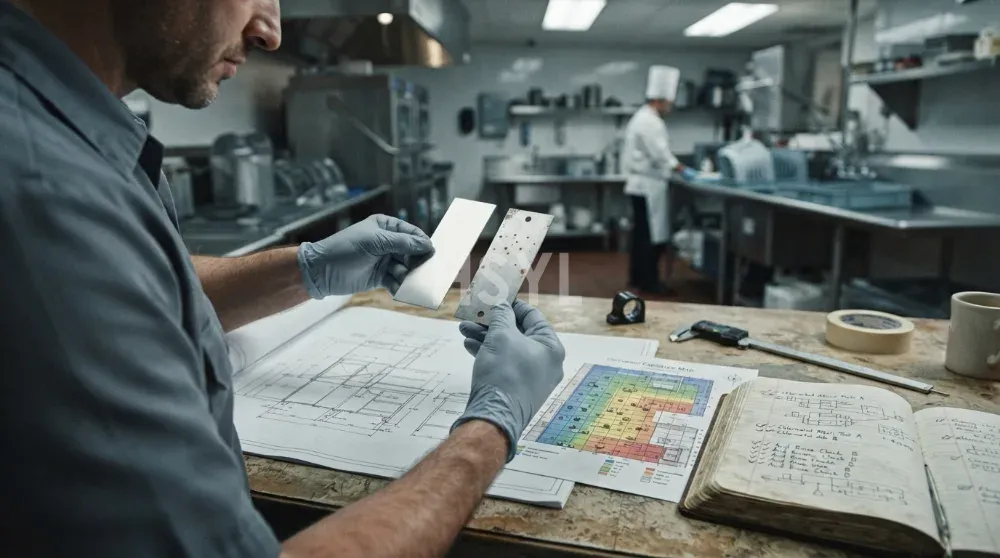
The wrong question is “Which grade is best?” The useful question is “What will this exact surface contact, at what temperature, for how long, and how will it be cleaned?” A sink bowl, a dry cabinet panel, a heated brine vessel, and a coastal washdown area may sit in the same kitchen but face different corrosion mechanisms. Specifying one grade across all four without an exposure map can either leave vulnerable locations under-specified or add alloy cost where it does not address the real risk.
This guide is a selection method, not a declaration that either alloy is legally suitable for food contact. Material compliance, hygienic design, fabrication quality, and destination-country obligations remain separate decisions. Use HSYL’s materials and fabrication guides for the wider specification context and the compliance standards hub for market-specific evidence questions.
1. Start with the Exposure, Not the Equipment Name
Record every wetted or contaminated zone. Include direct food contact, splash, condensate, cleaning runoff, chemical dosing points, floor-level aerosols, coastal salt deposition, and contact with dissimilar metals. Then distinguish continuous immersion, intermittent wetting, deposits that remain between shifts, and surfaces that dry completely. A broad label such as “commercial kitchen” does not describe any of these conditions.
Temperature and time change the decision. A solution encountered briefly during a controlled rinse is not the same as residue trapped hot under a gasket. Evaporation can concentrate salts beyond their bulk concentration, while deposits and lapped joints can create oxygen-depleted crevices. Ask operations to supply actual product recipes, water analysis, sanitation chemicals, concentrations, temperatures, dwell times, and rinse practices rather than relying on a generic cleaning schedule.
| Exposure input | Question to document | Why it changes selection |
|---|---|---|
| Food or process fluid | What ingredients, salts, acids, and residues contact the surface? | Bulk chemistry and concentration after drying can differ. |
| Temperature and dwell | Is contact cold, heated, cyclic, or stagnant between shifts? | Heat and retained solution can increase localized-corrosion risk. |
| Cleaning chemistry | Which products, dilution controls, contact times, and rinse steps apply? | Misuse or incomplete rinsing may dominate the alloy choice. |
| Geometry | Where can liquid, soil, or chemical remain under joints and fittings? | Crevices and deposits create a different environment from open surfaces. |
| Consequence | Would attack be cosmetic, hygienic, structural, or process-critical? | Higher consequence requires stronger evidence and review. |
2. Understand What the 304–316 Difference Can and Cannot Tell You
Types 304 and 316 are families of austenitic stainless steels, not complete purchasing specifications. The Nickel Institute’s overview of nickel-containing stainless steel describes their formability and weldability, while the Stainless Steel Industry of North America notes that 316 includes molybdenum and that this addition is particularly helpful under chloride exposure. That supports a relative comparison; it does not provide a universal operating limit.
Grade 316 is generally the stronger candidate when chloride-driven pitting or crevice corrosion is a material risk. However, “stronger candidate” is not the same as “approved.” Surface condition, weld finishing, temperature, stagnation, oxidizing conditions, and concentration all matter. The British Stainless Steel Association warns that even 316 has limitations in seawater and that smooth surfaces, finished welds, drainage, and crevice avoidance influence performance.
| Decision factor | 304 position | 316 position | Required caution |
|---|---|---|---|
| General indoor use with controlled cleaning | May be a practical candidate | May add corrosion margin | Verify actual chemicals, wet time, and finish. |
| Repeated chloride or brine exposure | Requires closer justification | Usually the stronger starting candidate | Neither grade is automatically safe from pitting. |
| Crevices, deposits, or stagnant liquid | Risk can rise materially | Improved alloying does not remove the geometry risk | Redesign and cleanability may matter more than a grade swap. |
| Reducing acids or severe chemical service | Do not assume suitability | Do not assume suitability | Obtain corrosion-specialist review and project-specific evidence. |
| Dry non-contact enclosure | Assess by ambient and cleaning exposure | Assess whether added alloying addresses a real hazard | Separate appearance from process-contact requirements. |
3. Treat Chlorides as a System Variable
Chlorides can arrive through brine, salt-rich food, water, disinfectants, coastal air, construction contamination, or incorrectly mixed cleaners. Their risk is not captured by a single concentration copied from a handbook. Temperature, pH, oxidizing conditions, surface deposits, evaporation, and geometry can change the local exposure at the metal surface.
Do not convert a laboratory salt-spray duration into service life. Accelerated tests are useful only when the method, specimen finish, fabrication state, acceptance criterion, and relevance to service are agreed. BSSA specifically cautions that salt-spray outcomes depend on shape, finish, and test conditions and should not be used alone to declare a grade suitable for a generic environment. If testing is required, the buyer and material specialist should define what decision the test is intended to support.
4. Separate Food Acidity from Corrosion Severity
“Acidic food” is too broad to select an alloy. Identify the actual acid, concentration, product temperature, oxygen condition, salt content, contact time, and cleaning transition. Tomato product, fermented sauce, citrus residue, and a formulated descaler may all be described as acidic while presenting very different conditions. Do not state that 316 is mandatory for every acidic product or that 304 is suitable below a universal pH.
The same caution applies to cleaning chemicals. Ask the chemical supplier for intended substrate compatibility, dilution and temperature limits, rinse requirements, and restrictions. A material choice cannot compensate for uncontrolled dosing or the use of a chemical outside its instructions. Where a sanitation regime is still being designed, keep the alloy decision open until operations and chemical suppliers have confirmed the real exposure.
5. Use Geometry and Fabrication as Selection Inputs
A flat, polished coupon does not represent a welded corner, threaded fitting, lap joint, gasket seat, or poorly drained tube. Crevices can retain soil and concentrate contaminants. Heat tint, embedded carbon-steel particles, rough grinding, and unfinished weld areas can also reduce the corrosion margin of the finished assembly. Specify the delivered surface and fabrication acceptance criteria, not only the base-metal grade.
Review the component families most exposed to retained moisture. Wash arms, tank corners, drain connections, fastener interfaces, and gasket grooves deserve more attention than a dry decorative panel. Procurement teams comparing dishwashing equipment or food-preparation equipment should ask for a material map that distinguishes product-contact, splash, washdown, structural, and enclosure zones.
6. Build a Zone-by-Zone Grade Decision Matrix
Divide the machine into functional zones and assign an exposure statement to each. Then record the proposed grade, fabrication condition, evidence, open questions, and approver. This prevents a quotation phrase such as “stainless steel construction” from becoming an assumed promise that every hidden bracket, fastener, and wetted part uses the same alloy.
| Zone | Exposure statement | Decision record | Acceptance evidence |
|---|---|---|---|
| Direct product contact | Product, temperature, time, clean-down, stagnation | Grade and product-contact suitability route | Material certificate, component declaration, agreed tests |
| Splash and condensate | Frequency, salt deposition, ability to dry | Grade, finish, drainage, cleaning access | Drawing callout and fabrication inspection |
| Washdown zone | Chemical, concentration control, rinse, pooling | Alloy plus joint and seal design | Chemical compatibility and FAT checks |
| Dry enclosure | Ambient humidity, aerosols, external cleaning | Appearance and corrosion requirement | Approved finish sample and material record |
| Hidden joint | Crevice, insulation, gasket, dissimilar metal | Eliminate, seal, drain, or justify | Section drawing and inspection access |
7. Decide When 316 Is Not Enough
Escalate the selection when the process includes hot concentrated chlorides, persistent deposits, seawater contact, reducing acids, unknown chemical mixtures, high consequence of leakage, or a history of localized attack in comparable service. The next step is not automatically a more expensive grade. It may be a geometry change, better drainage, a revised cleaning method, a non-metallic component, a higher-alloy material, controlled testing, or specialist corrosion review.
Likewise, do not use magnet response as a pass/fail grade test. Austenitic stainless can show some magnetism after cold work or fabrication, and simple reagent screening has limitations. If grade identity is commercially important, define traceable material certificates and an agreed positive material identification plan. HSYL’s stainless-steel equipment category provides the equipment context; the purchase specification must still define the exact material zones.
8. Freeze the Decision with Responsibilities and Evidence
Before order release, close the exposure map, material map, cleaning regime, fabrication notes, and evidence list. State who confirms process chemistry, who approves material selection, who controls cleaning chemicals, and who verifies destination-market requirements. The destination-market compliance guide helps keep legal conformity separate from engineering preference.
Ask suppliers to identify exclusions and alternatives rather than hide uncertainty behind “304 standard” or “316 upgrade.” If HSYL is invited to review a project, provide the product and sanitation chemistry, temperatures, dwell times, water data, layout, critical zones, and consequence of corrosion through the technical enquiry page. Final suitability must be confirmed for the specific equipment and destination; no grade name alone establishes food-contact compliance or corrosion life.