Required blast-chiller capacity is the maximum mass and geometry of hot food cooling at the same time—not the kitchen's daily production. The calculation must follow each batch from loading until it reaches the project's verified release condition. Product depth, pan arrangement, starting condition, loading delay and door opening can make two equal kilogram loads behave very differently.
First Define the Cooling Rule and Its Jurisdiction
The cooling target belongs to the operator's food-safety plan and applicable authority. For example, the FDA Food Code 2022 is a model offered for adoption by U.S. jurisdictions. Its section 3-501.14 states that cooked time/temperature control for safety food should cool from 57°C (135°F) to 21°C (70°F) within two hours and to 5°C (41°F) or less within six hours total. The same document lists methods such as shallow pans, smaller portions, rapid cooling equipment and containers that facilitate heat transfer.
Those values must not be presented as a universal global rule. Confirm what the destination authority has adopted, the customer's own standard, the food classification, any approved process and the measurement method. Write the applicable target at the top of the calculation sheet before comparing equipment.
Map Every Batch on a Cooling Timeline
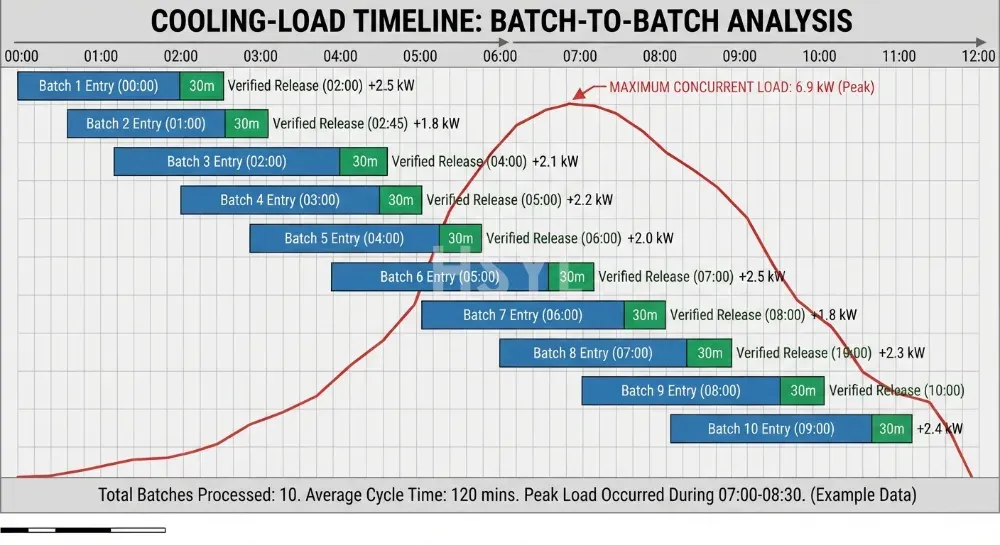
For each product family, record the time cooking ends, time the last pan enters the chiller, starting condition, pan type and fill, number of pans, total food mass, target condition and latest acceptable verified release. Include the time needed to move, portion, label and probe the load. If loading takes twenty minutes, the first and last pans do not share the same cooling history.
Use a separate row when product geometry or process conditions differ. A shallow pan of sauce, a deep container of rice, a dense roast and a trolley of plated meals cannot be represented by one generic “food” load merely because they enter at similar temperatures.
The concurrency calculation is:
required concurrent food load at time t = sum of all batches loaded but not yet released at time t
Evaluate that sum across the complete production day. The maximum point defines the minimum simultaneous mass that the selected configuration must accommodate under the stated pan, rack and process conditions. Mass is only one part of the duty; the physical loading pattern must be carried into the trial.
Worked Example: Find the Overlap Before Adding a Margin
Assume a project has three hypothetical batches. The release times below are planning assumptions for workload calculation, not guaranteed equipment performance. They must later be replaced by results from the proposed model and actual products.
| Batch | Food load | Last pan loaded | Planned verified release | Occupied interval |
|---|---|---|---|---|
| A | 36 kg | 10:00 | 11:30 | 10:00–11:30 |
| B | 24 kg | 10:35 | 12:05 | 10:35–12:05 |
| C | 18 kg | 11:00 | 12:30 | 11:00–12:30 |
From 11:00 to 11:30, all three batches remain in the cooling process. The maximum concurrent food mass is therefore:
36 kg + 24 kg + 18 kg = 78 kg
That result does not mean “buy a 78 kg machine.” The project must next confirm whether the batches can share a cycle, whether the total pans and racks fit with required spacing, whether different starting conditions or allergens require separation, and whether the proposed model can meet the cooling target at that load. If the operation chooses a contingency allowance, record why it is needed. A universal percentage can conceal scheduling, process or equipment problems.
Convert Food Mass into the Actual Loading Geometry
A rated kilogram capacity is meaningful only with its test method. Request the pan format, pan depth, product used or simulant, load distribution, starting condition, target, ambient condition, cycle definition and probe method behind the rating. Then compare those conditions with the project's products.
Build a loading drawing for the worst credible batch combination. Show:
- pan or tray dimensions and material;
- food fill depth and mass per pan;
- rack positions used and deliberately unused spacing;
- airflow clearance around the load;
- lids, covers or packaging condition;
- probe locations and product identification;
- trolley, rack and door-clearance interfaces.
Coordinate the complete container path with the GN pan interface guide. Physical fit is necessary but not sufficient: filling every available rail can reduce the airflow and surface exposure on which the cooling result depends.
Keep Rapid Cooling Separate from Cold Storage
Do not use the volume of a holding refrigerator as proof that it can cool a large hot load. The FDA Food Code's public-health rationale distinguishes commercial refrigeration intended to hold cold food from rapid chilling equipment designed to remove heat quickly. Adding hot product to a storage cabinet can also disturb food already being held.
The process should define a release from blast chilling into cold storage. Record the verified food condition, label or batch status, transfer time and destination storage location. Size the holding inventory separately. Explore the commercial refrigeration equipment category only after the project has separated pull-down duty from storage duty.
Include Loading, Defrost, Cleaning and Recovery in the Day
A theoretical cycle sequence can fail when operational time is omitted. Add pre-cooling where required by the selected equipment, product staging limits, door-open loading, probe setup, unloading, record completion, cleaning, defrost and recovery. Confirm whether a new batch can be added during an active cycle; do not assume mixed-time loading is permitted or valid.
Check the failure scenario. If a cooking batch is ready while the chiller remains occupied, identify the approved response: production delay, smaller upstream batch, another validated cooling method, a second independent unit or a documented contingency. Unplanned room-temperature waiting cannot be treated as free buffer capacity.
Design the Trial Around the Worst Credible Product
Before purchase release, test the selected configuration with representative products and the proposed maximum concurrent geometry. Agree which product is most difficult to cool, based on density, thickness, composition, container and loading arrangement. The food-safety lead should define the sampling plan and the refrigeration engineer should confirm the equipment setup and instruments.
At minimum, record:
- equipment identity, software or program revision and pre-test condition;
- product identity, recipe or formulation reference and starting state;
- mass per pan, number of pans, rack positions and loading duration;
- probe type, calibration status, placement and recording interval;
- air or cabinet readings used for diagnostics, kept separate from food acceptance readings;
- time-temperature data for the defined locations;
- door openings, interruptions, alarms, deviations and corrective action;
- final release decision and responsible reviewer.
A display showing the target cabinet temperature is not proof that the slowest food location met the required profile. Conversely, a failed trial should trigger review of load geometry, product, method and equipment—not an unsupported change to the acceptance target.
When sizing chilling equipment for airline catering, work backwards from the required kitchen release time and include the time needed for meal assembly and cart loading. Compare the overlapping batches with the wider flight kitchen equipment plan so the chilling schedule supports the departure wave. Keep aircraft-installed equipment and specialist cart systems as separately confirmed scope items.
Return a Sizing Brief That a Supplier Can Actually Verify
Issue the batch timeline, maximum concurrent mass, pan and rack drawing, product families, starting conditions, required cooling profile, loading and cleaning sequence, available utilities, destination market and trial protocol. Ask each bidder to state the exact model, usable loading arrangement, test basis, exclusions and evidence offered.
Connect the final trial to the commercial kitchen FAT process. Keep food-safety acceptance under the competent project team. HSYL model capacity, cycle time, utility use and product result should only be published after the exact configuration and witnessed method support those statements.