Direct Answer / Key Takeaway: Engineering guide to commercial steam-jacketed kettle sizing (100L–600L). Compare Direct Steam vs. Self-Contained Electric/Gas, ASME Section VIII pressure ratings, 316L liners, and 5-year TCO.
Sizing a commercial steam-jacketed kettle requires calculating working batch volume at 80% to 85% of nominal rim capacity, matching heat transfer surface area (m2) to product viscosity, and selecting between a Direct Steam interface (supplied by an external central boiler at 15–45 PSI / 103–310 kPa) and a Self-Contained Electric or Gas closed-loop steam generator. Unlike stockpots heated from a flat bottom disc—which create localized thermal hotspots exceeding 260°C (500°F) and scorch high-protein or high-Brix slurries—a hemispheric steam jacket distributes latent heat uniformly across a 105°C to 144°C (221°F to 291°F) boundary layer with an overall heat transfer coefficient (U-value) of 850 to 1,700 W/(m2·K).
- Direct Steam Architecture: Optimal for central kitchens, hospital commissaries, and food processing plants equipped with an existing building steam header. Achieves the fastest cold-start boil recovery (18 to 25 minutes for 200 L to 300 L vessels) with zero onboard combustion flues or high-amperage heating elements.
- Self-Contained Closed-Loop Architecture: Integrates a factory-sealed, vacuum-evacuated jacket filled with distilled water and corrosion inhibitors, heated by immersion electric elements (12 kW to 45 kW) or atmospheric/infrared gas burners. Eliminates the need for an external boiler room or condensate return piping.
- Jacket Geometry (2/3 Partial vs. Full Jacket): A 2/3 partial jacket prevents superheating above the liquid line when simmering broths, soups, and pasta; a full steam jacket maximizes heat exchange surface area per liter for heavy-viscosity sauces, chili, fillings, and confectionery reductions when paired with a planetary scraper agitator.
- Metallurgy & Pressure Compliance: Specify AISI 316L (UNS S31603) molybdenum-stabilized stainless steel for the inner food-contact hemisphere to prevent chloride stress-corrosion cracking and acid pitting, engineered in strict accordance with ASME Boiler and Pressure Vessel Code (BPVC) Section VIII, Division 1.
Key takeaway: Sizing a commercial steam-jacketed kettle requires calculating working batch volume at 80% to 85% of nominal rim capacity, matching heat transfer surface area (m2) to product viscosity, and selecting between a Direct Steam interface (supplied by an external central boiler at 15–45 PSI / 103–310 kPa) and a Self-Contained Electric or Gas closed-loop steam generator. Unlike stockpots heated from a flat bottom disc—which create localized thermal hotspots exceeding 260°C (500°F) and scorch high-protein or high-Brix slurries—a hemispheric steam jacket distributes latent heat uniformly across a 105°C to 144°C (221°F to 291°F) boundary layer with an overall heat transfer coefficient (U-value) of 850 to 1,700 W/(m2·K).
Thermodynamic Heat Transfer & Pressure Vessel Mechanics: Direct Steam vs. Self-Contained
In institutional batch cooking—spanning bone stocks, tomato reductions, béchamel sauces, curries, porridge, and braised meats—the primary engineering failure mode of direct-fired stockpots and tilting braising pans is thermal flux concentration. When a gas flame or electric hotplate applies heat strictly to the bottom horizontal base of a cylindrical pot, the heat flux density (q/A) frequently exceeds 65 kW/m2. Because viscous slurries exhibit poor natural convection, the boundary layer directly contacting the base overheats, polymerizing sugars and denaturing dairy proteins into an insulating carbonized char layer before the upper strata of the batch reach pasteurization temperature.
A commercial steam-jacketed kettle resolves this thermodynamic bottleneck by surrounding the lower two-thirds or the entirety of a deep hemispheric inner liner with an outer pressure vessel shell, creating a sealed annular interstitial space (15 mm to 28 mm radial clearance). When saturated steam enters this annular jacket and contacts the cooler exterior wall of the inner hemisphere, it undergoes phase change from vapor to liquid condensate. This condensation releases the enthalpy of vaporization (latent heat) directly into the stainless steel wall at a constant saturation temperature governed strictly by the absolute pressure inside the jacket.
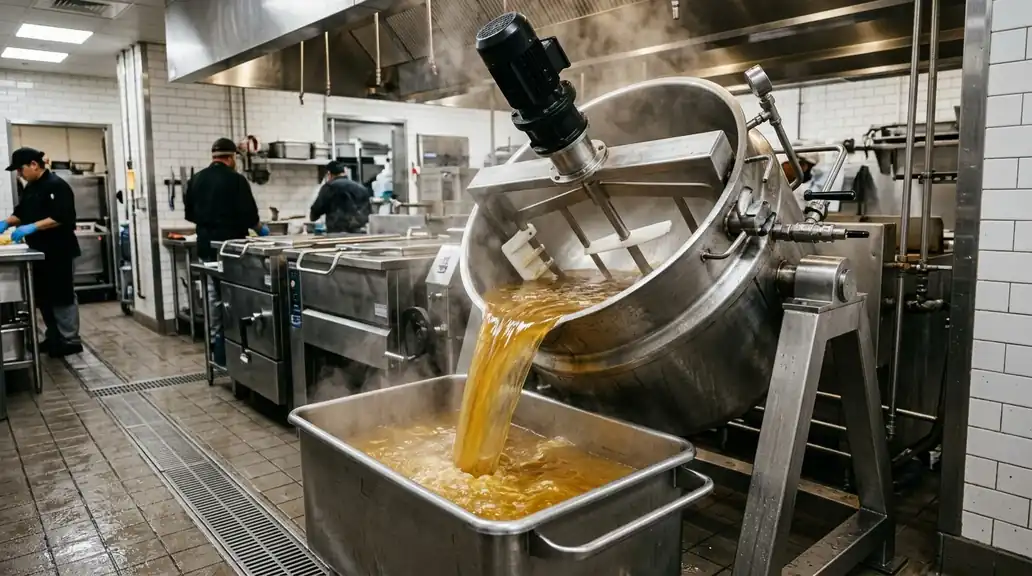
Saturation Pressure vs. Jacket Wall Temperature Curve
Because saturated steam condenses isothermally, a steam-jacketed kettle acts as a self-regulating thermal governor. Unlike open flames (1,100°C) or electric resistance rods (450°C sheath temperature), the inner wall of a steam kettle can never exceed the saturation temperature of the steam pressure supplied to the jacket. Facility engineers within our Capacity & Sizing resource hub select working pressure ratings based on the thermal sensitivity of the menu:
- 15 PSI (103.4 kPa / 1.03 bar gauge): Produces a saturated steam temperature of 121.0°C (249.8°F) with a latent heat of vaporization (hfg) of 2,199 kJ/kg (945.4 BTU/lb). Ideal for delicate dairy cream sauces, custards, oatmeal, and gentle simmering where protein coagulation on the vessel wall must be prevented.
- 30 PSI (206.8 kPa / 2.07 bar gauge): Produces a saturated steam temperature of 134.5°C (274.1°F) with hfg = 2,160 kJ/kg. Represents the standard operating benchmark for general institutional commissaries, school canteens, and hospital kitchens processing soups, stocks, and rice porridge.
- 45 to 50 PSI (310.3 to 344.7 kPa / 3.10 to 3.45 bar gauge): Produces a saturated steam temperature of 144.4°C to 147.6°C (292.0°F to 297.7°F). Increases the logarithmic mean temperature difference (Δ TLMTD) across the hemisphere by 62% compared to a 15 PSI system, cutting batch bring-to-boil durations by 35% to 40% and enabling rapid Maillard browning of ground meats and mirepoix prior to liquid addition.
Fundamental Heat Transfer & Batch Boil-Up Time Governing Equations:
- Sensible Heat Load to Boil (Qsensible):
Qsensible = m · cp · (Tboil - Tinitial) - Jacket Heat Transfer Rate (Qjacket):
Qjacket = U · As · Δ TLMTD = msteam · hfg · ηthermal - Batch Bring-to-Boil Time (tboil in minutes):
tboil = (m · cp · (Tboil - Tinitial)) / (60 · U · As · Δ TLMTD) - m = Active batch mass (kg), calculated at 80%–85% of nominal kettle volume
- cp = Specific heat capacity of product (4.184 kJ/(kg·K) for water/broth; 3.45 to 3.85 kJ/(kg·K) for heavy sauces)
- U = Overall heat transfer coefficient (1,250 to 1,650 W/(m2·K) for agitated low-viscosity liquids; 650 to 950 W/(m2·K) for unagitated viscous slurries)
- As = Effective wetted steam jacket surface area (m2)
Direct Steam vs. Self-Contained Closed-Loop Engineering Comparison
Before selecting a vessel from our Commercial Cooking Equipment lineup, project engineers must audit the facility's mechanical room infrastructure:
- Direct Steam Kettles: The kettle jacket has no internal heating elements or burners. Instead, facility steam from a central boiler room is piped through a strainer, a pressure-reducing valve (PRV), and a rotary trunnion joint (on tilting models) directly into the jacket. As steam condenses against the hemisphere, liquid condensate drains from the lowest point of the jacket through a thermostatic or float-and-thermostatic (F&T) steam trap. Because the steam supply is generated externally, direct steam kettles have virtually zero onboard electrical components (unless equipped with a motorized agitator or hydraulic tilt pump) and offer the highest reliability in high-humidity washdown zones.
- Self-Contained Electric & Gas Kettles: Designed for facilities without a central steam plant. During factory manufacturing, the annular jacket is evacuated to a negative vacuum (-0.06 to -0.08 MPa) and pre-charged with a precise volume of pure distilled water treated with rust-inhibiting glycol additives. In electric models, heavy-duty Incoloy 800 immersion heating elements seated at the bottom of the jacket boil this sealed water charge into steam; when the steam condenses on the upper hemisphere wall, gravity returns the condensate directly back to the bottom sump in a perpetual closed loop. Because no water leaves the sealed jacket, a self-contained kettle never requires feedwater plumbing, water softeners, or floor condensate drains for the steam circuit.
Engineering Specification & Sizing Matrix: 100 L to 600 L Batch Vessels
A critical sizing error in institutional kitchen planning is equating a kettle's nominal rim capacity with its usable working batch volume. Under vigorous boiling or planetary scraper agitation, liquid thermal expansion (≈ 4.2% from 20°C to 100°C) and vortex wave cresting require a minimum freeboard clearance of 15% to 20% below the upper pouring lip. Consequently, a nominal 200 L kettle yields an active working batch of 160 L to 170 L.
In addition, because the surface-area-to-volume ratio (As / V) of a sphere decreases geometrically as radius increases (As / V ∝ 1/r), a 600 L kettle has significantly less jacket heat transfer area per liter of soup (0.0038 m2/L) than a 100 L kettle (0.0058 m2/L). Below is the verified engineering parameter matrix for the Commercial Steam-Jacketed Tilting Kettle Series (CK-SJK-100 through CK-SJK-600), alongside our stationary and heavy-duty Steam-Jacketed Kettles for High-Volume Batch Cooking:
| Specification Parameter | CK-SJK-100 (100 L) | CK-SJK-200 (200 L) | CK-SJK-300 (300 L) | CK-SJK-500 (500 L) | CK-SJK-600 (600 L) |
|---|---|---|---|---|---|
| Nominal Capacity / Working Batch (82%) | 100 L / 82 L (21.6 Gal) | 200 L / 164 L (43.3 Gal) | 300 L / 246 L (65.0 Gal) | 500 L / 410 L (108.3 Gal) | 600 L / 492 L (130.0 Gal) |
| Inner Hemisphere Diameter × Depth | Ø 700 × 510 mm | Ø 800 × 580 mm | Ø 900 × 630 mm | Ø 1,100 × 720 mm | Ø 1,200 × 780 mm |
| Effective Heat Exchange Area (As) | 0.58 m2 (6.24 ft2) | 1.12 m2 (12.06 ft2) | 1.42 m2 (15.28 ft2) | 2.00 m2 (21.53 ft2) | 2.30 m2 (24.76 ft2) |
| Surface-to-Volume Ratio (As / Vnom) | 5.80 m2 / m3 | 5.60 m2 / m3 | 4.73 m2 / m3 | 4.00 m2 / m3 | 3.83 m2 / m3 |
| Direct Steam Consumption (at 0.3 MPa / 43.5 PSI) | 52 kg/h (115 lb/h) | 98 kg/h (216 lb/h) | 135 kg/h (298 lb/h) | 210 kg/h (463 lb/h) | 248 kg/h (547 lb/h) |
| Self-Contained Electric Heating Power (Optional) | 15 kW (380V/3Ph) | 24 kW (380V/3Ph) | 30 kW (380V/3Ph) | 42 kW (380V/3Ph) | 48 kW (380V/3Ph) |
| Planetary Agitator Motor & Speed (VFD Optional) | 0.55 kW (36 rpm) | 0.75 kW (36 rpm) | 1.10 kW (30–36 rpm) | 1.50 kW (28–36 rpm) | 2.20 kW (24–36 rpm) |
| Tilting Mechanism & Draw-Off Valve | Self-locking worm gear + DN50 valve | Self-locking worm gear + DN50 valve | Worm gear / Hydraulic + DN50 valve | Hydraulic tilt (90°) + DN65 valve | Hydraulic tilt (90°) + DN65 valve |
| 250 g Portion Yield per Batch (82% Fill) | ≈ 328 portions | ≈ 656 portions | ≈ 984 portions | ≈ 1,640 portions | ≈ 1,968 portions |
Why Two 250 L Kettles Outperform One 500 L Kettle in Multi-Recipe Cook-Chill Lines
When designing a Cook-Chill Production Schedule paired with Blast Chiller Concurrent Load Sizing, kitchen consultants frequently evaluate whether to install a single CK-SJK-500 (2.00 m2 jacket area) or two CK-SJK-200/CK-SJK-300 units (2.24 to 2.84 m2 combined jacket area). Dual medium-capacity kettles provide 25% to 42% more total heat exchange surface area for the same batch volume, reducing boil recovery time by 11 minutes per cycle while preventing a single batch transfer surge from overwhelming downstream pump-fill stations or blast chillers.
Regulatory, Pressure Vessel & MEP Facility Compliance
Because a steam-jacketed kettle stores pressurized thermal energy within a metallic shell surrounding food-contact zones, it is regulated simultaneously as an industrial pressure vessel and a commercial sanitation appliance:
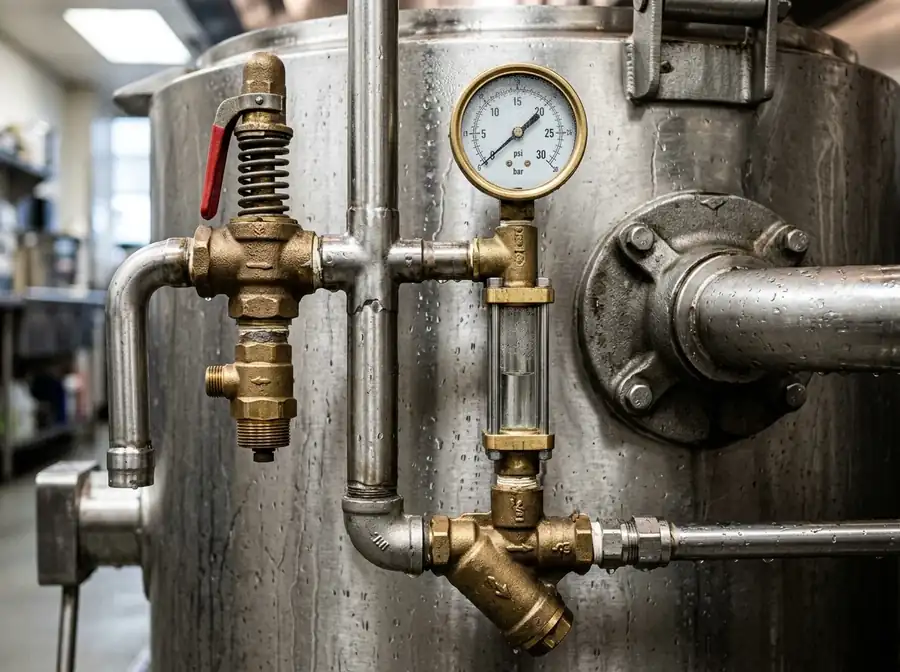
- ASME BPVC Section VIII, Division 1 Pressure Vessel Code: Under ASME Section VIII, Division 1, any jacketed vessel operating above 15 PSI (103 kPa) gauge pressure must undergo non-destructive weld examination (radiographic or liquid penetrant testing) and a factory hydrostatic pressure test at 1.3 × to 1.5 × the Maximum Allowable Working Pressure (MAWP). Every vessel must be fitted with an ASME-rated spring-loaded pop-safety relief valve set strictly at or below the stamped MAWP, discharging downward away from operator standing zones.
- NSF/ANSI Standard 4 (Commercial Cooking Equipment Sanitation): Per NSF/ANSI Standard 4, all food-contact welds inside the hemisphere must be ground smooth and polished to Ra ≤ 0.8 μm with internal corner radii ≥ 6.35 mm (0.25 in.). Tangent draw-off valves (
DN50/ 2 in. orDN65/ 2.5 in.) must utilize tool-free plug or compression stems that disassemble completely without dead-end threads where warm meat fibers or dairy proteins can incubate Clostridium perfringens. - Condensate Drain Quenching & Plumbing Codes (IPC Chapter 8): Direct steam kettles discharge condensate at 100°C to 135°C through their steam traps. If condensate is not routed back to the boiler feedwater receiver tank and must discharge to the kitchen sanitary drainage system, municipal plumbing codes (IPC Section 803) prohibit discharging wastewater above 60°C (140°F) directly into PVC/cast-iron building drains, requiring a thermostatic cold-water tempering valve or condensate cooler.
MEP Steam Header Sizing, Pressure-Reducing Stations & Steam Trap Selection
When commissioning a bank of direct-steam kettles (CK-SJK-200 through CK-SJK-600) in an institutional central kitchen, the mechanical, electrical, and plumbing (MEP) engineer must size the branch steam header for cold-start condensing surge loads rather than steady-state simmering rates. When culinary staff open the steam inlet globe valve on a cold kettle filled with 4°C (39.2°F) chilled stock water, the instantaneous condensation rate inside the jacket spikes to 2.2 × to 2.8 × the nominal continuous hourly rating during the first 6 minutes of heat-up. If the supply branch pipe is undersized, steam velocity exceeds the 25 m/s (5,000 fpm) acoustic erosion threshold, causing severe water hammer, rapid rotary-joint seal degradation, and pressure starvation across adjacent kettles.
Each direct-steam kettle drop must incorporate an individual Y-strainer (100-mesh stainless screen), a pilot-operated pressure-reducing valve (PRV) calibrated to the kettle's stamped MAWP (0.20 to 0.30 MPa), an automatic thermostatic air vent on the upper jacket manifold to purge non-condensable gases at startup, and a dedicated float-and-thermostatic (F&T) steam trap on the condensate outlet. Never manifold multiple steam-jacketed kettles into a single shared steam trap—differential pressures between a boiling kettle and a cold-filling kettle will cause steam short-circuiting (group trapping stall), waterlogging the lower hemisphere with subcooled condensate and reducing heat transfer capacity by up to 48%.
Component Metallurgy & Agitator Kinematics: 316L Hemispheres vs. Planetary Scrapers
Inner Hemisphere Metallurgy: Why AISI 316L Is Mandatory for Acidic & Saline Recipes
While standard AISI 304 (18% Cr, 8% Ni) stainless steel is ideal for exterior kettle shrouds, tubular support legs, and hinged spring-assist covers, it is vulnerable to chloride pitting and stress-corrosion cracking (SCC) when used for the inner pressurized cooking hemisphere. Commercial recipes routinely combine low pH organic acids (tomato paste at pH 3.8 to 4.2, vinegar reductions at pH 2.8 to 3.4) with sodium chloride concentrations of 1.5% to 3.5% at boiling temperatures (100°C+).
Above 60°C (140°F), free chloride ions (Cl-) penetrate the passive chromium-oxide (Cr2O3) film on AISI 304 steel, initiating microscopic subsurface pits that propagate through the stressed 3.0 mm to 4.0 mm hemisphere wall within 18 to 36 months. Specifying AISI 316L (UNS S31603)—which incorporates 2.0% to 3.0% Molybdenum (Mo) and restricts carbon to ≤ 0.03% to prevent carbide sensitization along weld heat-affected zones—raises the Pitting Resistance Equivalent Number (PREN = %Cr + 3.3%Mo + 16%N) from 18.0 (in 304) to 24.2+ (in 316L), guaranteeing a 10-to-15-year perforation-free vessel service life.
Planetary Scraper Agitators & Spring-Loaded PTFE Blades
When cooking products with dynamic viscosities exceeding 2,500 cP—such as lotus seed paste, chili bean sauce, polenta, cheese roux, or caramel—thermal boundary fouling reduces the overall heat transfer coefficient (U) by more than 55% within 90 seconds if the wall is not mechanically swept. HSYL CK-SJK agitated models integrate an overhead bridge-mounted planetary mixing head (0.55 kW to 2.20 kW) that rotates the primary frame at 24 to 36 rpm while counter-rotating secondary mixing fingers. Food-grade, spring-loaded PTFE (Teflon) or PEEK scraper blades ride continuously against the contour of the 316L hemisphere, shearing away the stagnant thermal film and folding it into the core of the batch every 1.6 seconds.
Trunnion Tilting Kinematics vs. Tangent Draw-Off Valve Fluid Mechanics
Product discharge architecture dictates both ergonomic safety and batch turnaround speed. Stationary kettles rely exclusively on a bottom-mounted tangent draw-off valve (DN50 / 50 mm or DN65 / 65 mm internal bore) welded tangentially to the lowest point of the inner hemisphere so liquid swirls out completely without leaving a stagnant puddle. While stationary tangent draw-off kettles excel at transferring clear broths, stocks, and thin soups directly to a positive-displacement pump-fill station, large particulates (braised beef cubes, bone-in poultry, or whole root vegetables) bridge across a 50 mm valve port.
For particulate-heavy stews, chili, and high-viscosity pastes, trunnion-mounted tilting kettles (CK-SJK-100 to CK-SJK-600) provide unobstructed wide-lip pouring into mobile 200 L Euro-bins or floor drainage troughs. Up to 200 L capacity, a high-ratio self-locking worm-and-sector gear handwheel allows one operator to tilt a full vessel with less than 45 N of rim effort while mechanically preventing unintended back-driving at any pour angle. For 300 L to 600 L vessels where active liquid mass reaches 250 kg to 500 kg, dual-acting electro-hydraulic tilting cylinders with velocity-fuse check valves deliver smooth, stepless 0° to 92° pouring control while automatically raising the overhead planetary agitator bridge clear of the kettle rim.
5-Year Total Cost of Ownership (TCO) & Labor Payback Analysis
To quantify the capital investment between a Direct Steam kettle (connected to an existing 84%-efficient central gas steam boiler), a Self-Contained Electric kettle, and a bank of Traditional Open-Burner Stockpot Ranges producing 1,200 L/day of bone broth and viscous sauces (320 days/year), evaluate the 5-year lifecycle ledger below:
| Cost Component (5-Year Cumulative) | CK-SJK-300 Direct Steam Kettle (Agitated) | CK-SJK-300 Self-Contained Electric (30 kW) | 4x Open-Burner Gas Stockpot Ranges (Manual Stir) |
|---|---|---|---|
| Initial Equipment & MEP Hookup CAPEX | $5,400 (Includes Steam Trap & PRV Kit) | $6,200 (Includes 3-Phase Breaker Panel) | $3,800 (4 Ranges + Heavy Aluminum Stockpots) |
| Thermal Transfer Efficiency (ηsys) | 78% (Boiler × Insulated Jacket) | 92% (Sealed Immersion Closed-Loop) | 32% (68% Flue & Ambient Side-Wall Heat Loss) |
| 5-Year Energy Consumption Cost (_ESCDOLLAR_0.14/kWh Elec; _ESCDOLLAR_1.15/Therm Gas) | $11,450 (Central Steam Equivalent) | $24,190 (34,560 kWh/yr) | $27,920 (High Ambient HVAC Load Penalty) |
| 5-Year Direct Kitchen Labor Cost (Stirring, Lifting & Decanting at _ESCDOLLAR_18/hr) | $14,400 (0.5 hr/day Automated Tilt + Scraper) | $14,400 (0.5 hr/day Automated Tilt + Scraper) | $100,800 (3.5 hrs/day Manual Stirring & Ladling) |
| 5-Year Scorched Batch Waste & Maintenance | $950 (PTFE Scraper Blades & Trap Service) | $1,650 (Contactor, Element & PTFE Blades) | $16,500 (1.8% Scorched Batch Loss + Pot Replacement) |
| Total 5-Year Lifecycle Cost (TCO) | $32,200 (Baseline Benchmark) | $46,440 (+$14,240 vs. Direct Steam) | $149,020 (+$116,820 Labor & Waste Deficit) |
Engineering ROI Conclusion: Replacing manual open-burner stockpots with an agitated CK-SJK-300 steam-jacketed tilting kettle recovers its entire equipment CAPEX within 1.4 months through labor reallocation, zero batch scorching, and elimination of manual hot-liquid ladling injuries (OSHA Ergonomics compliance).
Discuss Your Steam-Jacketed Kettle & Agitator Specification with HSYL Engineers
Send HSYL your batch recipe viscosity, portion targets, available building steam pressure or 3-phase electrical supply, and acidity/salinity profile. Our team specifies the exact 316L hemisphere volume, planetary scraper torque, and tilting mechanism for your commissary. Contact HSYL for Steam Kettle Sizing & Project Support.