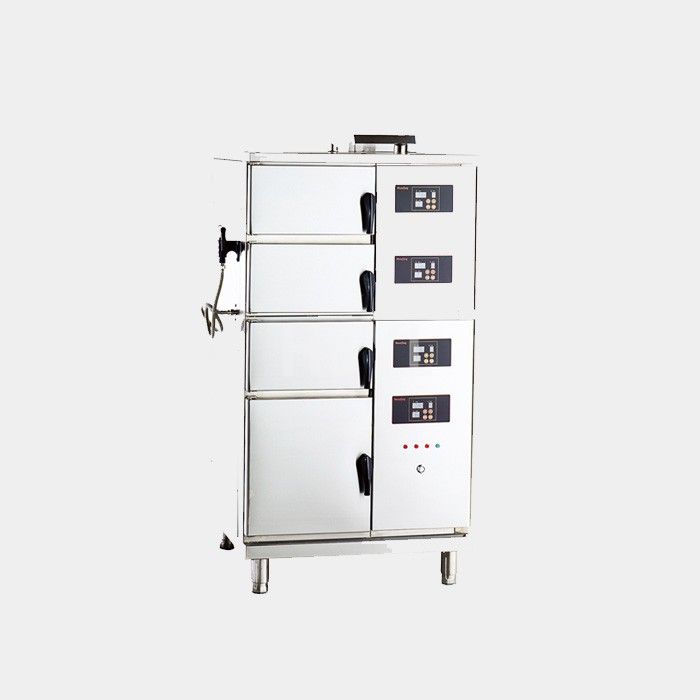
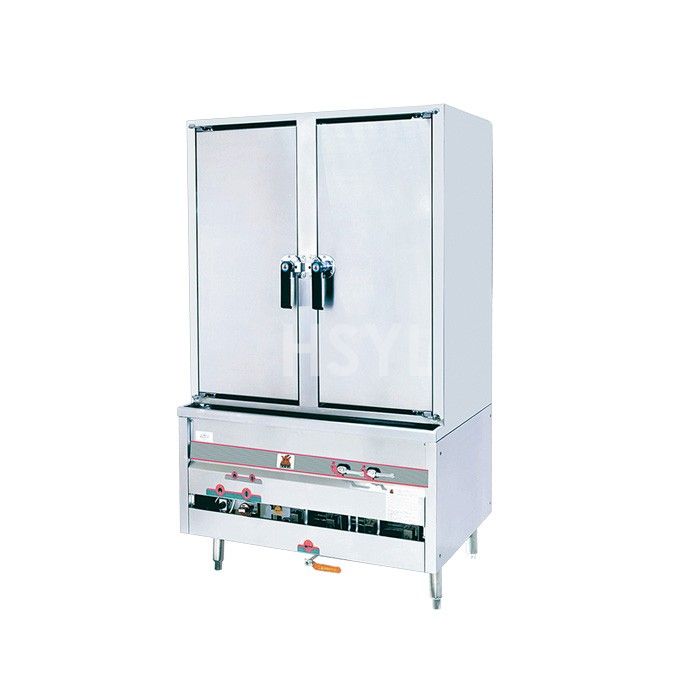
This method works for any cabinet steamer. The model data used to land the calculation comes from HSYL's two cabinet ranges — the HSC Intelligent Steamer Cabinet Range, which loads GN pans from 4 to 24 per batch, and the HSO Electric and Gas Steamer Cabinet Range, which runs 400 × 600 mm trays — so the arithmetic ends on a real configuration, not a theoretical one.
The Four-Step Pans-per-100-Meals Calculation
Rated pan count is a machine specification, not a capacity answer. The conversion from meals to pans runs through your own menu data:
- Fix the steamed portion weight per meal. Take the grams of steamed product one meal actually carries — rice, a protein portion, vegetables — from your menu costing, not from a guess. A canteen rice portion and a banquet fish portion differ by an order of magnitude, and this single number drives everything below it.
- Weigh one loaded pan and count its yield. Fill a 1/1 GN pan (or your 400 × 600 tray) with the actual product at production depth, weigh the net product, and divide by the portion weight. That gives portions per pan — the number catalogue sheets never publish. Pan depth and product density move this figure significantly; the GN pan size guide covers the EN 631 pan dimensions and depths if your kitchen has not standardized pan sizes yet.
- Compute pans per 100 meals. Divide 100 by portions per pan, round up. This is the menu-specific capacity unit that lets you compare machines with different rated loads on one basis.
- Convert to batches per service. Multiply pans per 100 meals by your peak meal count, divide by the pans one batch holds, round up. Then check that batch count against your service window at the cycle time your menu steams at — the subject of the batch-planning section below.
Worked Example: 600 Meals per Service
The numbers below are illustrative assumptions to show the arithmetic — they are not HSYL product data. Substitute your own weighed values before specifying a machine.
| Step | Assumption (illustrative) | Result |
|---|---|---|
| 1. Portion weight | 200 g steamed rice per meal | — |
| 2. Portions per pan | Loaded 1/1 GN pan yields 6 kg net rice | 6,000 g ÷ 200 g = 30 portions per pan |
| 3. Pans per 100 meals | 100 ÷ 30 | 3.33 → 4 pans per 100 meals |
| 4. Batches per service | 600 meals peak; cabinet holds 10 pans per batch | 600 × 4 ÷ 100 = 24 pans → 3 batches |
Read the result as a decision, not a number. If rice is the only steamed item and the service window allows three cycles, a 10-pan cabinet covers 600 meals. If the menu also steams fish and vegetables in the same window, those products add their own pans per 100 meals on top — and if they steam at different timings, a single chamber forces them into sequence, which is where the batch count starts to exceed the window.
Model Capacity Data: What Each Configuration Holds per Batch
The documented per-batch loads across the two ranges:
| Model | Format | Pan / Tray Load per Batch | Power | Electrical Supply |
|---|---|---|---|---|
| HSC-4T-E | Tabletop | 4 × 1/1 GN | 5 kW electric | 3N~380V |
| HSC-6T-E | Tabletop | 6 × 1/1 GN | 10 kW electric | 3N~380V |
| HSC-4U-G(S) | Floor-standing | 2×1/1 GN ×3 + 4×1/1 GN ×1 (10 pans) | 16 kW gas | 1N~220V for controls and ignition |
| HSC-5U-G(S) | Floor-standing | 2×1/1 GN ×4 + 4×1/1 GN ×1 (12 pans) | 16 kW gas | 1N~220V for controls and ignition |
| HSC-8U-G(S) | Floor-standing | 2×1/1 GN ×6 + 4×1/1 GN ×2 (20 pans) | 20 kW gas | 1N~220V for controls and ignition |
| HSC-10U-E(S) | Floor-standing | 2×1/1 GN ×8 + 4×1/1 GN ×2 (24 pans) | 27+2 kW electric | 3N~380V |
| HSO-1E / HSO-2E / HSO-3E | Floor-standing | 400 × 600 mm trays; tray count — | 21 kW / 39 kW / 27 kW electric | — |
| HSO-1G / HSO-2G / HSO-3G | Floor-standing | 400 × 600 mm trays; tray count — | 25 kW / 42 kW / 42 kW gas | — |
Fields marked "—" are not published for that model; confirm the tray load and electrical supply on the model specification sheet before freezing a capacity plan. The HSC range also supports 1/2 GN pans, 2/1 GN pans and 12-inch dishes, and a 45 kg water tank supports continuous batch operation across the range. Once the capacity target is fixed, the choice between these models runs through pan format and site utilities — the selection path covered in our equipment selection guides.
From Pans to Batches: Cycle Time Decides Whether the Window Holds
A batch count is only feasible against the clock. Multiply the batches per service by the steaming time your slowest menu item needs, add loading and unloading between cycles, and compare the total with the production window before service. A cabinet that holds the whole service in one batch can still be the wrong size if that one batch takes longer than the window allows; conversely, a smaller cabinet running three quick cycles may out-produce a larger one on a mixed menu.
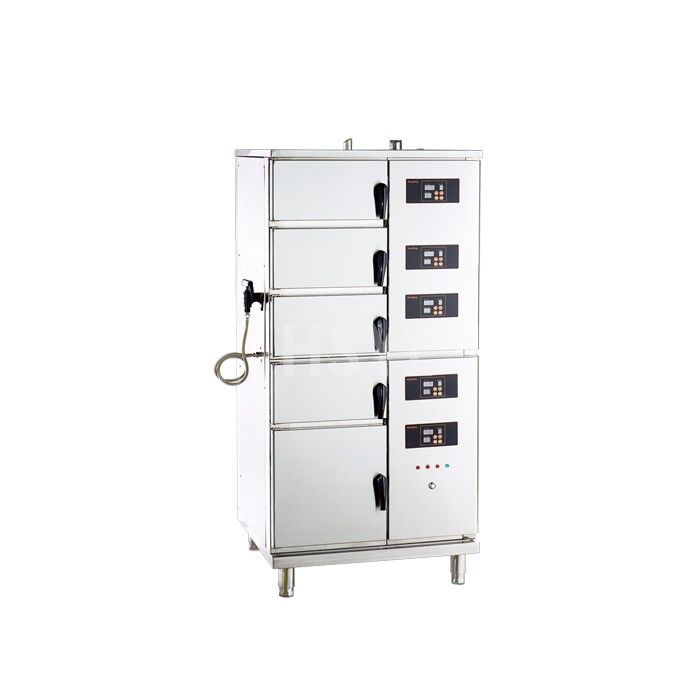
Mixed menus change the arithmetic again. When rice, fish and vegetables steam at different timings, independent compartments turn sequential batches into parallel ones: the HSC tabletop models carry independent temperature, heating and time controls for each compartment, so different products run different programs at the same time. That is a capacity multiplier no pan-count figure shows. For canteen-scale planning, the steamer's batch rhythm also has to match the service wave at the pass — the school canteen kitchen solution shows how steamer output connects to holding and the serving line at that scale.
Five Capacity Planning Mistakes
- Sizing by rated pan count without weighing the product. A 24-pan cabinet holds 24 pans, not 24 pans' worth of your menu. Portions per pan comes from a scale, not a catalogue.
- Calculating from daily average meals instead of the peak service. Steamers are specified against the busiest single service, because batches cannot be banked in advance the way refrigerated prep can.
- Ignoring cycle time. Capacity is pans per batch multiplied by batches the window allows. A plan that stops at pan count assumes the whole service fits in one cycle — verify the timing before downgrading to a smaller model.
- Mixing pan formats across the workflow. Steaming in 400 × 600 mm trays while holding and serving run GN adds a re-panning step at the busiest point of service and inflates the effective pans per 100 meals. Standardize one interface end to end.
- Planning zero headroom. Menu growth, a second sitting, or a contract win turns an exactly-sized cabinet into the bottleneck. A one-batch buffer costs less than a second machine later.
Related Equipment & Systems
Capacity numbers only hold when the pans themselves are standardized — the GN pan size guide maps the EN 631 sizes and depths used in the calculation above. When the batch plan is fixed, the equipment selection guides take over: pan format, gas versus electric utilities and compartment configuration across the HSC and HSO ranges. The full lineup sits under commercial cooking equipment.