Direct Answer / Key Takeaway: Plan cooking kettle batch scale-up with controlled ingredients, working loads, mixing, heating and sampling. Keep recipe changes separate from equipment changes.
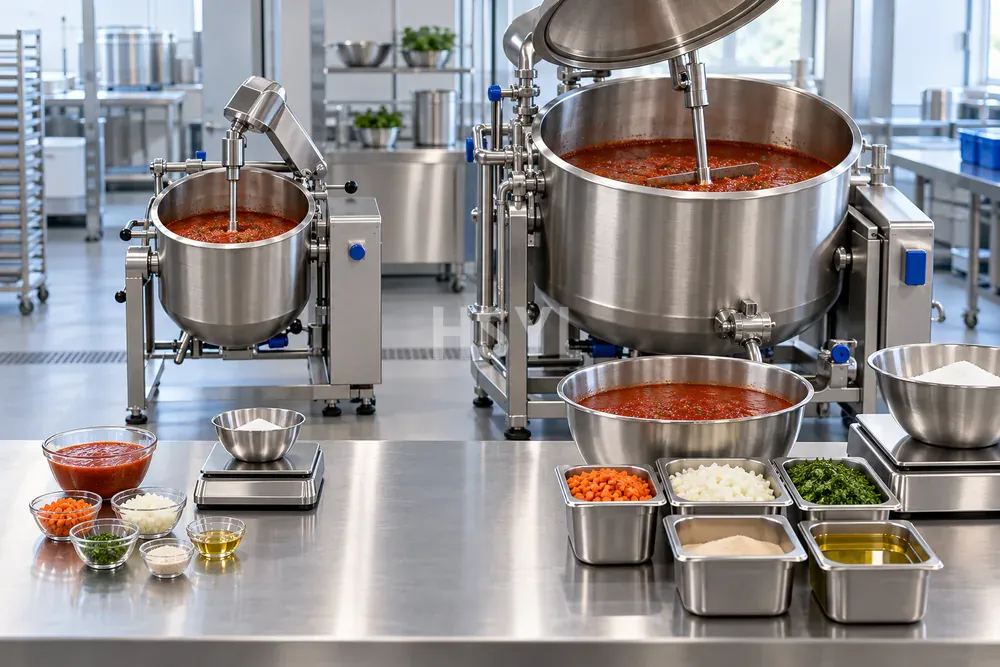
Cooking kettle batch scale-up begins with a defined small-batch recipe and ends with evidence that the intended larger batch meets its product requirements. Multiplying ingredient quantities is necessary for a planned comparison, but it does not, by itself, validate the larger process.
Keep a record of what is changing: batch quantity, vessel, mixing arrangement, ingredient preparation, heating method or the downstream transfer. When all those factors change without documentation, the team cannot explain the finished result or reproduce it.
Release a small-batch reference
Identify the recipe revision, ingredient specification, preparation and starting condition. Record the accepted result using the production team's defined measurements and observations. The reference should describe the product at an agreed inspection condition, not only the operator's judgement that it looked right.
Include sampling, discharge and any approved food-safety checks. The UK government cooking guidance is official background for food businesses; use the applicable requirements and the facility's validated process when defining the actual product criteria.
Separate the arithmetic from the process trial
In an illustrative recipe calculation, increasing a 12-kilogram input batch to 48 kilograms gives a quantity multiplier of four. The calculation can organize the intended ingredient quantities when the recipe permits that treatment. It does not establish four times the cooking time, identical mixing settings or the same accepted result.
Check each ingredient and preparation step with the recipe owner. Some ingredients may be introduced through a controlled sequence, and the selected machine must support the approved method. Do not infer the larger process from a single total-mass ratio.
Keep a change register
- Product and ingredient specification retained from the reference.
- Working batch quantity and exact vessel configuration.
- Approved ingredient introduction and mixing sequence.
- Heating and control conditions used in the trial.
- Sampling and product-inspection locations or stages.
- Discharge, receiving and preparation for the next batch.
Trial the intended working load
Confirm the offered equipment's permitted load and operating method before starting. Use representative ingredients and a trial planned with the supplier and responsible production staff. Manufacturer resources, including the Cleveland kettle range information, illustrate that kettle configurations differ; the actual offer needs its own controlled documentation.
Record the product through the agreed stages rather than inspecting only one final sample. Retain differences between approved sample positions or release points. Follow safe manufacturer-approved access and measurement procedures, without interrupting safeguards or improvising contact with moving mechanisms.
Include the complete transfer to the next operation. If the larger batch waits in a receiving container because downstream capacity is occupied, that delay belongs in the production study. Scaling the cooking vessel can expose a different constraint in filling, cooling or dispatch.
Adjust with traceable comparison runs
Choose an evidenced question for the next trial and record what is altered. Keep the original observation alongside the revised recipe or setting. A successful sample after several undocumented adjustments does not define a reproducible process.
Compare accepted product, input and recovered quantity, occupied time and work between batches using the same boundaries. Explain rejected or retained material and keep the trial's limitations visible. Avoid converting development observations into a production guarantee before the intended routine duty has been demonstrated.
Release the larger-batch instruction
The released instruction should connect ingredient quantities, preparation, permitted load, equipment configuration, operating sequence and acceptance criteria. Include the changes authorized by the recipe owner and the evidence used for approval. Train the actual operators on the new revision.
Retain the reference and scale-up records for future changes. A new ingredient, a larger load or a replacement vessel may require another review. The useful output of development is a controlled production method that the kitchen can repeat and inspect, not simply a multiplied ingredient list.