Executive Engineering Summary: High-Volume Batch Production Logistics
A commercial catering kitchen is engineered for batch scalability, production logistics, and precise temperature-holding chains rather than short-order à la carte plating. Producing 1,000 to 10,000 banquet meals or corporate meal trays within a compressed delivery window requires industrial thermal kettles, motorized braising pans, roll-in combination ovens, and automated packing belts. Every square meter of a commercial catering facility must adhere to strict uni-directional workflow zoning—from dirty receiving and raw butchery to high-temperature cooking, rapid blast chilling, clean assembly, and refrigerated dock dispatch.
Catering Efficiency Principle: Segregate clean and soiled zones with physical stainless steel partition kerbing and differential air pressure (+15 Pa clean zone) to guarantee complete food safety and zero cross-contamination under HACCP and ISO 22000 standards.
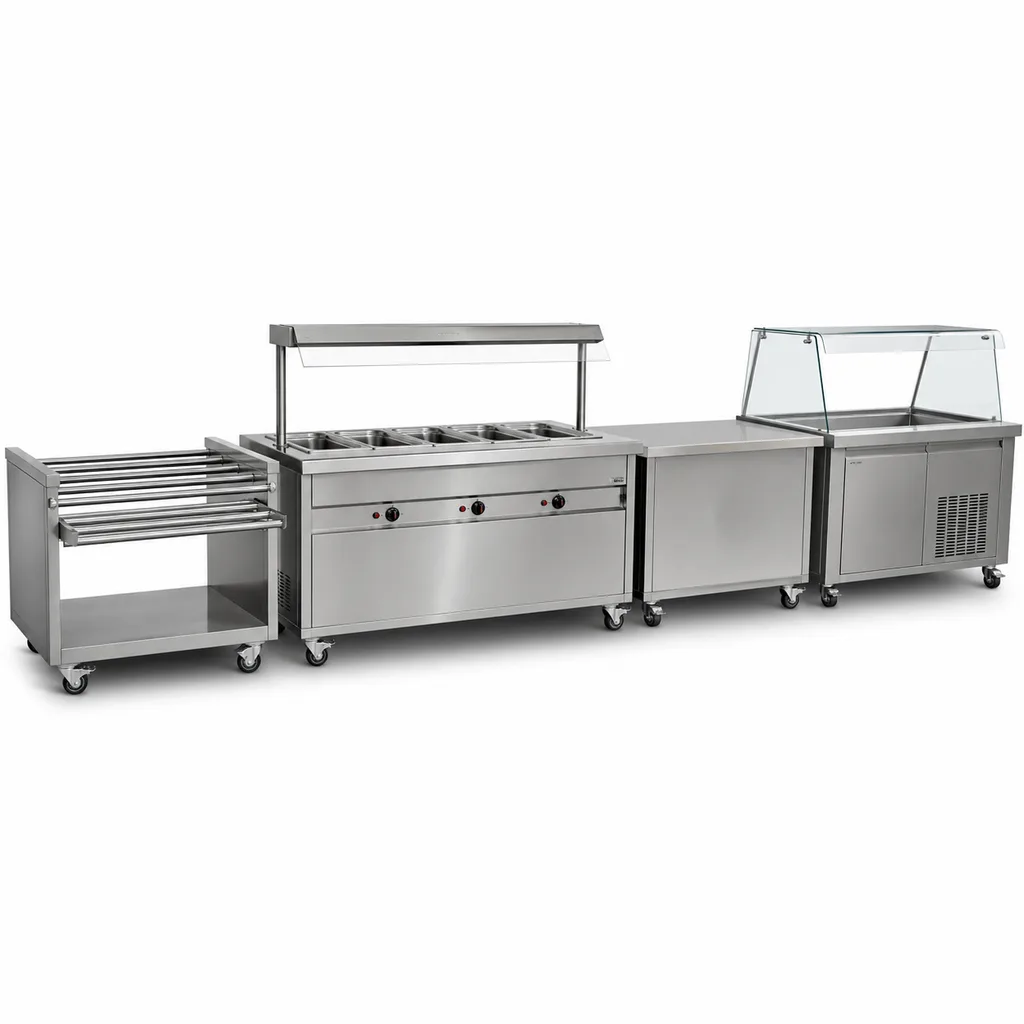
Figure 1: High-volume catering meal assembly conveyor line integrated with heated bain-marie inserts and tray dispensing units.
Industrial Batch Thermal Processing Machinery
In high-capacity catering operations, small sauté pans are replaced with heavy-gauge batch cooking apparatus. Equipment must provide rapid heat-up cycles, uniform temperature distribution across hundreds of kilograms of food, and automated vessel tilting for ergonomic decanting into standard Gastronorm (GN) transport trolleys:
- Steam-Jacketed Tilting Kettles: Available from 150L to 500L capacities. A sealed stainless steel jacket surrounds the bottom two-thirds of the hemispherical kettle bowl, delivering 0.3 to 0.7 MPa pressurized saturated steam. This eliminates hot spots and scorching when simmering bulk stocks, gravies, curries, and soups.
- Motorized Tilting Braising Pans (Bratt Pans): Multifunctional workhorses featuring heavy AISI 304 composite bases (15mm steel bonded to 3mm stainless steel). Designed for searing 80kg of meat, braising stews, shallow frying, and poaching. Motorized hydraulic or worm-gear tilting allows one operator to discharge 150 liters of boiling product safely in under 45 seconds.
- Roll-In 20-Pan Combi Steamer Batteries: Accommodates full roll-in mobile pan cassettes (20 × 2/1 GN or 40 × 1/1 GN). Cooking cycles are digitally programmed with core probe verification. Roll-in trolleys allow entire batches to transition seamlessly from the oven directly into matching roll-in blast chillers without manual pan handling.
- Continuous Automatic Rice Steaming Lines: Conveyor-driven or multi-tier cabinet steam systems producing 240kg to 600kg of perfectly gelatinized rice per hour with integrated water metering and automatic tray ejection.
High-Capacity Catering Machinery Specifications
| Machinery Type | Capacity Rating | Utility Input Rating | Batch Cycle Time | Sanitation & Safety Feature |
|---|---|---|---|---|
| Tilting Braising Pan (Bratt Pan) | 150L – 200L Vessel | 27 kW 380V / 95,000 BTU/hr | 35–50 min per 120kg stew batch | Motorized 90° tilt with safety interlock cut-off |
| Steam-Jacketed Tilting Kettle | 300L – 500L Hemispherical | Direct Steam 0.5 MPa / 45 kW Boiler | 40–60 min per 400L soup boil | Double-safety relief valves & 316L acidic bowl |
| Roll-In 20-Pan Combi Steamer | 20 × 2/1 GN (40 × 1/1 GN) | 55 kW 380V 3N~ / Water 0.4 MPa | 25–40 min per 200kg poultry load | Automatic multi-step CIP chemical wash cycle |
| Industrial Roll-In Blast Chiller | 20 × 2/1 GN Roll-In Trolley | 11 kW 380V Semi-Hermetic Unit | 160kg from +70°C to +3°C in 90 min | Automated core probe temperature logging |
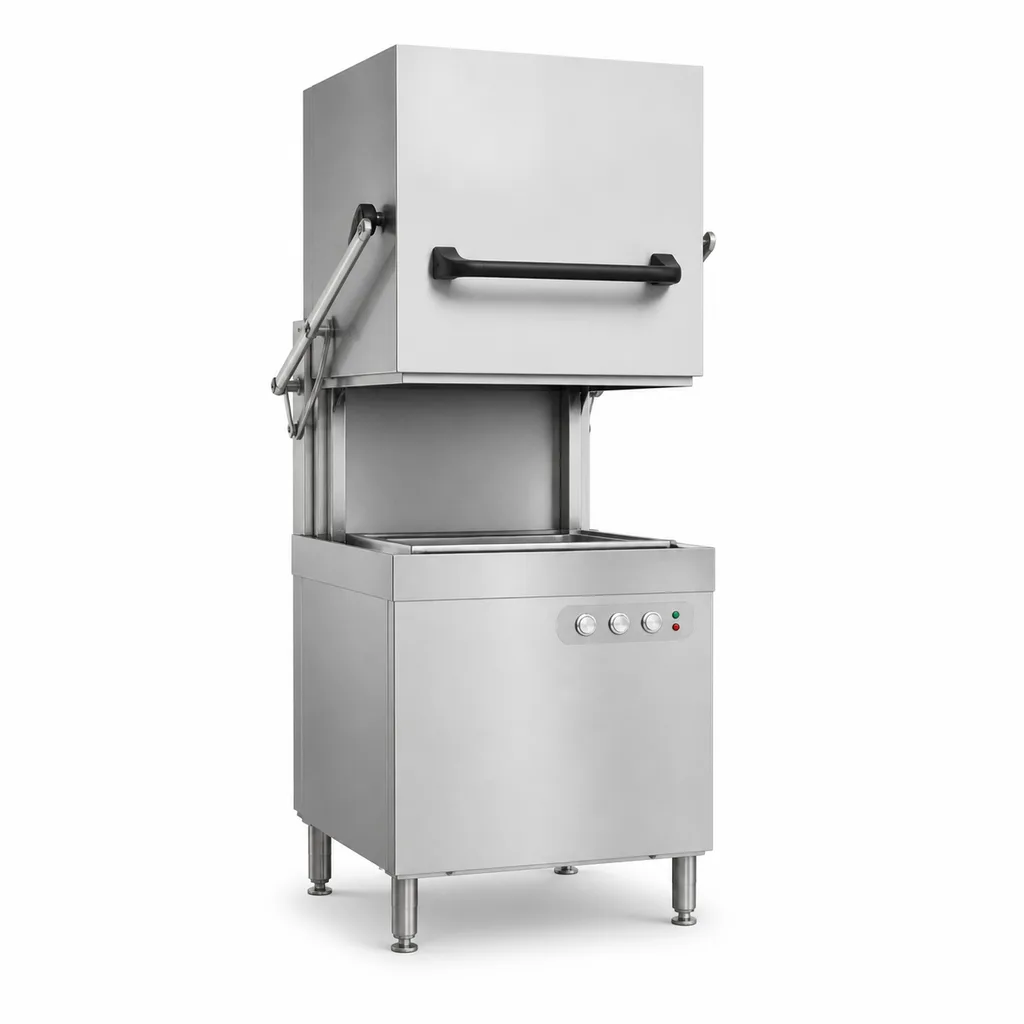
| Conveyor Flight Dishwasher | 3,000 – 4,500 plates / hr | 38 kW 380V + Heat Recovery | Continuous belt feed (1.5 m/min) | 85°C final sanitizing rinse with booster heater |
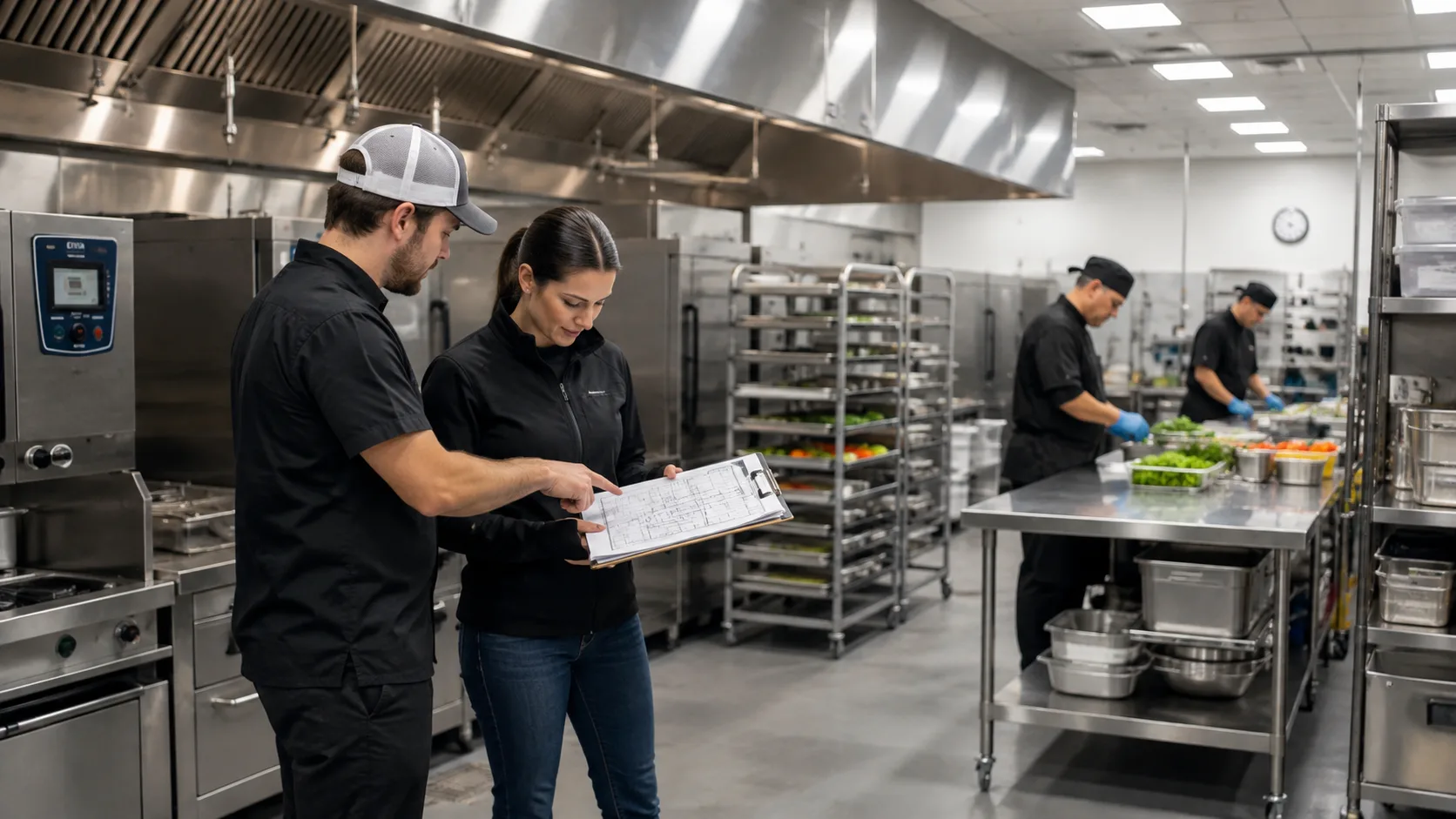
Figure 2: Industrial batch cooking zone with centralized stainless steel drainage trench, tilting kettles, and roll-in combi steamers.
The Cook-Chill Architecture & Cold Chain Logistics
Modern catering operations achieve high profit margins by decoupling food production from event service timing. Under a certified Cook-Chill protocol, large banquet menus are batch-cooked, portion-packed, rapidly chilled, and cold-stored for up to 5 days without flavor degradation or microbial growth:
- Thermal Cooking & Core Temperature Logging: Foods are cooked to minimum core temperatures exceeding 74°C (165°F) to ensure vegetative pathogen pasteurization.
- Shock Blast Chilling: Cooked food in 65mm GN pans is immediately loaded into high-velocity blast chillers. The refrigeration coils drop the core temperature to +3°C within 90 minutes, arresting enzymatic breakdown and moisture evaporation.
- Cold Staging & Assembly (+2°C to +4°C): Assembly and individual tray sealing take place inside a refrigerated packaging room held at +10°C to +12°C. Operators wear sanitized PPE and stainless steel packing belts move portions under automated heat-sealing film wrappers.
- Regeneration at Event Sites: Mobile banquet holding carts or on-site combi steamers regenerate chilled food back above 74°C within 30 minutes, maintaining crisp textures and moisture profiles identical to freshly cooked dishes.
Logistical Food Transport: Active vs Passive Holding
Transporting thousands of portions from a central catering facility to banquet halls or corporate clients requires precision insulated hardware:
- Passive Polyurethane Insulated Food Pan Carriers: Constructed with rotomolded polyethylene shells and high-density CFC-free polyurethane foam cores. High-performance carriers limit temperature loss to less than 1.5°C per hour without power, keeping hot soups and roasts above 65°C for over 4 hours.
- Active Heated Banquet Transport Cabinets: Mobile 14-gauge stainless steel cabinets on 150mm heavy-duty casters. Integrated PTC heating elements and forced-air convection maintain cabinet temperatures between 70°C and 85°C during pre-staging at the banquet venue.
- Refrigerated Logistics Fleet: Dedicated delivery vehicles equipped with direct-drive transport refrigeration units maintaining +2°C box temperatures with onboard GPS temperature dataloggers complying with FSMA (Food Safety Modernization Act) sanitary transportation rules.
Centralized High-Throughput Warewashing Engineering
Sanitation in a catering kitchen is an industrial operation. Processing 3,000 to 10,000 tableware pieces and hundreds of scorched 1/1 GN pans demands high-capacity warewashing machinery:
- Continuous Flight-Type Conveyor Dishwashers: Features a continuous peg-style conveyor belt where plates, trays, and cutlery baskets are loaded continuously. Multi-stage washing incorporates pre-wash scrapers (45°C), intensive detergent wash (65°C), dual pumped rinse, and an 85°C fresh water sanitizing rinse booster. Integrated heat recovery coils capture steam from the exhaust hood to pre-heat incoming cold water by 25°C, reducing electrical booster load by 35%.
- High-Pressure Commercial Utensil / Pot Washers: Dedicated stainless steel wash cabinets operating with 3.0 kW high-pressure oscillating wash pumps delivering 1.2 bar jet velocity. These machines strip stubborn baked-on starches and caramelization from 1/1 GN pans, dough hooks, and kettle agitators without manual scrub labor.
Central Catering Kitchen Spatial Zoning & Material Flow Architecture
To eliminate cross-contamination and bottlenecking during high-volume production, a catering facility must enforce an uncompromising uni-directional flow pattern based on the 'clean-to-dirty' zoning paradigm:
| Zoning Designation | Target Temperature & Pressure | Key Equipment Deployed | HACCP Hygiene Protocol |
|---|---|---|---|
| Zone A: Receiving & Raw De-Boxing | Ambient / +15°C (Negative) | Pallet jacks, platform scales, insect air curtains | Corrugated outer cardboard stripped before warehouse entry |
| Zone B: Cold Prep & Butchery | +10°C to +12°C (Neutral) | Veg washers, meat dicers, vacuum tumblers, 304 SS benches | Color-coded cutting stations; maximum 45-min meat exposure |
| Zone C: High-Heat Batch Cooking | +20°C to +24°C (Negative) | Tilting kettles, bratt pans, 20-pan combi ovens, hood canopy | Minimum 74°C core cook verification; floor grease trenching |
| Zone D: Clean Packing & Blast Chill | +10°C to +12°C (+15 Pa Positive) | Roll-in blast chillers, automated tray sealers, portion scales | Sanitary gowning airlock; HEPA air filtration; strict PPE |
| Zone E: Staging & Dispatch Dock | +2°C to +4°C (Neutral) | Mobile banquet carts, roll-in cold rooms, dock levelers | Vehicle pre-cooling inspection; digital transit datalogging |
CIP (Clean-In-Place) & Floor Drainage Engineering
Sanitation in an industrial catering kitchen cannot rely on manual mop buckets. High-capacity facilities utilize automated Clean-In-Place (CIP) loops and specialized hygienic drainage architecture:
- Stainless Steel Slot Drainage Channels (AISI 304): Continuous linear trenches with built-in longitudinal fall (minimum 1%) terminating in deep sediment basket sumps. Channels feature radius coved internal corners to prevent bacteriological harborages of Listeria monocytogenes.
- Chemical CIP Washing for Tilting Kettles: Fixed spray balls integrated into vessel lids circulate caustic wash solutions (65°C) and sanitizing peracetic acid rinses, stripping burned protein films without requiring workers to enter kettle interiors.
- Heavy-Duty High-Pressure Foam Sanitation Stations: Wall-mounted central chemical metering stations delivering 20 to 40 bar pressurized water and dense chlorinated foaming agents for rapid washdowns of floor tiles, wall curbs, and mobile carts.