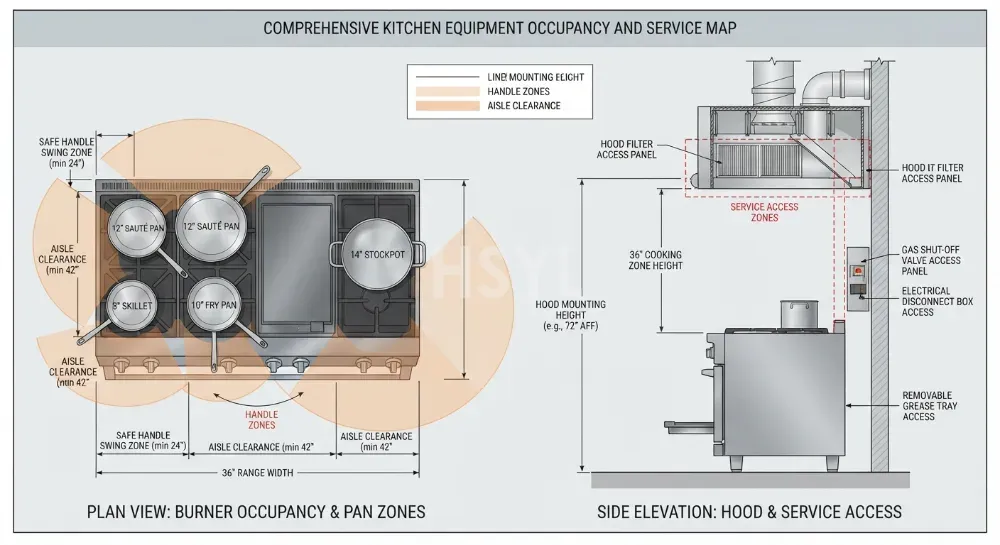
“Six burners” is a component count, not a production answer. One large stockpot can occupy a burner while blocking its neighbour; pan handles can collide; a low simmer may remain in place through an entire service; and an oven below the range may compete with staff movement at the top. Select a commercial range from an occupancy map of real cooking tasks.
Draw one row for every cooking task
Start with the busiest service period and list the pans or vessels that must be active at the same time. For each, capture outside diameter or footprint, filled mass where relevant, handle projection, agitation method, heat-control need, start time, active duration and destination after cooking.
Task occupancy = setup time + active heating + attended holding + removal/transfer time
The formula is deliberately simple. Its value comes from honest inputs. A sauce that occupies gentle heat for forty minutes is not a short task because stirring takes only a few minutes. A stockpot that is filled or drained near the range needs a safe movement path in addition to a burner.
Place scaled pan outlines over the proposed top. Check adjacent pan clearance, handle position, wall and splashguard conflict, reach to controls and the chef’s working stance. Repeat for the actual simultaneous combination—not a demonstration using one small pan.
Decide which duties belong on the range
Persistent simmering, high-output boiling, pan finishing, griddle work and oven production may deserve different equipment or heat-control characteristics. Moving a long-duration task to another suitable appliance can release a burner during the peak; adding burners without changing the workflow can simply lengthen the line.
If the range includes an oven, define that oven’s production separately. Record tray or vessel format, loading sequence, door-opening pattern and whether staff can use the oven without obstructing top work. The ENERGY STAR commercial oven criteria explicitly treat ranges as outside the covered commercial-oven product types. Do not transfer an oven efficiency label or test basis to the complete range unless the exact product documentation supports the claim.
Review the line from the cook’s hands outward
- Landing: identify where raw pans arrive and cooked vessels leave without crossing handles or controls.
- Water and ingredients: show filling, seasoning and utensil access; avoid repeated travel behind another cook.
- Heavy vessels: define lifting, tipping or transfer method rather than relying on staff strength.
- Hot surfaces: preserve working clearances and check nearby refrigeration, walls and heat-sensitive finishes.
- Cleaning: show grate or plate removal, spill capture, access under and behind the unit, and the route for cleaning components.
- Maintenance: keep isolation, panels and replaceable components accessible after adjacent equipment is installed.
A scaled line elevation should accompany the plan. It reveals control height, backsplash and shelf conflicts, utility entry, raised bases or legs and the relationship to the exhaust system.
Compare fuel options against the verified site
Gas, electric radiant, solid hotplate and induction configurations behave differently and impose different cookware, control, heat-rejection, cleaning and utility requirements. Avoid a universal claim that one technology is always faster, cheaper or better. Ask each supplier for the exact model’s declared input, controls, supported cookware or vessel limitations, clearances and test basis.
Coordinate fuel or electrical capacity, voltage, frequency, phase, isolation, ventilation, make-up air, fire protection and any interlocks under the destination rules. The electrical power configuration guide helps frame electrical questions, and the ventilation design guide frames hood coordination. Neither page substitutes for the project’s competent designers or authority approval.
Run the range as a station before approval
A useful trial loads the proposed top with the real simultaneous pan combination. Use agreed representative product or water-based test loads only where the limitations are accepted. Record heat-up or cooking sequence, control response, pan stability, neighbour interference, handle positions, staff movement, transfer steps and recovery after a demanding task.
Judge food results using the operator’s defined endpoint. Judge the station using the occupancy map: did every required task have a usable position at the right time? If the supplier changes burner layout, controls, pan supports or oven configuration, update and repeat the relevant part of the review.
Issue a station-specific selection record
The procurement package should therefore contain a timed task list, scaled pan map, top and elevation drawings, required accessories, utilities, exhaust/fire interfaces, cleaning and service clearances, exact-model documents and trial acceptance record. Compare candidates in the commercial cooking equipment category only after these inputs are clear.