A commercial griddle is decided at the plate, not at the casing. Three plate variables, in this order, determine whether the machine matches your menu: plate thickness, which sets recovery and temperature stability; plate material and finish, steel or chrome; and plate surface pattern, flat, grooved or a combination of both. Width, gas power and thermostat range come after — they size a decision you have already made.
This guide works through the three decisions using the documented specifications of HSYL's two griddle ranges — the full-size gas and electric commercial griddle models in 700 and 900 series depths and the HG countertop electric griddle range — so each criterion lands on a real configuration instead of a generic material checklist.
Decide Plate Thickness Before Size or Power
Plate thickness is thermal mass. A thicker plate stores more heat per square centimeter, so when a full batch of chilled or frozen product lands on the surface, the plate temperature dips less and recovers faster; a thin plate on the same burner loses temperature across the loaded zone and cooks unevenly until the burner catches up. Thickness is therefore a duty decision, not a quality badge: heavy back-to-back loading — burger patties through a lunch rush, batch after batch of breakfast proteins — wants the thickest plate offered; intermittent à la carte cooking with idle gaps between orders can run a thinner plate without penalty, because the burner has time to reheat it.
On the documented side, the full-size range offers an optional 18 mm chromed plate, specified for better heat retention and distribution. Plate thickness for the standard steel configuration and for the countertop HG range is not published on the product pages — confirm the plate thickness of your shortlisted model on the model specification sheet before treating recovery performance as settled. What is documented underneath the plate matters just as much: the full-size range places several heating elements tightly beneath the plate to even out heat distribution, and the HG countertop range uses high nickel-chromium alloy heating tubes with an imported EGO thermostat. Thickness and element layout work as a pair — ask about both, not one.
Steel vs Chrome: What the Surface Finish Actually Changes
A standard steel plate is the default working surface of the industry. It seasons with use, tolerates metal spatulas and scrapers, and suits high-volume operations where the plate is a consumable work tool. A chromed plate is a different tool for a different priority. The full-size range documents three concrete advantages for its optional 18 mm chromed plate: better heat retention and distribution, no flavor transfer between foods, and a polished surface that is easier to clean.
Read those three points as a menu statement. No flavor transfer means fish at lunch does not perfume pancakes at breakfast on the same plate — relevant for all-day operations that share one griddle across dayparts. Easier cleaning means the surface resets between services in minutes rather than a boil-out. The trade-off, as general industry practice, is that a chrome finish is protected rather than seasoned: abrasive scraping and aggressive metal tools damage the polished surface, so the kitchen's cleaning routine changes with the plate. If your staff cleans a steel plate with a heavy scraper every night and will not change that habit, the chrome option pays for a surface you will then degrade; if cleaning discipline is in place, the documented retention and flavor-isolation benefits are real.
Whichever finish you choose, compare the cleaning hardware the ranges document around the plate, because that is where daily labor lives: the full-size range fits a large removable fat collector and makes the plate itself removable for cleaning and repair access; the HG countertop range runs an edge flap, pull-out boxes and an integrated oil cleaning blade. These are not accessories — they decide how long the plate stays in spec between deep cleans.
Flat vs Grooved vs Combined: Map the Surface to the Menu
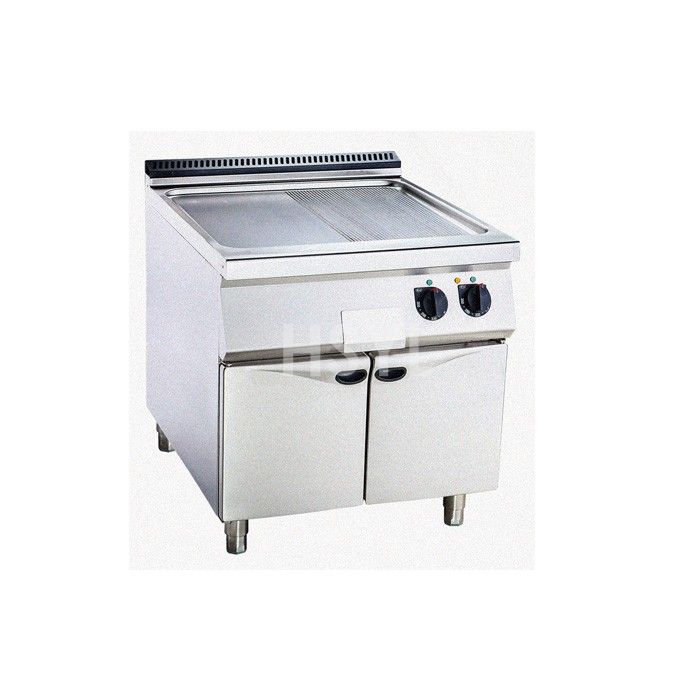
Surface pattern is a menu decision, and the full-size range documents it as a configuration choice: full or part module is available with a smooth, grooved or combined plate. Map each pattern to what it cooks well:
- Flat (smooth) plate. Full spatula contact and an unbroken surface: eggs, pancakes, fried rice, grilled sandwiches, cheese melts and anything delicate. This is the default for breakfast-heavy and mixed menus.
- Grooved plate. Raised ribs put sear marks on proteins and lift the product out of its own rendered fat — burgers, steaks, chicken, sausages. The grooves are harder to clean and useless for eggs or batters, so a grooved-only plate fits a meat-led menu, not an all-day one.
- Combined plate. Flat and grooved zones on one plate, full or part module. This is the configuration for split daypart service: flat zone runs breakfast items while the grooved zone holds sear duty for lunch proteins, without buying a second machine.
Write down the share of your menu that needs full flat contact versus sear-and-drain. If one share is under roughly a third of plate-hours, a combined plate or a flat plate with technique adjustments usually beats dedicating a full machine to the minority duty. Temperature range is documented across the full-size range as thermostatic control from 50 to 350 °C with digital display of temperature, time and program; how the zones split on a combined configuration is a per-model question — confirm the zone layout on the model specification sheet.
Model Data: Full-Size and Countertop Ranges at a Glance
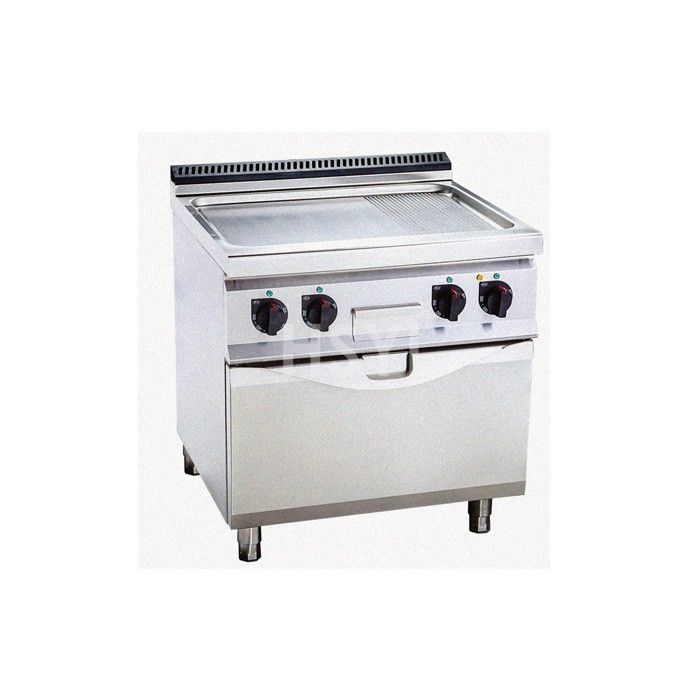
The full-size range spans 400 and 800 mm widths across 700 and 900 series depths, in gas and electric versions. A cabinet or oven underneath is documented as available only for 800 mm width or above — which is consistent with the markedly higher weights recorded on the 800-width VG rows.
| Model | Energy | Power | Dimensions (mm) | G.W. / N.W. (kg) |
|---|---|---|---|---|
| HG7040-G | Gas | 5 kW | 400 × 700 × 920 | 75.5 / 51.6 |
| HG7080-G | Gas | 10 kW | 800 × 700 × 920 | 133.7 / 100.5 |
| HG7080VG | Gas | 15 kW | 800 × 700 × 920 | 170.6 / 137.4 |
| HG9040-G | Gas | 6 kW | 400 × 900 × 920 | 94 / 65.8 |
| HG9080-G | Gas | 12 kW | 800 × 900 × 920 | 170.1 / 131 |
| HG9080VG | Gas | 17 kW | 800 × 900 × 920 | 218.1 / 179 |
| HG7040-E | Electric, 380 V / 50 Hz | 3 kW | — | — |
| HG7040R-E | Electric, 380 V / 50 Hz | — | — | — |
| HG7080-E | Electric, 380 V / 50 Hz | 9 kW | — | — |
| HG7080VE | Electric, 380 V / 50 Hz | — | — | — |
| HG9040-E | Electric, 380 V / 50 Hz | 3.5 kW | — | — |
| HG9080-E | Electric, 380 V / 50 Hz | 10.5 kW | — | — |
| HG9080VE | Electric, 380 V / 50 Hz | 16.5 kW | — | — |
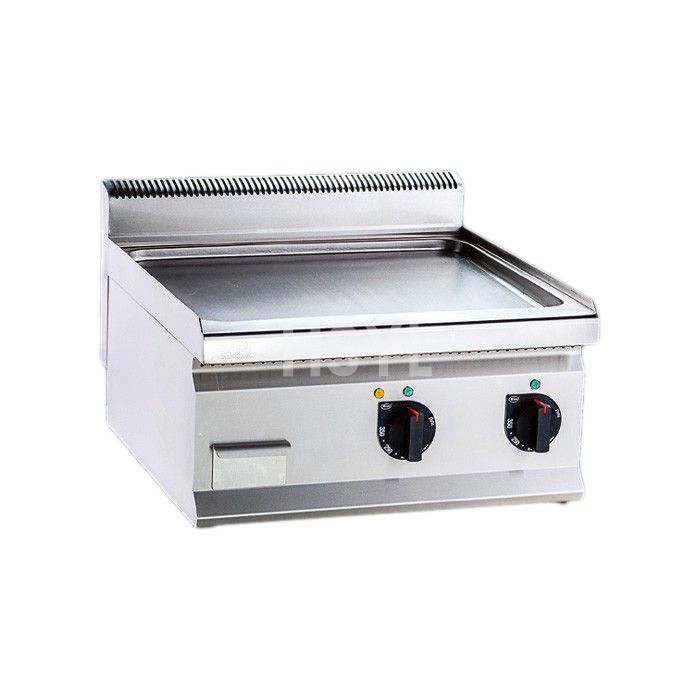
For smaller lines and satellite stations, the HG countertop electric range documents two configurations:
| Model | Dimensions (mm) | Electric Power | Voltage | G.W. / N.W. (kg) |
|---|---|---|---|---|
| HG6035E | 350 × 600 × 415 | 4.2 kW | 380 V | 35.6 / 22 |
| HG6060E | 600 × 600 × 415 | 8.4 kW | 380 V | 53.1 / 35.8 |
Fields marked "—" are not published for that model; request the confirmed specification sheet by model code before freezing a layout. Note that every electric row here, countertop included, is recorded at 380 V — a single-phase 220 V site filters out the entire electric lineup before plate options are discussed. The full lineup sits under commercial cooking equipment.
Five Griddle Plate Mistakes That Surface After Installation
- Buying on width and kW, treating the plate as a default. Two griddles identical in size and power cook differently if one carries a thin steel plate and the other the 18 mm chromed option. Specify the plate — thickness, finish, pattern — in the purchase requirement, not as an afterthought.
- Assuming the published plate spec covers every model. The 18 mm chromed plate is documented as optional on the full-size range; plate thickness for standard configurations and for the countertop range is not published. Confirm the exact plate build of your shortlisted model on the model specification sheet.
- Choosing chrome for a metal-scraper kitchen. Chrome's documented advantages — no flavor transfer, easy cleaning, even heat — depend on the polished finish surviving. If the nightly routine is aggressive metal scraping, the finish degrades and the premium buys nothing. Match the plate to the cleaning culture, or change the culture with the plate.
- Ordering a grooved-only plate for a mixed menu. Grooves are sear hardware for proteins; eggs, pancakes and fried rice need flat contact. Mixed menus belong on a smooth or combined plate — the full or part module option exists precisely for this case.
- Confirming power but not voltage class. Every electric model across both ranges is recorded at 380 V / 50 Hz, and the gas models run 5–17 kW of gas power with electronic ignition and a flame-failure device. A site budget that assumes a standard socket discovers the real supply requirement at commissioning.
Related Equipment & Guides
Plate decisions sit inside the larger cooking-line layout. If the hot line also runs open burners, the commercial range selection guide covers burner count, pan fit and simultaneous cooking — the complementary half of the same decision. For the full griddle lineup with model-level specifications, start from the full-size griddle model range or the countertop electric configurations, then request a technical proposal with your menu split and utility conditions.