Direct Answer / Key Takeaway: Test a cooking kettle for thick sauces using representative recipes, working loads, mixing, heat distribution, discharge and approved cleaning access.
A cooking kettle for thick sauces should be evaluated with the recipe and working load it is intended to process. Nominal vessel volume does not describe mixing behaviour, heating consistency, accepted product recovery or cleaning work. Those tasks need a representative product trial and an agreed inspection method.
Describe the sauce before discussing the machine: ingredients, particles, starting state, recipe sequence, intended texture and the way the finished batch must leave the kettle. The trial should connect those conditions to the offered configuration.
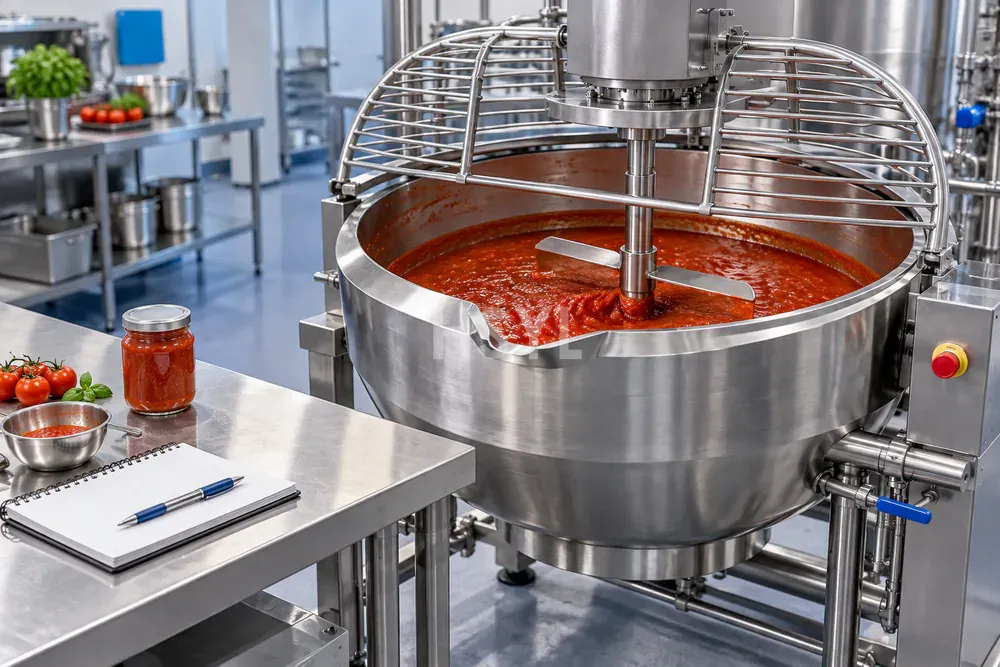
Write the product requirement in observable terms
Identify the recipe revision and the permitted ingredient substitutions. Record the required consistency at the specified inspection condition, particle integrity, colour or other quality criteria that matter to production. Agree the relevant food-safety validation with the responsible team.
Include the complete batch route. A product that cooks acceptably but cannot be transferred in a useful way is not a completed production solution. Define the receiving container, downstream operation and allowed handling arrangement before the supplier plans a demonstration.
Ask which mixing and heating arrangement is being offered
Obtain the exact vessel, agitator, scraper where provided, control arrangement and permitted working-load information. Request the operating and cleaning documents for that configuration. Features described for a related catalogue model do not automatically apply to the offer.
Manufacturer documents such as the Cleveland mixer-kettle manual show why operation is configuration-specific. They provide background, not permission to apply another machine's settings, safeguards or product capacity to an HSYL unit.
Inspect the product through the complete batch
Run a supplier-agreed trial with representative ingredients and the approved operating procedure. Record the starting condition, presented load, ingredient sequence and control settings. Take observations through the batch at the approved points without improvising access to moving or hot equipment.
| Trial question | Evidence to retain |
|---|---|
| Is the product adequately mixed? | Agreed sample locations and consistency observations |
| Is the heating result acceptable? | Defined food measurements and process record |
| Are particles preserved as required? | Product inspection against the recipe criteria |
| Can the accepted batch be discharged? | Transfer time, receiving arrangement and retained product |
| Can the machine be released for the next batch? | Approved cleaning and preparation work |
Keep a failed result associated with its exact condition. Changing the working load, recipe and setting together can produce a better sample but leave the purchaser unable to identify the useful operating envelope.
Measure recovered product, not only the starting load
Use a defined method to record the accepted quantity reaching the receiving container and the product remaining in the process. Explain whether the record includes evaporation, sampling, rejected material or handling losses. Different reporting boundaries should not be combined into a yield claim.
For an illustrative arithmetic example, a trial presents a 60-kilogram input batch and measures 56 kilograms of accepted product at its defined receiving boundary. The difference needs a recorded explanation; it cannot automatically be classified as equipment loss. These are hypothetical inputs, not a predicted kettle result.
Include the work between batches
Record approved cleaning access, accessory handling, inspection and preparation for the next released recipe. Follow the exact machine's safeguards and permitted procedures. The trial must not require someone to reach into an operating mixing mechanism to prove that the product is being handled.
Compare the complete occupied interval with the kitchen's required batch releases. If the sauce is one of several products sharing the vessel, retain the changeover conditions as part of the capacity brief.
Give the supplier the recipe requirement, representative product, receiving containers, available utilities and full-cycle record. This provides a practical basis for evaluating the cooking equipment configuration without substituting an unsupported litres-per-hour headline for accepted output.