Direct Answer / Key Takeaway: Plan multi-stop meal delivery equipment with stop order, loading geometry, access events and handover conditions. Validate the full route and return cycle.
Multi-stop meal delivery equipment should be selected for the whole route, not only the distance to the first customer. Stop order, unloading, repeated access, waiting and the return of handling equipment can change the duty presented to containers, carts and vehicles.
Start with identified route loads and the operation's approved food-condition and handover requirements. The equipment brief should explain how those loads are handled from kitchen release through the final stop and the relevant return tasks.
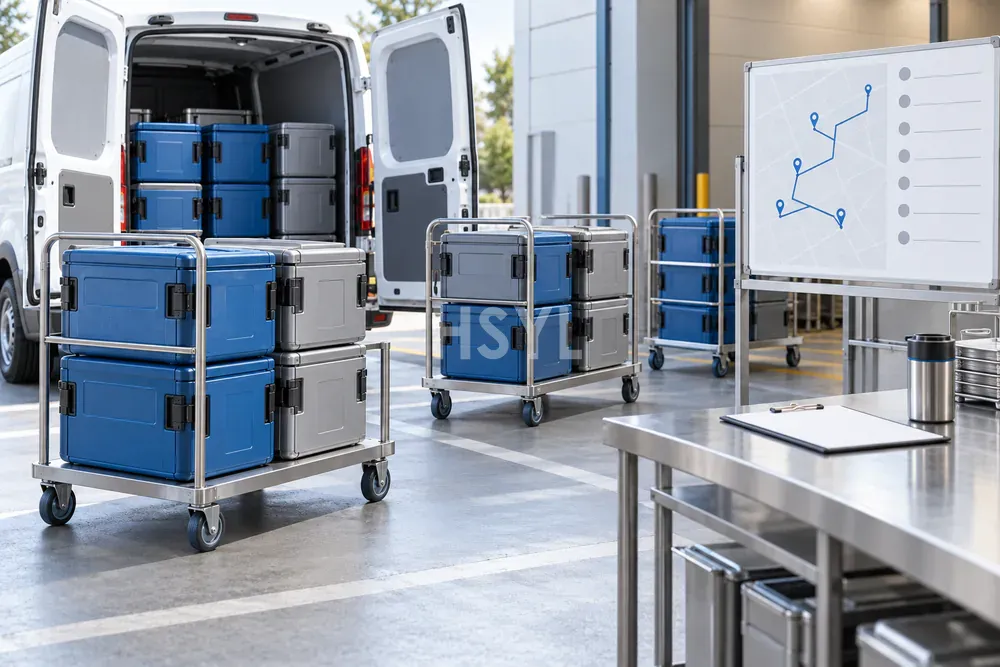
Describe each stop as an operating event
Record journey, arrival, parking or access, unloading, recipient checks and departure. Include the actual size and format of the meal load and the equipment needed to move it. A building doorway, ramp or lift can be part of the delivery interval even when the driving time is short.
Keep the meal group and recipient requirement identifiable. Some loads must remain grouped until their complete handover, while others may use a different distribution arrangement. Do not create an equipment count without stating which service pattern it represents.
Build the access sequence
Place each handling unit within the vehicle or transport arrangement according to the approved route plan. Check whether the first stop can be served without repeatedly unloading loads intended for later stops. Include doors, restraints and turning room in the physical review by the responsible team.
Count the access events affecting each remaining load. A load near the final stop may experience a different journey and access pattern from the first release. Retain those conditions when planning the representative transport trial.
| Route record | Equipment question |
|---|---|
| Load dimensions and mass | Which approved container and handling arrangement fits? |
| Stop order | Can the intended unit be removed without disturbing others? |
| Access pattern | What condition does the remaining load experience? |
| Site interface | Can equipment pass through the actual recipient route? |
| Return work | When are containers and carts ready for another route? |
Verify the complete route condition
Use representative products, permitted loads and the approved monitoring method. The UK food-delivery guidance provides official context for containers, food conditions and information. The actual operation's governing requirements and approved process determine the trial criteria.
An illustrative route includes three stops with planned handling intervals of six, eight and five minutes. Those intervals add nineteen minutes of handling to the journey record. They do not establish the overall route time or an allowable exposure limit. Record driving, waiting and actual handovers separately.
Test the relevant limiting conditions rather than only an ideal first delivery. Keep a delayed arrival or changed unloading sequence in the trial record and follow the approved exception procedure. A container demonstration under different access conditions should not be presented as validation of this route.
Include the return and cleaning cycle
Identify which containers, carts or other handling units must return and how they enter the facility's approved cleaning and inspection process. Record the interval until each unit can be released for its next permitted task.
If the same set supports several daily routes, map their overlap. Additional equipment may be needed because the previous set is still in return processing, even when all meals fit into the outbound vehicle. Separate usable food-load capacity from the circulation requirement of handling equipment.
Give suppliers a route brief they can assess
Provide product and container details, stop sequence, access events, recipient interfaces, approved conditions, monitoring and the return cycle. Request the exact offered configuration, supported duty and a representative demonstration with stated limitations.
Review options through the food holding and transport equipment discussion. A route-based enquiry connects equipment to accepted deliveries and reusable handling capacity, instead of treating a catalogue container volume as proof of the complete meal-delivery service.