Direct Answer / Key Takeaway: Factory Acceptance Test (FAT) protocol for commercial kitchen equipment. Detailed checklist for dimensional tolerances, electrical, and heat tests.
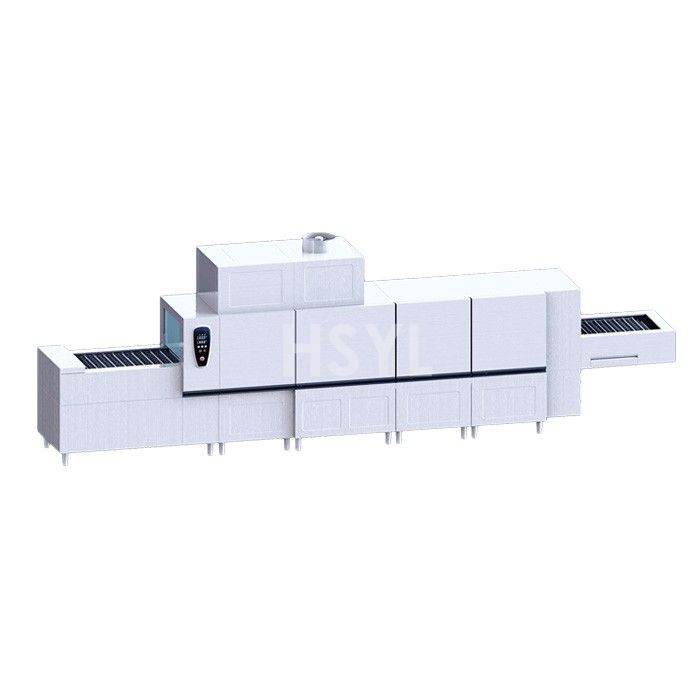
When procuring high-capital commercial kitchen equipment within our FAT & Compliance Hub, international hospitality groups, institutional catering consultants, and procurement directors must mitigate cross-border supply chain risks. Importing customized cooking suites, steam-jacketed kettles, conveyor dishwashers, or refrigeration racks from overseas manufacturing plants without an exhaustive Factory Acceptance Test (FAT) exposes projects to catastrophic delays, electrical mismatches, and expensive on-site rework. A formal FAT protocol provides empirical verification that manufactured machinery satisfies contractual engineering drawings, safety standards (CE, UL, NSF), and thermodynamic performance criteria before the equipment is crated for ocean freight. This engineering specification guide details our standardized FAT inspection checklist, testing instrumentation, acceptance criteria, and non-conformance remediation workflows.
1. The Four-Stage FAT Engineering Framework
A rigorous FAT execution encompasses four distinct progressive phases: documentation audit, mechanical/dimensional verification, electrical safety testing, and dynamic thermal/hydraulic load trials.
| FAT Inspection Phase | Core Technical Focus | Key Testing Instruments Used | Pass / Fail Acceptance Threshold |
|---|---|---|---|
| Phase 1: Material & Documentation | Mill Test Certificates (MTC), 3.1 certification, electrical schematics, component BOM audit | XRF Niton Alloy Analyzer, document cross-referencing | Zero unapproved component substitutions; AISI 304 Cr ≥18%, Ni ≥8% |
| Phase 2: Dimensional & Weld Finish | Overall dimensions, rough-in utility locations, weld finish Ra, panel flatness | Digital laser distance meters, Mitutoyo surface roughness tester, feeler gauges | Dimensional tolerance ±1.5mm; food zone Ra ≤0.8 µm; zero sharp burrs |
| Phase 3: Electrical Safety & Grounding | Dielectric withstand (Hi-Pot), earth continuity, insulation resistance, wire marking | Chroma 19032 Hipot Tester, Fluke insulation multimeters, ground bond tester | Hi-Pot: 1500V/1min leakage <5mA; Earth continuity <0.1 Ω; Insulation >100 MΩ |
| Phase 4: Dynamic Functional Load Run | Thermodynamic pull-down / heat-up, sensor calibration, emergency stop interlocks | Multi-channel Fluke dataloggers, calibrated thermal imaging cameras, tachometers | 100% full-load continuous 4-hour operation; core temps within ±1.5°C of spec |
2. Metallurgical & Mechanical Fabrication Verification
Visual inspection is insufficient to detect sub-standard metallurgical substitutions. During our Phase 1 and Phase 2 FAT inspections, quality engineers perform handheld X-ray Fluorescence (XRF) spectroscopy on external panels, internal cooking cavities, and structural frames.
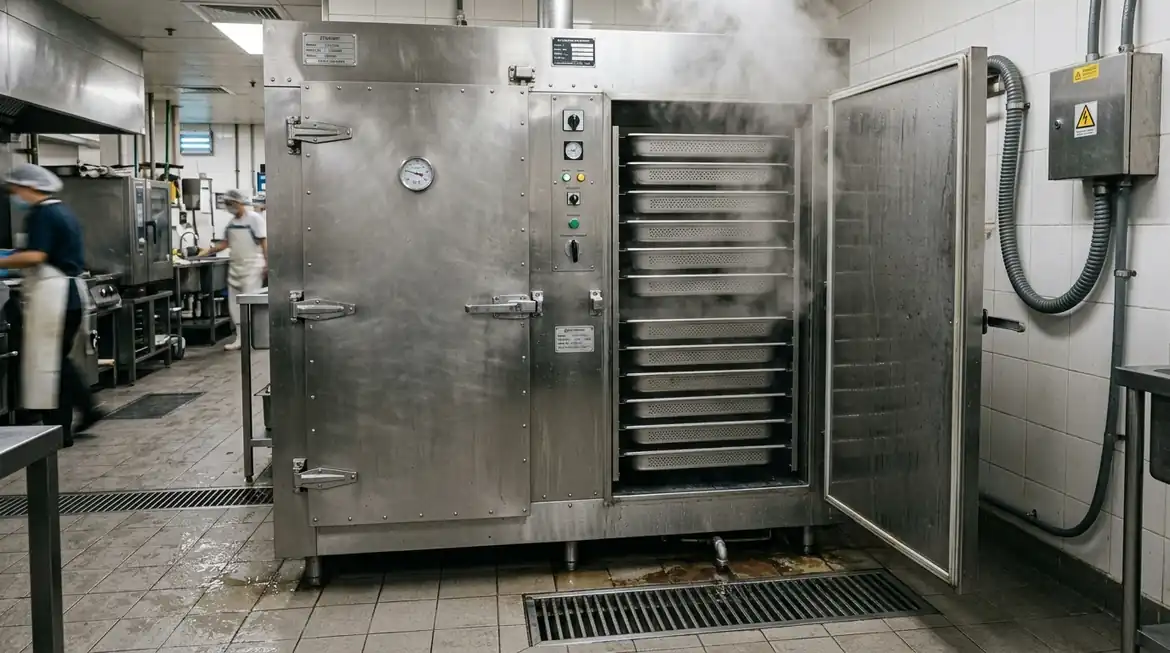
Specific metallurgical and mechanical parameters verified include:
- Austenitic Stainless Grade Verification: Positive Material Identification (PMI) confirms that food contact basins utilize AISI 304 or AISI 316L (molybdenum 2.0%–2.5% for high-salt brine applications) with zero 200-series manganese-rich counterfeit steel.
- Sheet Thickness Gauging: Ultrasonic thickness gauges verify sheet thickness meets contractual specifications (e.g., 1.5mm for heavy-duty worktops, 1.2mm for body panels) without under-gauge sheet rolling fraud.
- Weld Cleanliness & Passivation: Welds are inspected using ferroxyl chemical swab tests to ensure complete pickling and passivation, confirming that zero free iron or weld discoloration remains to initiate pitting corrosion.
3. Electrical Safety, Dielectric Withstand & Control Automation
International export requires strict adherence to destination electrical codes, whether 400V/3Ph/50Hz for Europe, the Middle East, and Asia, or 208V–240V/480V 60Hz for North America. Phase 3 testing enforces rigid dielectric testing:
| Electrical Test | Standard Reference | Applied Voltage & Duration | Acceptance Criteria |
|---|---|---|---|
| Earth Bond Continuity | IEC 60335-1 / UL 197 | 25A AC test current, 60 seconds | Resistance between PE terminal and all exposed metal ≤0.10 Ω |
| Dielectric Withstand (Hi-Pot) | IEC 60335-1 / UL 197 | 1,500V AC (or 1,750V for 480V gear), 60 seconds | Zero dielectric breakdown; leakage current strictly <5.0 mA |
| Insulation Resistance | IEC 60335-1 / EN 60204-1 | 500V DC test potential, 60 seconds | Measured insulation resistance ≥100 MΩ (dry conditions) |
| Emergency Stop & Interlocks | ISO 13849-1 (PL r) / EN 1672-2 | Manual physical trip during 100% full-speed load | Immediate motor cutoff within ≤0.50 seconds; zero automated restart |

4. Dynamic Functional & Thermal Load Performance Run
Operating equipment under no-load conditions fails to reveal thermal bottlenecks or motor overheating. During Phase 4, the equipment runs at 100% continuous rated thermal or motor capacity for a minimum of 4 continuous hours.
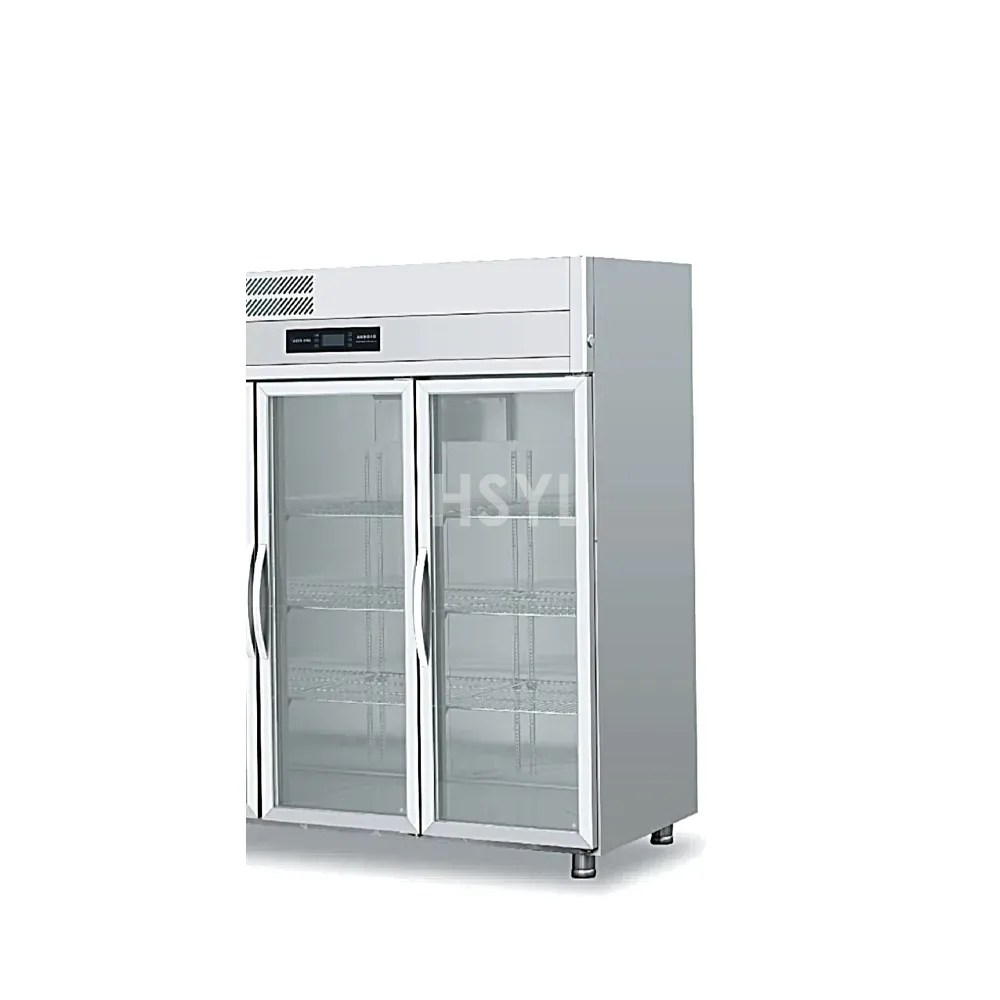
For thermal cooking equipment (combi ovens, steam cookers, fryers), calibrated thermocouple probes log preheat time, recovery time following simulated door openings, and temperature uniformity across all pan levels (variance must not exceed ±2.5°C). For commercial refrigeration units, pull-down testing verifies that storage compartments reach ≤3.3°C (38°F) within specified engineering curves while monitoring compressor case temperatures, evaporator frost distribution, and condensing fan vibration.
5. 5-Year Financial Risk & TCO Payback of Formal FAT Execution
Executing a comprehensive FAT protocol costs approximately $1,500 to $3,500 per major equipment suite, but eliminates catastrophic financial exposures that occur when defective machinery lands on site overseas.
| Risk Exposure Factor | Direct Shipment Without FAT Protocol | Certified FAT Protocol Completed | Financial Savings & Risk Mitigation |
|---|---|---|---|
| On-Site Re-Engineering / Welding | $18,000 – $45,000 (Local mechanical contractor modifications) | $0 (Equipment fits utility rough-ins precisely) | -$35,000 average saving |
| International Air-Freight of Parts | $4,500 – $12,000 (Emergency expedited replacement parts) | $0 (All sub-components verified pre-shipment) | -$8,000 average saving |
| Hotel / Hospital Opening Delay Fines | $50,000 – $250,000 (Liquidated damages for late handover) | $0 (Zero critical path project schedule delays) | -$150,000 critical liability avoidance |
| Electrical Code Violation Red-Tags | $8,000 (Municipal inspection re-test and rework) | $0 (Pre-certified electrical schematics and UL/CE reports) | -$8,000 average saving |
| Total Project Risk Exposure | $80,500 – $315,000 | $2,500 (FAT execution fee) | ROI: >30x to 100x cost recovery |
6. Virtual Witnessed FAT vs. On-Site Inspection Protocols
While on-site client attendance at the manufacturing facility provides direct oversight, modern international procurement frequently leverages high-definition Virtual Witnessed FAT (V-FAT). HSYL deploys multi-camera live streaming (including digital inspection borescope views and screen-shared Fluke thermal imaging dataloggers) enabling international consultants in London, Dubai, or New York to witness every test step in real time. Full high-definition video archives, calibrated instrument calibration certificates (ISO 17025 accredited), and raw Excel data logs are signed off digitally via cryptographic electronic signatures prior to authorizing container loading.
7. Punch-List Management & Non-Conformance Categorization
Deficiencies identified during the FAT are classified into three rigid priority categories:
- Critical (Category A): Electrical safety violations, unapproved sub-component substitutions, structural weld cracks, or thermal performance failure. Shipment is strictly frozen until root cause analysis and re-testing are complete.
- Major (Category B): Dimensional variances within ±5mm, non-functional cosmetic blemishes on non-food zones, or missing spare parts. Rework must be completed and photographic evidence approved within 48 hours.
- Minor (Category C): Labeling adjustments, user manual wording updates, or packaging strapping enhancements. Addressed immediately during export crating.
Engineering Specification Checklist for Turnkey FAT Audits
- Ensure all electrical wiring utilizes flame-retardant halogen-free insulation color-coded to IEC 60446 or NFPA 79 standards with heat-shrink wire ferrules.
- Verify that pressure vessels (steam jackets, boilers) include official ASME Section VIII or EU Pressure Equipment Directive (PED 2014/68/EU) hydrostatic test certificates stamped at 1.5× maximum allowable working pressure (MAWP).
- Confirm that all moving mechanisms include dual safety limit switches and mechanical emergency stops wired to fail-safe safety relays.
- Require export packaging to feature vacuum heat-sealed barrier bags with desiccant packs inside ISPM 15 fumigated solid plywood crates.
Book Your Factory Acceptance Test with HSYL Quality Engineers
Ordering customized commercial kitchen machinery for international hospitality or healthcare projects? HSYL provides comprehensive FAT documentation packages, third-party inspection access (SGS, TÜV, Intertek), and live virtual testing for every order. Contact our international engineering QA division to download our complete FAT template and schedule a factory inspection.