Direct Answer / Key Takeaway: Compare commercial dishwashers vs. three-compartment sinks for health code compliance. Analyze wash-rinse-sanitize sequences, water consumption, and peak labor costs.
When designing commercial warewashing infrastructure within our Hygiene & HACCP Hub, foodservice consultants and health inspection officials frequently evaluate the regulatory boundaries between automated commercial dishwashing machines and manual three-compartment sink systems. Institutional kitchens serving hundreds or thousands of meals daily must maintain verified pathogen destruction while optimizing water usage, utility loads, and labor costs. Under FDA Food Code §4-501 and NSF/ANSI Standard 3, both methods are legally recognized, yet they diverge completely across thermal efficacy, chemical contact kinetics, throughput capacity, and water consumption. This engineering specification report analyzes thermodynamic thermal sanitization versus chemical sanitization, hydraulic sizing requirements, MEP utility rough-ins, and 5-year operating economics.
1. Thermodynamic & Chemical Sanitization Mechanisms
Sanitizing dinnerware, glassware, and cooking utensils requires either thermal thermal destruction of vegetative pathogens or chemical biocidal oxidation. The engineering physics governing each method dictate physical equipment design and operational monitoring.
| Engineering Parameter | High-Temp Commercial Dishwasher | Low-Temp Chemical Dishwasher | Manual 3-Compartment Sink System |
|---|---|---|---|
| Sanitization Mechanism | Thermal lethal heat accumulation (NSF 3 Heat Unit equivalent) | Chemical biocide injection (Sodium hypochlorite / chlorine) | Manual chemical immersion (Quaternary ammonium, chlorine, iodine) |
| Rinse Water Temperature | 82°C – 90°C (180°F – 194°F) via built-in electric booster | 49°C – 60°C (120°F – 140°F) ambient hot water line | Wash: 43°C (110°F); Rinse: 43°C; Sanitize: 24°C–49°C |
| Dwell / Contact Time | 10 – 15 seconds final rinse spray curtain | 60 – 90 seconds continuous chemical bath | Minimum 60 seconds continuous submerged immersion |
| Chemical Concentration | Zero chemical sanitizer required (Rinse aid only) | 50 – 100 PPM free available chlorine | Quat: 200–400 PPM; Chlorine: 50–100 PPM; Iodine: 12.5–25 PPM |
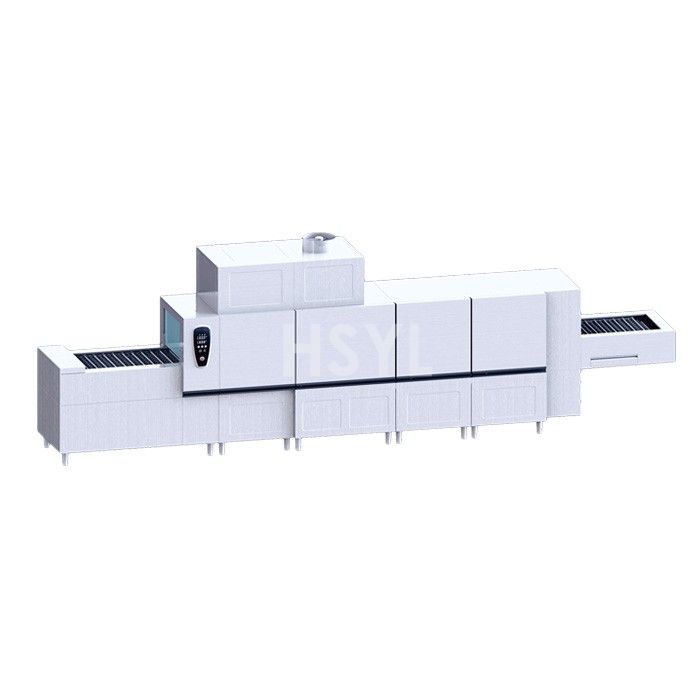
| Throughput Capacity | 60 to 240 racks/hour (1,200 to 4,800 dishes/hr) | 30 to 50 racks/hour (600 to 1,000 dishes/hr) | 15 to 25 equivalent racks/hour (Labor bottlenecked) |
2. Regulatory Compliance: FDA Food Code & NSF/ANSI 3 Standards
Health code compliance under NSF/ANSI 3 requires high-temperature dishwashing machines to deliver a cumulative 3,600 Heat Units (HUE) during the rinse cycle, guaranteeing an equivalent 5-log reduction (99.999% destruction) of microbial pathogens including Salmonella, Listeria, and Escherichia coli. To achieve this in a 10-second rinse cycle, the manifold must spray water at 82°C (180°F) minimum at an operating pressure between 15 and 25 psi (103–172 kPa).
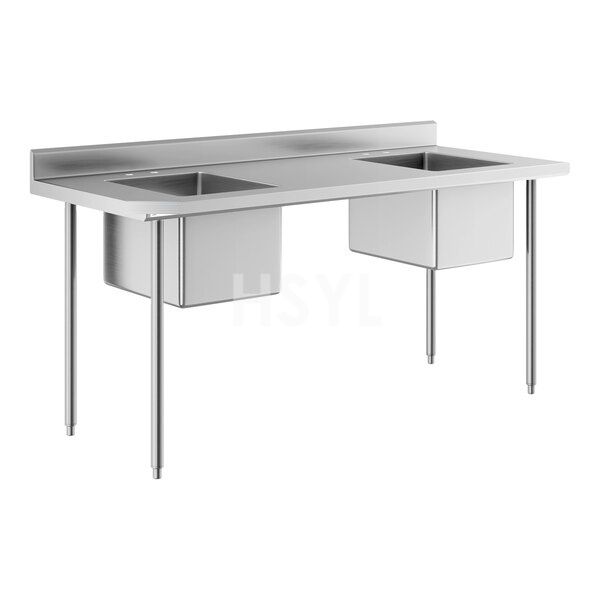
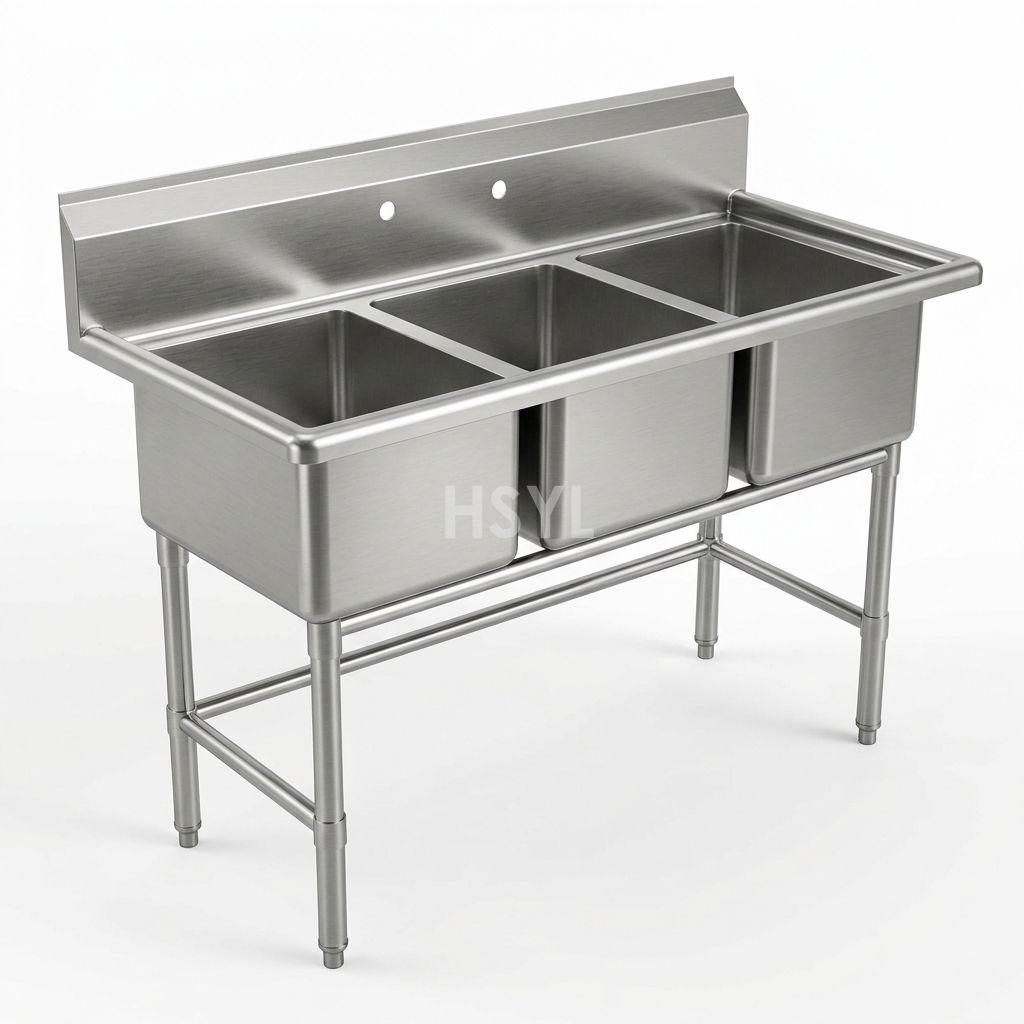
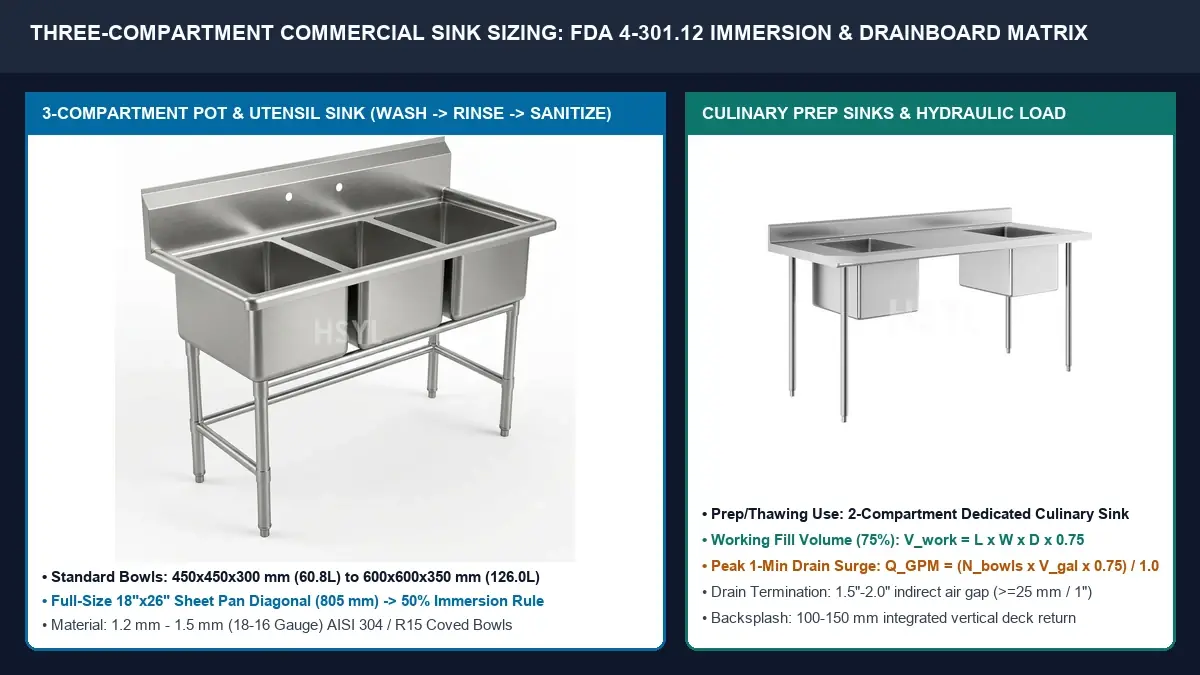
Conversely, manual three-compartment sink systems governed by FDA Food Code §4-301.12 mandate rigid physical geometry: each sink compartment must be large enough to completely submerge the largest pot, pan, or sheet pan utilized in the kitchen (standard 600mm × 600mm × 350mm bowl depth). Staff must manually test chemical sanitizer ppm concentrations every 2 hours using chemical test strips, logging results into physical or digital audit logs. Failure to submerge ware for the full 60 seconds represents the single most common critical health code violation in commercial sculleries.
3. Water, Energy, and Hydraulic MEP Utility Consumption
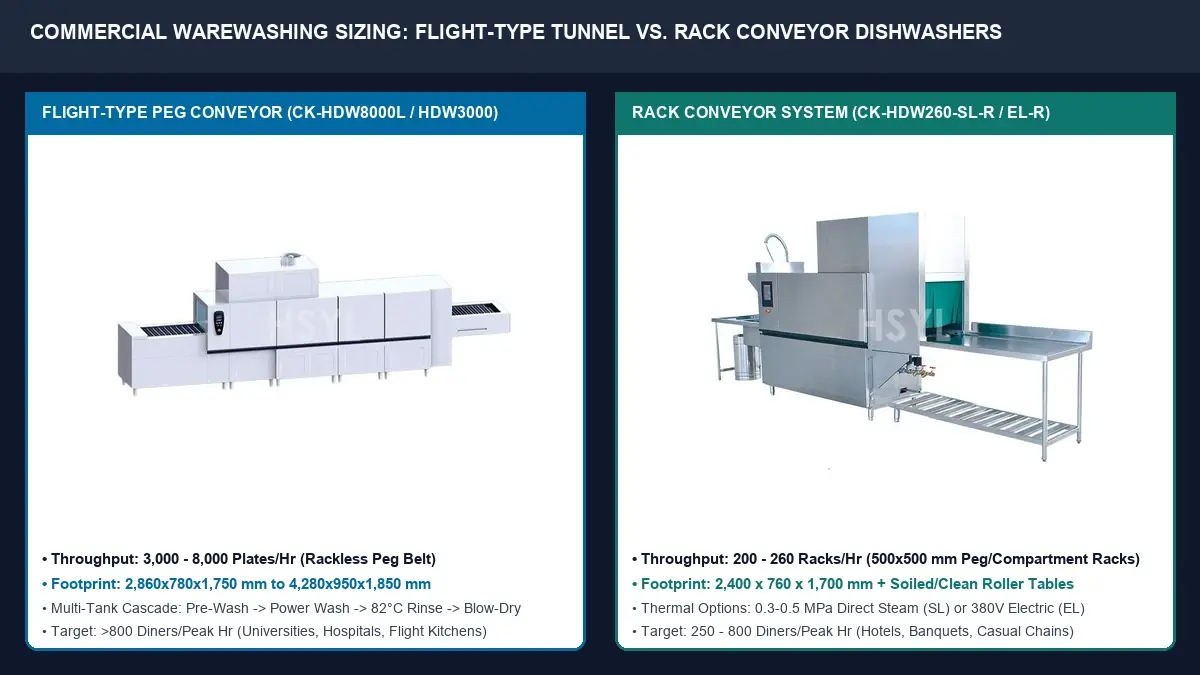
Water and energy conservation mandates dramatically favor automated warewashing over manual sinks. A modern ENERGY STAR qualified high-temperature door-type dishwasher consumes merely 0.70 to 0.89 gallons (2.65 to 3.37 liters) of water per rack of 20 plates. A flight conveyor machine reduces this further to 0.35 gallons per rack.
In contrast, an operator utilizing a manual three-compartment sink with a continuously running pre-rinse spray valve (1.6 GPM / 6.0 LPM) and frequently refilling 40-gallon sink basins consumes an average of 60 to 120 gallons (227 to 454 liters) of hot water per hour of active washing. additionally, manual sinks dump vast volumes of hot water into grease interceptors, often overloading grease traps with emulsified fats unless properly tempered.
4. Operational Workflow & Kitchen Ergonomics: Scullery Layout Architecture
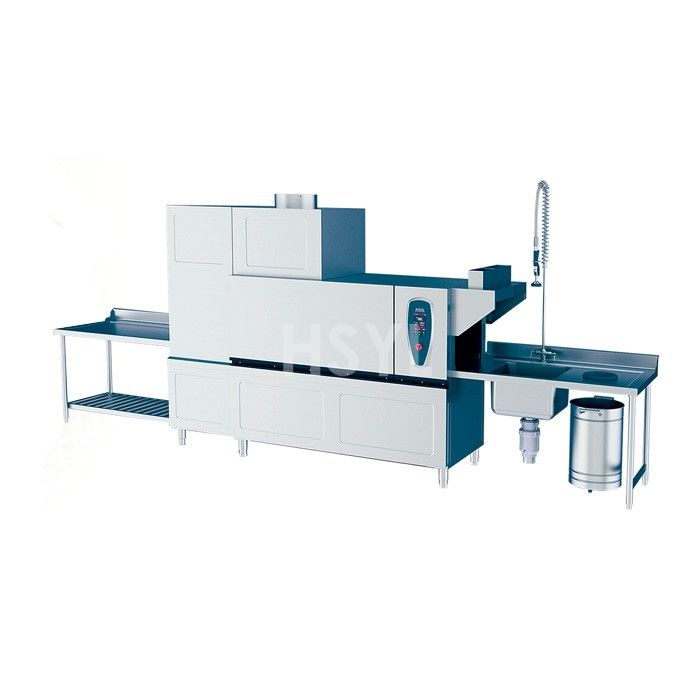
To eliminate labor fatigue and physical ware damage, high-performance dish sculleries implement a distinct linear or corner pass-through topology:
- Scrap & Pre-Wash Station: Soiled wares are scraped into waste bins, then rinsed using a balanced spring-loaded pre-rinse faucet (1.15 GPM high-pressure spray) over an AISI 304 scrap trough with a removable perforated basket.
- Pass-Through Tabling: Soil-side stainless tabling is sloped toward the scrap sink (minimum 1:50 slope). Roller tables feed directly into the dishwasher chamber.
- Clean Dish Landing & Flash-Drying: Exiting wares at 82°C flash-dry within 45–60 seconds due to latent thermal evaporation, requiring zero towel drying (which is strictly illegal under health codes). Clean tables must provide a minimum of three rack lengths of staging buffer.
5. 5-Year Total Cost of Ownership (TCO) & Labor Economics
Although automated dishwashers carry higher upfront capital equipment expenditure, the immense reduction in manual washing labor and water heating utilities pays back the capital investment in under 12 to 18 months.
| 5-Year Operating Cost Category | Manual 3-Compartment Sink Only | High-Temp Pass-Through Dishwasher | 5-Year Financial Variance |
|---|---|---|---|
| Direct Washing Labor (2 Staff vs. 1 Staff) | $42,000 / yr ($210,000 over 5 yrs) | $22,000 / yr ($110,000 over 5 yrs) | -$100,000 (48% labor reduction) |
| Water Supply & Sewer Fees | $6,800 / yr ($34,000 over 5 yrs) | $1,900 / yr ($9,500 over 5 yrs) | -$24,500 (72% water reduction) |
| Water Heating Gas / Electric Utility | $5,400 / yr ($27,000 over 5 yrs) | $2,800 / yr ($14,000 over 5 yrs) | -$13,000 (48% energy reduction) |
| Chemical Sanitizer & Detergent | $2,200 / yr ($11,000 over 5 yrs) | $3,600 / yr ($18,000 over 5 yrs) | +$7,000 (Commercial detergent & rinse aid) |
| Dishware Chipping & Breakage Replacement | $3,500 / yr ($17,500 over 5 yrs) | $1,100 / yr ($5,500 over 5 yrs) | -$12,000 (68% breakage reduction) |
| Total 5-Year Operating Expenditure | $299,500 | $157,000 | Net 5-Year Savings: $142,500 |
6. Mechanical Backup Redundancy Requirements under Health Codes
A critical regulatory reality often overlooked by MEP engineers is that a three-compartment sink is legally mandatory even when a state-of-the-art flight-type dishwasher is installed. Under FDA Food Code §4-301.12, institutional food establishments must maintain a manual warewashing sink as an emergency backup. If municipal power failures, booster heater burnout, or wash pump motor failures disable the mechanical dishwasher, the kitchen must transition instantly to manual three-compartment sanitization without shutting down meal service. additionally, oversized stock pots (100L+), sheet pans, and delicate high-carbon butcher knives cannot be washed in automated machines and must be processed manually.
7. Preventive Maintenance & Booster Heater Descaling
To preserve 82°C sanitizing rinse performance, high-temperature dishwashers require strict water treatment. Feedwater total hardness exceeding 3 grains per gallon (50 ppm CaCO3) precipitates calcium carbonate scale across the 12kW–18kW electric booster heating elements. Scale thickness of just 1.5mm acts as a thermal insulator, increasing electrical energy draw by 15% and causing premature element burnout. Commercial dishwashers must be paired with dedicated automatic water softeners or reverse osmosis systems, coupled with automated weekly acid deliming cycles to dissolve limescale from spray nozzles and rinse manifolds.
Engineering Specification Checklist for Turnkey Sculleries
- Provide dedicated 400V/3Ph/50Hz or 208V/3Ph/60Hz electrical supply (30A–50A breaker) for dish machine and built-in booster heater.
- Install indirect waste lines with minimum 50mm (2-inch) air gap above floor sink rims to prevent sewage back-siphonage.
- Specify Type 2 condensate exhaust canopies over both entry and exit doors of conveyor machines pulling 200–300 CFM per linear foot.
- Ensure manual 3-compartment sinks are equipped with dual drainboards measuring at least the length of one sink compartment bowl.
Discuss Your Commercial Warewashing Scullery Engineering with HSYL
Planning an institutional dishwashing scullery, banquet wash-up area, or central warewashing facility? HSYL manufactures heavy-duty conveyor dishwashers, hood-type machines, and custom AISI 304 three-compartment sinks engineered to pass strict environmental health audits. Contact our commercial scullery engineering department for DWG layout designs and equipment quotations.