Direct Answer / Key Takeaway: Find dishroom workflow bottlenecks using return waves, rack handling, prewash, unloading and clean storage. Compare accepted output across the full cycle.
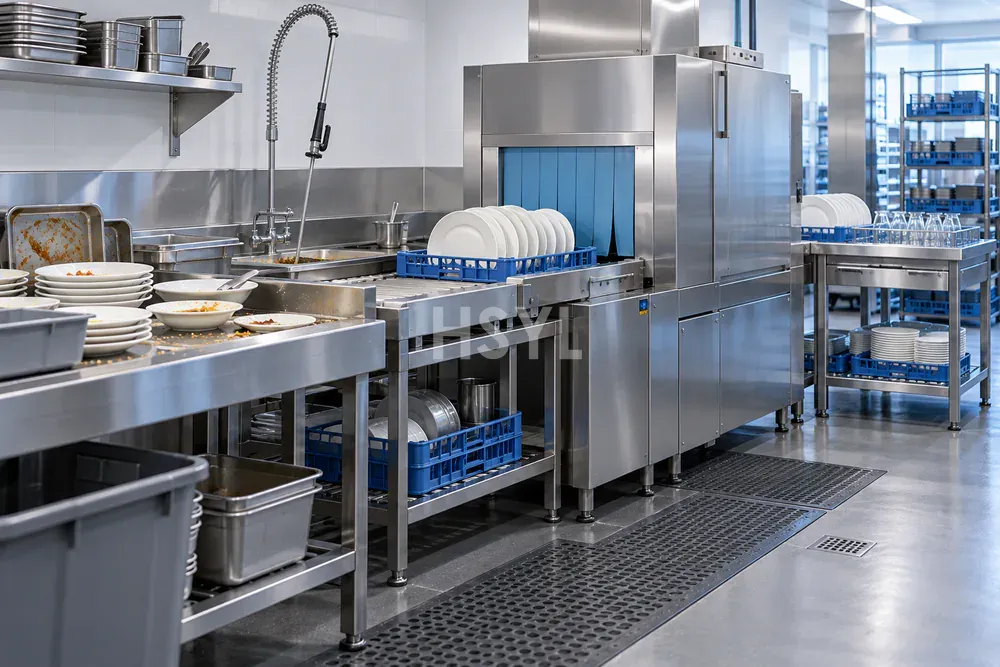
A dishwasher can meet its own operating cycle while the dishroom still falls behind. Trays may arrive in one concentrated wave, racks may be unavailable, unloading may stop the conveyor, or clean items may have nowhere to go. Dishroom workflow bottlenecks belong to the complete return-and-release sequence, not only the washing machine.
Start with the clean, service-ready item as the output boundary. Count what reaches that condition, and retain the rejected or rewashed items in the workload record. This makes the investigation useful for staffing, handling equipment and machine selection.
Map the return wave
Count incoming plates, cups, cutlery, trays and large utensils during the actual peak window. Keep the categories separate because their handling and rack arrangements differ. If the return area receives dining-room items and production pans at the same time, record both streams and where they converge.
A daily covers figure cannot describe the sharpness of that wave. Observe the arrival pattern and starting backlog. Also record the available people and whether they leave the line for waste handling, replenishment or moving clean items to another room.
Follow the rack through its whole route
Trace sorting, approved pre-treatment, rack loading, washing, unloading, inspection and clean storage. Observe how empty racks return to the loading point. A nominally fast machine can become starved of loaded racks or blocked by full unloading space.
Use the exact manufacturer's operating and loading information for the installed machine. The Hobart operator-resource guide is an example of manufacturer material organized around dishroom operation. It does not establish the settings or approved procedures of another brand.
| Position | Time or condition to record | Typical investigation question |
|---|---|---|
| Return and sorting | Arrival wave and sorting interruptions | Are mixed items reaching the next position ready? |
| Pre-treatment | Work duration and queued utensils | Does upstream preparation match the approved process? |
| Loading | Rack availability and loading time | Are suitable racks returning in time? |
| Unloading | Blocked space and inspection time | Can clean items leave without crossing dirty work? |
| Storage | Landing space and onward transfer | Is the clean-release point keeping pace? |
Keep output units consistent
Do not compare incoming plates per minute directly with baskets per hour. Record the rack composition and convert only where that composition is known. Changing from plate racks to mixed cups and utensils may change handling time and useful items per release.
For example, an illustrative 15-minute observation processes 20 identified racks, of which three require another approved wash. Seventeen racks reach the agreed clean-release condition in that observation. Reporting only 80 processed racks per hour equivalent would hide the rejected work; the accepted-window equivalent is 68 racks per hour, subject to the recorded rack mix and starting conditions.
Neither figure is a machine rating. The observation should state whether unloading, inspection and clean transfer were included. Use repeat windows before turning the result into a purchasing requirement.
Change the measured constraint
If the queue grows before sorting, trial a return organization or dedicated sorting role. If loading waits for empty racks, test the rack-return route and available rack stock. If unloading blocks the machine, investigate landing space and clean-item transfer. Choose one defined change rather than replacing several elements and losing the reason for any improvement.
Assess accepted output, rewash, queue age, operator movement and clean/dirty separation together. Faster handling is not useful if it compromises the released sanitation procedure or sends clean items back through dirty work.
Issue a complete wash-area requirement
When another machine or worktable is justified, provide the return wave, rack mix, operator plan, landing space and complete-cycle records. Include utility and access constraints. The existing dishwasher format comparison addresses machine choice; the line study explains how the surrounding dishroom must support that choice.
A balanced dishroom is demonstrated by the complete sequence under the agreed load. A fast isolated washing cycle is only one part of that evidence.