Commercial dishwashers come in three forms, and the form follows how many dishes move through in an hour. Undercounter machines wash one rack at a time for bars and small cafés; hood-type machines lift a hood over a rack for restaurants and canteens; conveyor machines pull a continuous stream of racks for hotels and central kitchens. On the HSYL line the three forms are documented with real throughput — 30 baskets per hour on the compact units, 60 on the hood-type, and 220 to 260 and up on the rack conveyor range — so the choice reduces to a covers-per-hour number, not a catalog browse. The HDW-80 hood-type dishwasher, the HDW-40 glasswasher and the conveyor range anchor the three bands below.
Undercounter: One Rack at a Time for Bars and Cafés
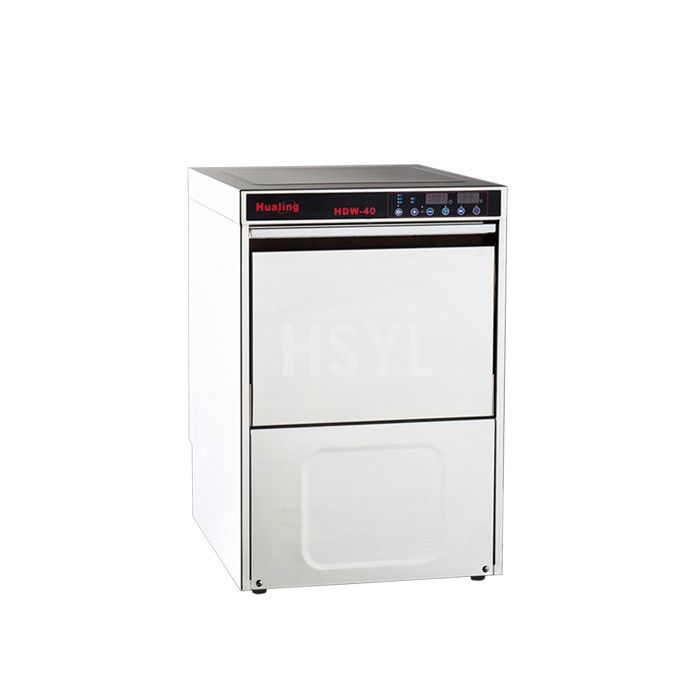
The undercounter tier sits below a counter and washes a single rack per cycle. The HDW-40 is the glass-first version of it — a front-loading unit documented at 30 baskets per hour on a 410 × 380 mm basket, 4.55 kW on a 230 V supply, in a 476 × 550 × 720 mm footprint. That is the machine for a bar, café or small prep area where glassware and light dishware turn over steadily but never pile up, and where the priority is glass clarity without the thermal shock that cracks stemware.
The ceiling of this form is the cycle count, not the rack size: one rack in, one rack out, roughly two minutes per cycle. Once a service starts generating more than a couple of dozen racks in an hour, the operator becomes the bottleneck loading and unloading a single door. That is the signal to move up a form.
Hood-Type: The Restaurant and Canteen Workhorse
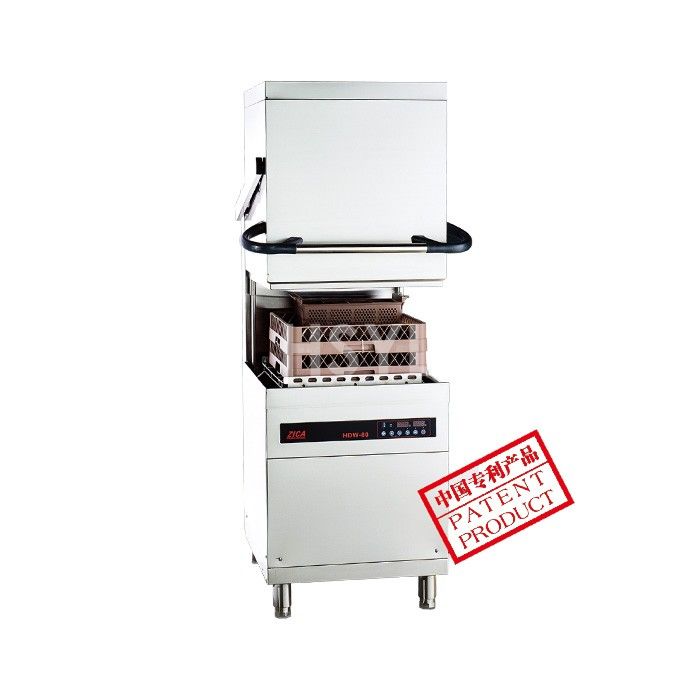
The hood-type machine lifts a hood straight up over a loaded rack and closes it down for the cycle, so the operator never swings a door through an aisle. The HDW-80 is documented at 60 baskets per hour on a 500 × 500 mm basket, 14.75 kW on a 380 V three-phase supply, in an 800 × 820 × 1470 mm frame. Its smaller sibling, the CK-HDW-50, runs the same 500 × 500 mm basket at 30 baskets per hour on a 4.55 kW, 230 V supply — the single-phase option when the building has no three-phase to spare.
This is the form for the mid-volume band: a full-service restaurant, a staff canteen or a hotel restaurant where the dishroom runs continuously through service but does not need a belt. The hood's vertical lift keeps the loading motion short, and the pass-through layout lets the dishroom run dirty-in on one side and clean-out on the other without operators crossing paths.
Rack Conveyor: Continuous Washing for Hotels and Central Kitchens
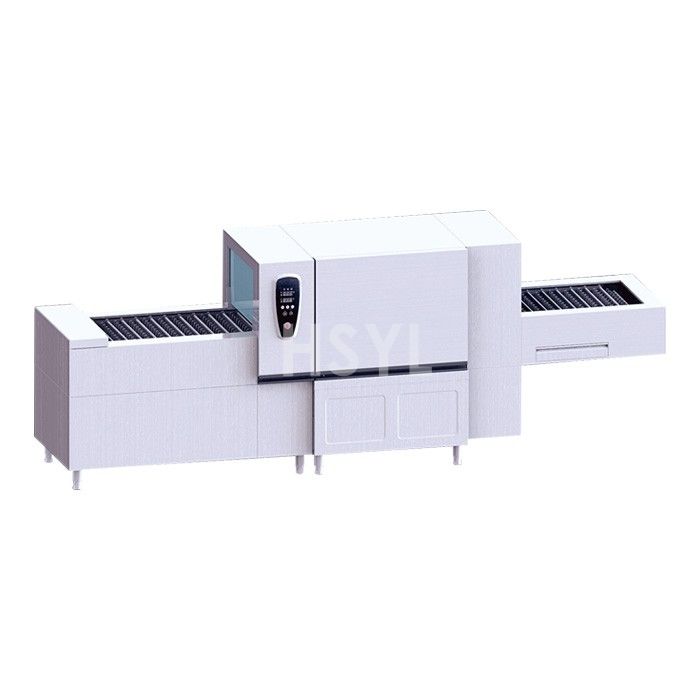
Conveyor machines move racks through wash and rinse zones on a belt, so loading never waits for a cycle to finish. On the HSYL line the band starts at the HDW220 at 220 baskets per hour and steps to the HDW260 at 260, with the HDW3000 and HDW8000L carrying their throughput in the model code for the largest institutional duty. These belong in hotels, university and hospital canteens, and central kitchens where the dishroom clears hundreds of covers in a sitting and the labour saving from a belt outweighs the larger footprint and utility draw.
One honesty note for the largest units: the HDW3000 and HDW8000L specification tables are published with throughput in the product code and the remaining fields on the quotation sheet, so treat the top of the range as configured-to-order rather than off-the-shelf. The exact dimensions, rinse-water draw and electrical load are confirmed against the product code at quotation time.
Size It: Covers to Racks per Hour
The type decision should fall out of a number, not a preference. Take your peak covers per hour, multiply by the items each cover produces — plates, sides, cutlery, prep bowls, typically 4 to 6 pieces — then divide by how many pieces fit a rack. A standard 500 × 500 mm rack holds roughly 18 to 25 full-size plates, so a restaurant doing 120 covers in a peak hour at 5 items each generates about 600 pieces, or 24 to 33 racks in that hour. Add a 25 percent buffer for the unpredictable rush, and the answer sits comfortably in hood-type territory rather than undercounter.
Run the same arithmetic and the bands line up: under 30 racks an hour stays undercounter, 30 to 80 sits in hood-type, and over roughly 150 racks an hour is where the conveyor starts paying for itself. The commercial dishwasher capacity guide works the full calculation through step by step; use this section to pick the form and that guide to confirm the number.
Why the Basket Interface Matters More Than the Brand
Every model in this range — from the 30-basket compact units to the 260-basket rack conveyor — runs a 500 × 500 mm basket (the HDW-40 glasswasher uses a narrower 410 × 380 mm glass basket by design). A single basket interface across the line means the dishroom's racks, pre-scrap stations and pass-through tabling do not have to change when volume grows and you step up a form. That is the hidden cost of mixing brands: it is not the machine price, it is re-fitting the whole warehandling loop around a different basket. Pick a form now, keep the basket, and the upgrade path stays clean.
Conveyor Heating: Electric or Steam
At the conveyor tier, the second decision is how the machine heats its wash and final rinse. The HDW260 comes in two documented versions of the same frame — the HDW260-SL-R steam-heated at 10 kW of electrical load plus 70 kg/h of steam, and the HDW260-EL-R electric-heated at 45 kW with no steam demand. The choice is a site question: a kitchen with an existing steam boiler feeds the machine for a fraction of the electrical load, while an all-electric site simply carries the 45 kW on the board. Same 260 baskets per hour either way. The full steam-versus-electric trade-off is covered in its own guide.
Three Forms Side by Side
| Form | Model | Baskets per Hour | Basket | Power | Fits |
|---|---|---|---|---|---|
| Undercounter / glasswasher | HDW-40 | 30 | 410 × 380 mm | 4.55 kW, 230 V | Bars, cafés, prep areas |
| Hood-type | CK-HDW-50 | 30 | 500 × 500 mm | 4.55 kW, 230 V | Small restaurants, single-phase sites |
| Hood-type | HDW-80 | 60 | 500 × 500 mm | 14.75 kW, 380 V | Restaurants, canteens |
| Rack conveyor | HDW220 | 220 | 500 × 500 mm | 41 kW, 380 V | Hotels, institutional |
| Rack conveyor | HDW260-EL-R | 260 | 500 × 500 mm | 45 kW, 380 V | High-volume electric sites |
| Rack conveyor | HDW260-SL-R | 260 | 500 × 500 mm | 10 kW + 70 kg/h steam | High-volume steam sites |
| Rack conveyor | HDW3000 / HDW8000L | By product code | 500 × 500 mm | Confirmed on spec sheet | Central kitchens, banquets |
The full dishwashing lineup sits under commercial dishwashing equipment. Where a field is confirmed on the specification sheet, that is the page's own stated practice for the configured-to-order units.
Related Equipment & Systems
The machine is only half the dishroom. Wash quality depends on the incoming water as much as the machine — the commercial dishwasher water quality guide covers hardness, filtration and the rinse results those protect. And once the type is set, the sanitizing-temperature question — high-temp versus chemical — decides the final rinse configuration; that is the next decision down the line.