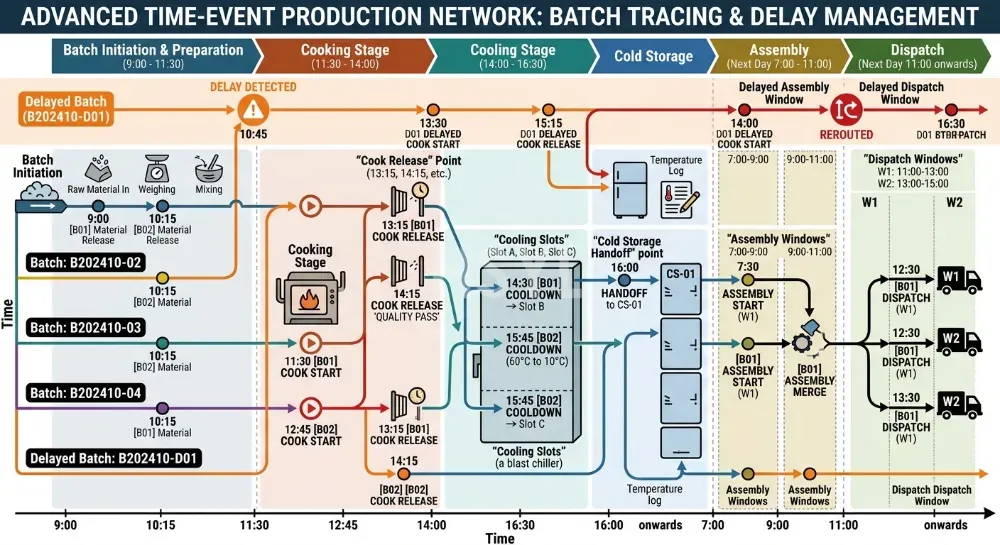
Cook-chill scheduling is not a list of cooking start times. Every batch changes status as it leaves cooking, is divided or packaged, enters cooling, reaches an approved release condition, occupies chilled storage, enters assembly and leaves for dispatch. If one stage is late, downstream time and capacity must be recalculated rather than hidden.
Represent each batch as a chain of controlled events
Give every batch an identity and planned quantity. Then record the required events: preparation release, cooking start and approved endpoint, transfer start, portioning/packaging where applicable, cooling start, intermediate checks required by the plan, cooling completion/release, storage location, assembly or regeneration handoff, load-out and destination receipt.
Batch status: planned → in process → awaiting controlled step → released → held → dispatched
Exception status: delayed / held for review / diverted / rejected
The food-safety lead must define time/temperature and other release limits from the applicable law and validated food-safety plan. The FDA Food Code 2022, for example, is a U.S. model used by adopting jurisdictions; its cooling provisions are not a universal rule for every country, process or packaged product.
Schedule the constrained step from concurrent load
Cooling equipment is often scheduled by total daily output, which ignores overlap. Draw every batch across the clock and identify what must occupy cooling positions at the same time. Include rack or container format, product depth, starting condition, loading/unloading and the approved cooling method.
If two batches need the same slot, do not resolve the conflict by assuming faster cooling. Options may include changing upstream batch timing or size, using another validated method, reallocating compatible equipment, changing containerisation, or revising dispatch. Each option needs food-safety and operational approval.
Use the live blast-chiller sizing guide to calculate and test concurrent cooling duty. The schedule then reserves the proven positions and includes loading, release and cleaning—not only the active cooling interval.
Connect released storage to dispatch
Protect cold storage from invisible overlap
Cooled batches may coexist with ingredients, next-day production, retained samples, returns or quarantined stock. Build a time-based storage-position schedule using actual containers or racks. Show segregation, airflow and access rules defined by the operator. A cabinet’s nominal volume does not demonstrate that the correct batch can be stored and retrieved without obstructing another.
Link each release to label and traceability data: batch identity, status, relevant times, storage assignment, use-by or other control determined by the food-safety plan, destination and dispatch unit. Prevent an unreleased batch from entering the same visual workflow as released stock.
Plan dispatch backward, then test the forward sequence
Start from vehicle departure and destination receipt. Work backward through load checking, staging, assembly, storage retrieval and production release. Then run the schedule forward to expose labour and space conflicts: Who moves the rack? Where does it wait? Can cleaning occur before the next batch? Is the route available during another shift’s receiving?
| If this event slips | Do not automatically | Decision required |
|---|---|---|
| Cooking release | Compress the controlled cooling window | Replan batch, cooling slot and dispatch under the food-safety plan |
| Cooling slot | Leave product in an undefined queue | Use an approved alternative, hold for decision or stop upstream release |
| Cold-store space | Overfill or block airflow/access | Allocate verified positions or change production/dispatch |
| Vehicle departure | Erase status or traceability checks | Apply documented late-dispatch and destination communication rules |
For a ground-based flight kitchen, use each departure wave and required kitchen release time to check overlap between cooking, chilling, tray assembly and cart loading. The airline catering equipment planning guide brings these requirements into one equipment brief and identifies specialist cart and airport interfaces that need separate scope confirmation.
Run a schedule challenge before go-live
Test a representative high-load day and one failure scenario. Use actual batch and container formats where possible. Record handoff times, queue duration, equipment occupancy, storage positions, staff movement, monitoring, label/status control and cleaning. Challenge a delayed batch, equipment unavailable condition or rejected reading and observe whether the team follows the approved exception path.
Keep the approved schedule with assumptions, capacities, named release authorities and contingency. Review it after menu, batch size, packaging, staffing, equipment, route or destination changes. The central-kitchen planning resource hub connects the schedule to facility capacity, while the commercial refrigeration category is relevant only after the cooling and holding duties are separately defined.