A commercial combi oven is not selected by asking how many meals it serves. The decisive question is whether the proposed oven configuration can complete the buyer's most demanding combination of batches—using the real pans, loading method, cooking profiles, cleaning windows and site utilities—without creating an unplanned production conflict.
Write the Oven Job List Before Comparing Machines
Begin with the jobs the oven must perform during the peak production window. Record each product, batch mass or portion count, pan or rack format, loading depth, starting condition, target result, preheat requirement, cooking profile, unloading work, cleaning or allergen changeover and latest completion time. Separate a required job from a feature that may be convenient but is not necessary.
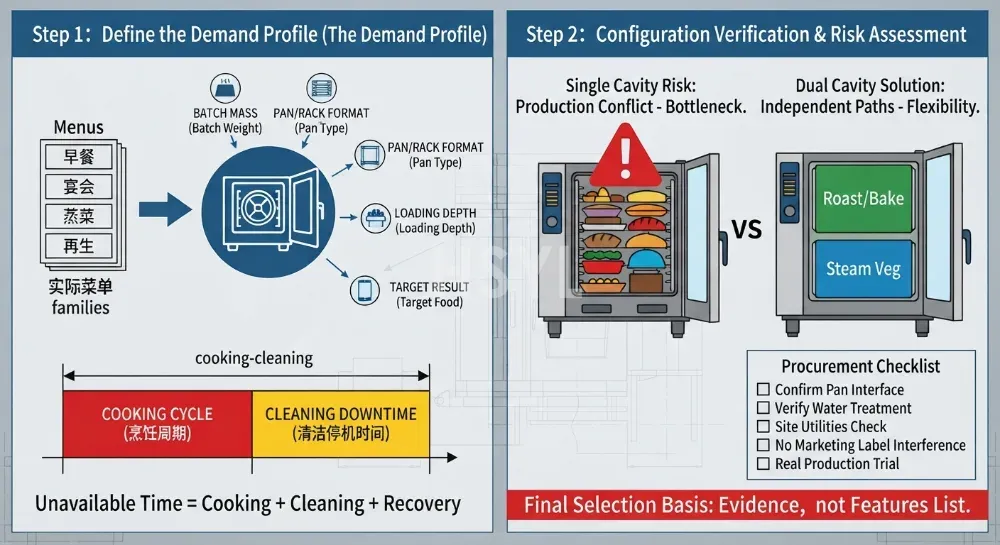
Do not combine every daily menu item into one average. A breakfast bake, banquet roast, steamed vegetable batch and regeneration wave may compete for the same cavity even if the total daily volume looks modest. The schedule must show which jobs overlap and which can be moved without changing service quality, food-safety controls or labor availability.
| Job field | Why it matters | Evidence to prepare |
|---|---|---|
| Product and target result | Determines whether steam, convection or a controlled combination is relevant | Recipe specification and accepted finished-product criteria |
| Usable batch load | Defines the real quantity per run rather than a nominal cavity size | Product mass, portions, pan fill and spacing |
| Time occupation | Shows how long the cavity is unavailable to other work | Preheat, load, cook, unload and recovery observations |
| Changeover | Reveals cleaning, allergen or flavor-transfer constraints | Approved sanitation and production sequence |
| Completion deadline | Connects cooking to holding, chilling, plating or dispatch | Service-wave or process timeline |
Turn Pan Capacity into a Time-Occupation Chart
A stated number of pan positions is a geometric starting point, not a production guarantee. Usable loading may be limited by food depth, spacing, airflow, steam contact, rack design, pan material, lid use and the product's effect on heat and moisture transfer. Some products can share a cooking profile; others cannot. Treat every proposed batch as a time block occupying a defined part of the cavity.
For each batch, calculate:
cavity occupation = preheat or mode transition + loading + cooking + unloading + required recovery or changeover
Plot those blocks against the production deadline. If two incompatible batches need the same cavity at the same time, the answer is not automatically a larger single oven. Options may include recipe resequencing, different pan loading, an earlier production start, two independent cavities, a separate specialist appliance or a change to the holding/chilling plan. Each option changes labor, utilities and resilience.
Confirm the complete pan and rack interface through the GN pan size guide. A “GN 1/1” description does not by itself confirm pan depth, flange support, rack pitch, lid clearance, trolley compatibility or the usable product load.
Decide Whether One Cavity Can Carry the Menu Risk
One versatile cavity can simplify the equipment lineup, but it also creates a shared bottleneck. Review what happens when a batch runs long, a recipe needs correction, cleaning starts late or the oven is unavailable. A second cavity can provide parallel production or operational fallback, yet it adds footprint, connected services, cleaning demand and maintenance responsibility. The decision should come from the production consequence, not from a generic preference for one large unit or two small units.
- Favor independent production paths when incompatible profiles overlap, one menu stream cannot wait for another, or a single failure would stop a critical service.
- Favor shared capacity when batches can genuinely be sequenced, the operating team can manage changeovers, and the risk of delay is acceptable and documented.
- Test roll-in or trolley handling when fast batch exchange matters; include trolley parking, floor transitions, hot movement and washing arrangements.
- Keep specialist processes separate when the required result, throughput or contamination control cannot be demonstrated in the proposed combi process.
The result is an oven allocation plan: which menu families use the combi oven, which use another appliance, when each batch enters, and what the recovery plan is after delay or failure.
Treat Cooking Modes as Controlled Processes, Not Marketing Labels
Steam, convection and combined modes can support different product results, but the name of a mode does not prove uniformity, yield, browning, texture, food-safety performance or cycle time. Those outcomes depend on the product, load, pan arrangement, initial condition, setpoints, sensor method, door openings and control logic. Ask the supplier to state what the selected configuration controls and what the operator must define.
Separate recipe repeatability from recipe ownership. A programmable controller can store settings, but the buyer still needs an approved process, trained loading practice and a verification method. Where a probe is used, define placement and product suitability. Where humidity or moisture control is important, define the finished-product acceptance criteria rather than accepting a descriptive setting name.
Check Utilities Against the Selected Operating Modes
Confirm the exact configuration before coordinating voltage, phase, gas type, water, treatment, drain, exhaust, heat rejection and controls. Requirements can change with energy source, steam-generation method, capacity, cleaning system and selected options. The connection schedule should state source document and revision, not just a copied value.
Water quality can affect steam generation, scale formation, cleaning and maintenance. Request the permitted water range and the supplier's treatment basis, then compare it with an actual site analysis. Define who supplies treatment, filters, isolation, drain connection and commissioning consumables. Do not promise a maintenance interval until the water, use pattern and selected system are known.
Ventilation and fire requirements depend on the equipment, cooking duty, listing or approval basis and destination rules. Coordinate the final appliance under the responsible hood and MEP design. Use the commercial cooking equipment category for product discovery only after the operating duty and available services are recorded.
Include Cleaning Time in Capacity, Labor and Utility Decisions
An oven is unavailable while it is being cooled, cleaned, inspected or released for the next duty. Put that interval on the same occupation chart as cooking. Review soil load, allergen policy, cleaning chemistry, water and drainage requirements, chemical storage, operator exposure, overnight scheduling and the action after an interrupted cleaning cycle.
Ask the proposed supplier to demonstrate access to racks, seals, drains, probes and removable parts. Confirm daily and periodic tasks, required consumables and safe isolation. A short automatic program does not prove the cavity is suitable for the buyer's next product; the sanitation method and release criterion belong to the operator's food-safety system.
Compare Energy and Water Claims Only on a Common Test Basis
Do not compare a catalogue maximum input, an idle rate and an annual energy estimate as though they were the same metric. The current ENERGY STAR commercial oven criteria use defined test metrics for eligible products, including cooking-energy efficiency, idle-energy rate and water consumption for relevant modes. That framework demonstrates why the test boundary matters; it does not prove that an unlisted model is certified or that a certified model will produce the buyer's menu at a predicted annual cost.
For a procurement comparison, require each bidder to use the same declared menu jobs, loads, operating hours, utility tariffs and cleaning assumptions. Mark manufacturer-rated data, certified data, witnessed trial data and calculation assumptions separately. If no comparable evidence exists, leave the lifecycle estimate open rather than manufacturing a saving percentage.
Run a Representative Production Trial Before Freezing the Selection
The most useful trial uses the buyer's difficult products and real interfaces. Freeze the candidate model and software revision. Record product identity, starting temperature or condition, pan type, load, rack position, recipe settings, preheat, door openings, cycle time, finished-product result and utility observations relevant to the decision. Test the proposed maximum usable batch and a challenging partial load if both matter operationally.
Do not rely on a showroom demonstration using an easier product or an undisclosed preparation method. Agree acceptance before the trial: food-safety result, doneness, color or texture method, weight or yield measurement if required, temperature distribution, repeatability, operator handling and cleaning turnaround. Preserve raw records and deviations. A single attractive tray is not evidence of the complete production schedule.
Freeze the Selection Only When the Evidence Travels with It
The final brief should include the oven job list, occupation chart, required production deadlines, pan and trolley interfaces, proposed cavity strategy, utilities, water analysis, ventilation basis, cleaning method, destination requirements, required documents and witnessed-trial protocol. Ask bidders to return a compliant configuration, exceptions, required options and open assumptions in the same order.
Then connect the selected oven to the wider kitchen equipment schedule and FAT process. The page has done its job when the buyer can explain why the proposed configuration fits the menu and how that fit will be verified—not when it produces the longest feature list.