Direct Answer / Key Takeaway: Build a commercial kitchen critical spare parts list using production impact, approved part identity, replenishment time, storage conditions and service access.
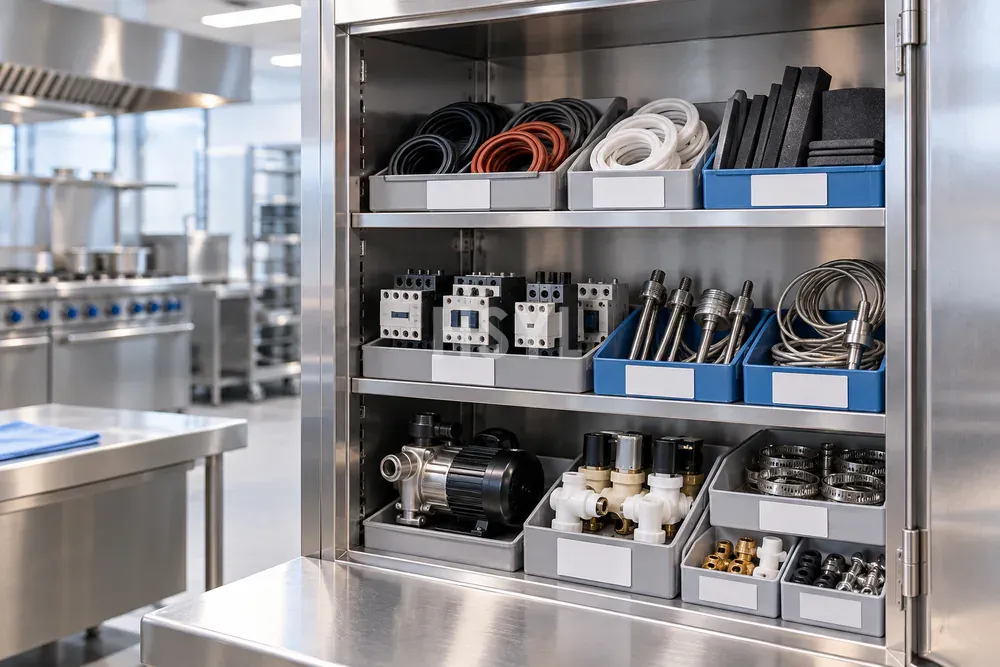
A commercial kitchen critical spare parts list should begin with the production consequence of an equipment outage. Stocking every inexpensive part can consume storage while leaving the kitchen unprepared for one component that stops its only usable cooking or washing route. Price is useful information, but it is not a complete criticality measure.
Review the equipment that supports each service window, identify the approved restoration route and confirm which parts belong to that route. The objective is a documented stocking decision for the actual kitchen, not a universal list of components for every appliance.
Describe the consequence before selecting stock
For each asset, record what becomes unavailable if it stops, which menu or process can continue elsewhere, and how long that alternative remains practical. An appliance used for one replaceable menu item may have a different priority from equipment required by several production steps.
Do not confuse duplicate equipment with a usable backup. Confirm its available capacity, connections, staffing and process suitability during the same service window. If the alternative depends on equipment already fully occupied, record that limitation in the spare parts decision.
Link a part to a specific restoration task
| Decision field | Evidence needed | Why it changes the decision |
|---|---|---|
| Affected operation | Equipment role and service window | Identifies the production consequence |
| Approved part identity | Model, serial range, part number and revision confirmation | Prevents stocking an incompatible component |
| Restoration method | Diagnosis and authorized replacement procedure | A part alone may not restore operation |
| Replenishment time | Current supplier and transport information | Defines the period the kitchen must cover |
| Storage requirements | Manufacturer handling and shelf-life information where applicable | Determines whether stock remains usable |
| Responsible person | Inventory owner and service contact | Makes the plan executable during an outage |
Confirm compatibility in writing before buying. A component's appearance, connector shape or familiar description is not a sufficient substitute for the supplier's approved part identification.
Use replenishment time carefully
Record what the quoted lead time actually covers. Supplier availability, order processing, international transport, receiving inspection and technician attendance may be separate stages. Date the information and note whether the item is reserved, stocked locally or only available to order.
As a hypothetical planning example, assume supplier processing takes five working days and shipment plus receiving takes four more. The combined planning period is nine working days before any separately scheduled service visit. This arithmetic is not an HSYL delivery commitment; the real decision requires current information for the selected part and destination.
A stocked part can shorten only the stages it replaces. If fault diagnosis, access or qualified service availability remains unresolved, holding the component will not guarantee a faster return to production.
Separate consumables, repair parts and strategic spares
Consumables follow usage and approved replacement requirements. Repair parts support a defined fault and service method. Strategic spares are held because the consequence of waiting justifies their storage and cost. Keep these reasons visible so that routine purchasing does not gradually become an unexplained collection of obsolete parts.
For parts shared across several assets, verify the exact commonality. Similar model families can contain different configurations or revisions. A shared stock item needs a record of the specific equipment identities it supports, not merely a broad appliance category.
Maintain the stock after the purchase
Record receipt, storage location, issue date and the asset receiving the component. Preserve labels and approved protective packaging. Follow the supplier's storage requirements rather than assuming that an unused electronic or mechanical part remains suitable indefinitely.
Review the list when equipment is replaced, a component is superseded, the menu changes or supplier availability shifts. Reconcile removed stock with the updated decision. An outdated inventory can look complete while supporting equipment that is no longer installed.
Send the asset identity and proposed part list through the spare parts support route for model-specific confirmation. Keep that confirmation with the inventory record so the next purchase and service decision use the same evidence.