Direct Answer / Key Takeaway: Guide to EU Ecodesign and MEPS commercial refrigeration regulations. Understand Energy Efficiency Index (EEI), energy labels, and Class 5 testing.
When engineering commercial refrigeration packages within our Hygiene & HACCP Hub for export to the European Union and the United Kingdom, mechanical contractors and procurement managers face strict environmental mandates. Commercial storage cabinets, refrigerated counters, and blast chillers operate 24 hours a day, 365 days a year, consuming substantial electrical energy in institutional kitchens. Under European Ecodesign Regulation (EU) 2015/1095 and Energy Labelling Regulation (EU) 2015/1094, commercial refrigerated storage cabinets must meet rigorous Minimum Energy Performance Standards (MEPS) and display transparent energy efficiency ratings. Placing non-compliant refrigeration units on the European market is illegal, exposing importers to heavy fines, customs confiscation, and mandatory product recalls under the European Product Registry for Energy Labelling (EPREL). This technical specification manual details EU MEPS energy calculation formulas, Climate Class testing, eco-refrigerant transitions (GWP <150), and 5-year lifecycle operating cost optimization.
1. The EU Regulatory Architecture: Ecodesign & Energy Labelling
The European Union regulates commercial refrigeration through two interlocking legislative directives designed to eliminate energy-inefficient appliances from the market.
| Regulatory Framework | Governing Directives | Primary Scope & Legal Mandate | Enforcement Mechanism |
|---|---|---|---|
| EU Ecodesign (MEPS) | Regulation (EU) 2015/1095 & Directive 2009/125/EC | Sets hard maximum energy consumption limits; bans inefficient Class G cabinets entirely | National market surveillance authorities; customs border import blocks |
| EU Energy Labelling | Regulation (EU) 2015/1094 & Framework (EU) 2017/1369 | Mandatory A to G energy label display on all marketing, datasheets, and physical cabinets | EPREL database registration; QR code direct access to official test datasheets |
| EU F-Gas Regulation | Regulation (EU) 2024/573 (Updated 2024 F-Gas Rule) | Bans fluorinated refrigerants with GWP ≥150 in hermetically sealed commercial units | Mandatory transition to natural hydrocarbons (R290 propane, R600a isobutane) |
| UK Ecodesign Equivalency | Energy Information (Amendment) (EU Exit) Regs | UK MEPS aligned with EU standards; requires separate UK EPREL/DoC filing | Office for Product Safety and Standards (OPSS) enforcement |
2. Climate Class Testing Mandates: Standard vs. Heavy-Duty Kitchens
Unlike domestic refrigerators tested in cool 20°C environments, commercial refrigeration operates in brutal commercial cookline environments with high ambient temperatures and door opening frequencies. EN 16855-1 and EN ISO 22041 establish strict testing climate classes.
| Climate Class Designation | Ambient Chamber Temp | Relative Humidity (% RH) | Dew Point Temperature | Operational Kitchen Suitability |
|---|---|---|---|---|
| Climate Class 3 (Normal Duty) | 25°C (77°F) | 60% RH | 16.7°C | Front-of-house bars, serveries, air-conditioned dining halls |
| Climate Class 4 (Standard Commercial) | 30°C (86°F) | 55% RH | 20.0°C | Standard preparation kitchens, cold pantry areas |
| Climate Class 5 (Heavy-Duty Professional) | 40°C (104°F) | 40% RH | 23.9°C | Heavy-duty cooklines, adjacent to combi ovens and deep fryers |
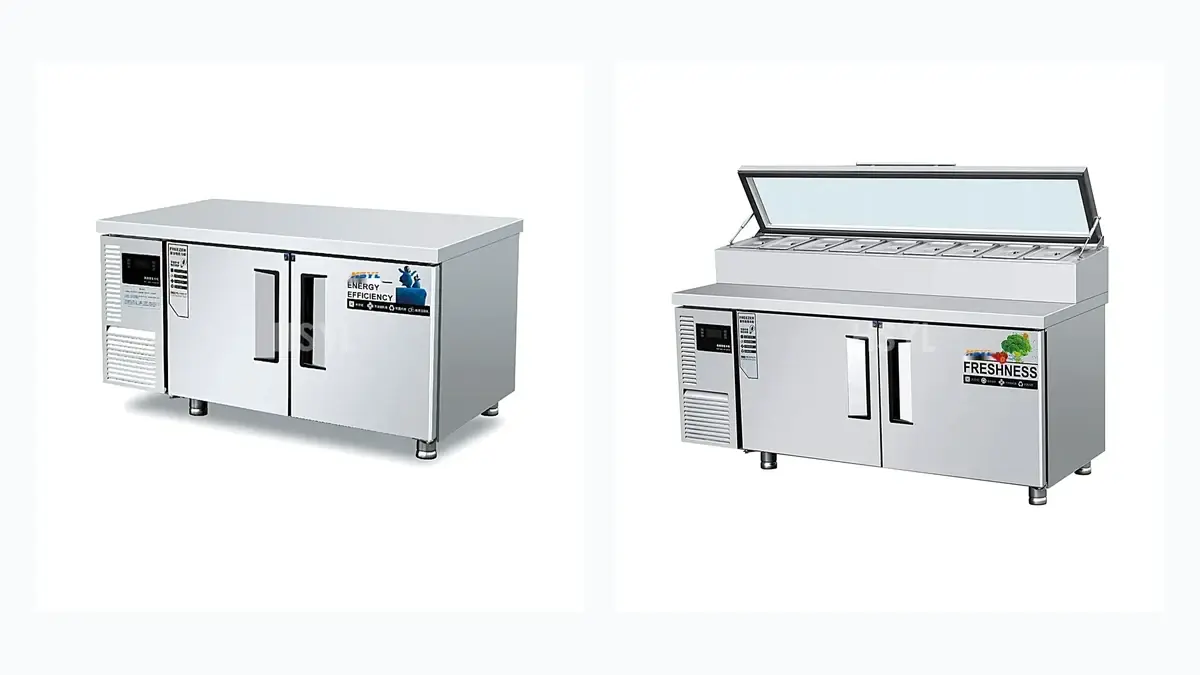
Under EU MEPS, commercial refrigerators must maintain internal temperature categories: M1 (-1°C to +5°C) or L1 (-15°C to -18°C) while undergoing continuous cyclic door-opening testing (every 30 seconds for 6 hours) inside climate-controlled testing chambers.
3. Energy Efficiency Index (EEI) Calculation Mathematics
The Energy Efficiency Index (EEI) determines whether a refrigeration cabinet qualifies for market entry and dictates its official Energy Class (A through G). The formula is defined under Regulation (EU) 2015/1094:
EEI = (AEC / SAEC) × 100
Where:
- AEC (Annual Energy Consumption): Actual measured electrical consumption in kWh/year based on 24-hour EN 16855-1 laboratory testing multiplied by 365.
- SAEC (Standard Annual Energy Consumption): The theoretical baseline energy consumption of a standard reference cabinet with identical net internal volume (Vn), calculated via regression coefficients: SAEC = M × Vn + N.
| Energy Efficiency Class | Energy Efficiency Index (EEI) Range | Market Status under EU Ecodesign MEPS |
|---|---|---|
| Class A (Elite High-Efficiency) | EEI < 25 | Top-tier market performance; qualifies for EU green subsidies |
| Class B (High-Efficiency) | 25 ≤ EEI < 35 | Standard premium commercial specification |
| Class C (Standard Commercial) | 35 ≤ EEI < 50 | Compliant standard commercial specification |
| Class D / Class E | 50 ≤ EEI < 85 | Entry-level compliance; restricted in government tenders |
| Class F / Class G | EEI ≥ 85 | BANNED: Prohibited from entry into the European Union |
4. Engineering Hardware for Class A / B Energy Ratings
Achieving Class A or Class B ratings under EU MEPS requires precise thermodynamic engineering and premium component integration:
- Natural Hydrocarbon Refrigerants (R290 Propane): R290 possesses zero Ozone Depletion Potential (ODP = 0) and a Global Warming Potential of just 3 (GWP = 3), compared to legacy R404A (GWP = 3,922). additionally, R290 exhibits superior thermodynamic latent heat of vaporization, reducing compressor power draw by 18%–25%.
- Variable-Speed Inverter Compressors: Utilizing Embraco FullMotion or Secop variable-speed hermetic compressors that modulate displacement frequency (1,500 to 4,500 RPM) to match real-time cooling loads, eliminating on-off cycling energy losses.
- High-Density Cyclopentane Thermal Insulation: Polyurethane insulation foam blown with cyclopentane blowing agents, providing minimum 70mm to 85mm wall thickness with high thermal resistance (lambda value ≤0.022 W/m·K).
- EC Evaporator & Condenser Fan Motors: Replacing legacy shaded-pole fan motors (efficiency ~15%) with electronically commutated (EC) brushless DC motors (efficiency >65%) from EBM-papst.
5. 5-Year Lifecycle Operating Cost & Energy Savings (TCO)
Refrigeration electricity costs dwarf initial equipment purchase price over a 5-year commercial operational lifespan. The table below benchmarks a legacy Class E cabinet against a modern Class A unit operating on European utility tariffs (€0.28 / kWh).
| 5-Year Financial Driver | Legacy Class E Cabinet (R404A, 700L) | HSYL Class A Heavy-Duty (R290, 700L) | 5-Year Financial Savings |
|---|---|---|---|
| Annual Energy Draw (kWh/yr) | 1,450 kWh / yr | 385 kWh / yr | 1,065 kWh / yr saved (73% reduction) |
| Annual Electricity Cost (@ €0.28/kWh) | €406 / yr (€2,030 over 5 yrs) | €108 / yr (€540 over 5 yrs) | -€1,490 (73% power cost reduction) |
| Kitchen HVAC Heat Rejection Penalty | €160 / yr (€800 over 5 yrs) | €45 / yr (€225 over 5 yrs) | -€575 (Reduced kitchen AC load) |
| Compressor Maintenance & Gas Leaks | €180 / yr (€900 over 5 yrs) | €40 / yr (€200 over 5 yrs) | -€700 (Reliable hermetic R290 system) |
| Total 5-Year Operating Cost | €3,730 | €965 | Net 5-Year Savings: €2,765 ($3,040) per unit |
6. Mandatory EPREL Database Registration & QR Codes
Since 2021, all commercial refrigeration equipment marketed in the European Union must be registered in the European Product Registry for Energy Labelling (EPREL) prior to commercial offer. Importers must verify that the machine’s physical rating label features a scannable QR code linking directly to the official public EPREL database entry. Customs border agents verify the manufacturer’s model registration number; containers holding unregistered models are denied entry at EU ports.
7. F-Gas Phase-Down: GWP Limits & ATEX Flammability Engineering
Under the revised EU F-Gas Regulation (EU) 2024/573, fluorinated gases with GWP ≥150 are prohibited in self-contained commercial refrigeration. Transitioning to flammable A3 hydrocarbon refrigerants (R290 propane) mandates compliance with safety standard EN 60335-2-89:
- Maximum Refrigerant Charge: Hydrocarbon charge is limited to a maximum of 150 grams (or up to 500 grams under updated Annex CC explosion containment designs).
- Spark-Proof Electrical Enclosures: All electrical relays, door switches, thermostats, and defrost timers must be sealed, non-sparking ATEX-rated components to eliminate ignition sources in the event of a micro-leak.
- Hermetically Sealed Tubing: Refrigeration circuits feature ultrasonic copper tube brazing with zero mechanical flare joints.
Engineering Specification Checklist for EU Export Projects
- Verify that the commercial refrigerator is certified to Climate Class 4 (30°C) minimum, and Climate Class 5 (40°C) for cookline installations.
- Confirm that the refrigerant is natural R290 (propane) with GWP <3 and total charge ≤150g per circuit.
- Require official EPREL registration certificates and energy labels showing Energy Class A, B, or C ratings.
- Ensure that cabinet insulation utilizes cyclopentane blowing agents with minimum 75mm wall thickness.
Specify EU MEPS Compliant Refrigeration Systems with HSYL
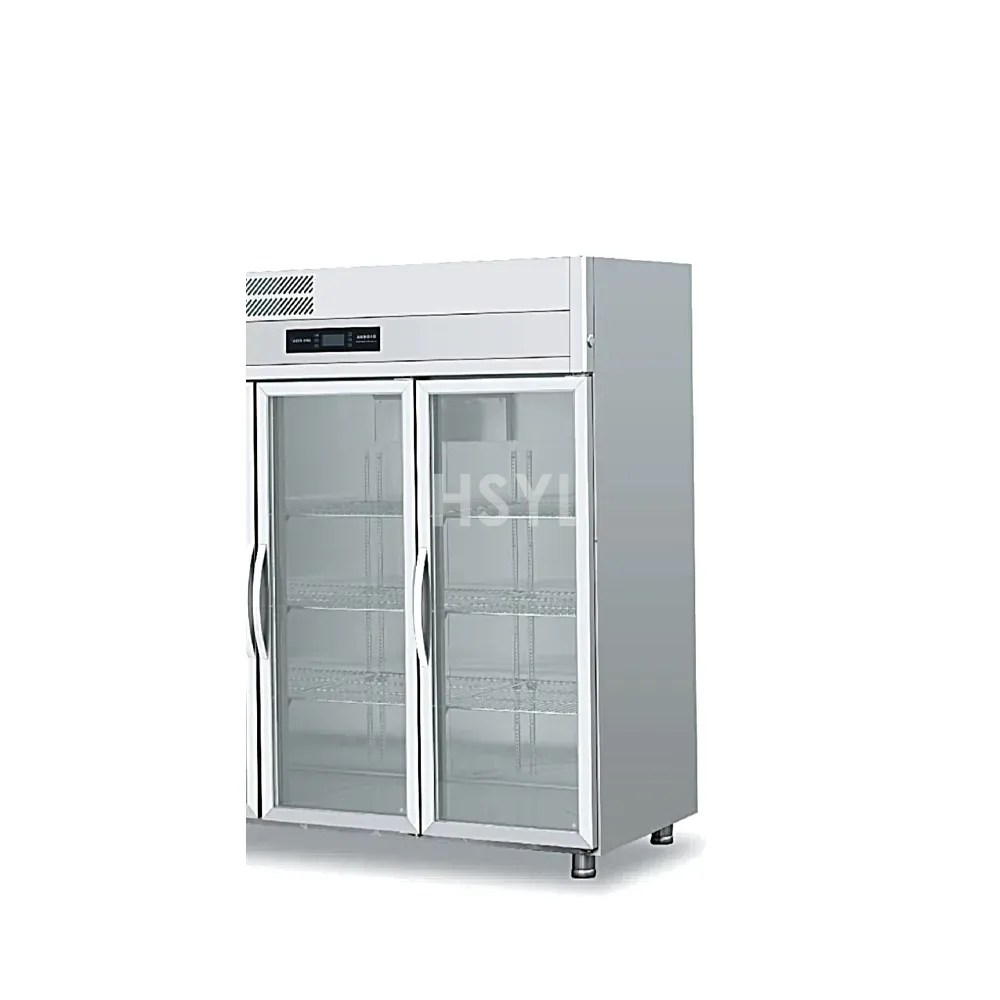
Engineering commercial foodservice facilities for European, UK, or global export? HSYL manufactures commercial reach-in refrigerators, undercounter counters, and prep tables certified to EU Ecodesign MEPS, Class A/B energy ratings, and R290 eco-refrigerant safety standards. Contact our refrigeration engineering division to access EPREL datasheets, energy test certificates, and competitive pricing.