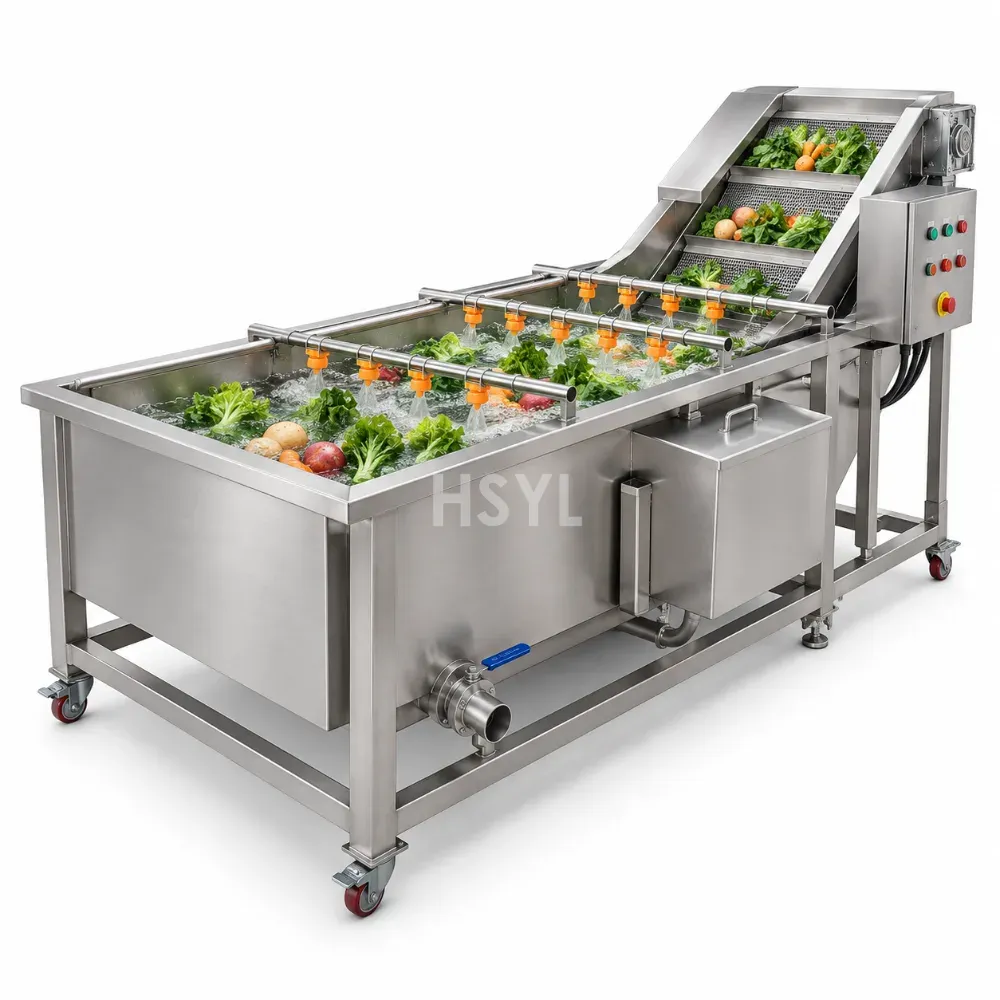
 Commercial Vegetable Washers
Commercial vegetable washers engineered for commercial prep rooms, central kitchens, institutional canteens and food processing facilities. HSYL provides specialized washing configurations engineered for leaf integrity, heavy root soil removal, water conservation and continuous HACCP compliance.
Request a Project-Specific Quotation
Commercial Vegetable Washer Model Lineup
HSYL manufactures four dedicated vegetable washing configurations to match produce characteristics, soil intensity and hourly production volume:
- YL-VW-300 Commercial Vortex Washer: Designed for delicate leafy greens, cut salads and herbs. Uses gentle hydraulic 360-degree helical swirling currents without mechanical impellers to remove dirt and insects without bruising fragile cell walls. Equipped with automatic basket tilting discharge.
- YL-VW-800B Continuous Brush Roller Washing & Peeling Machine: Built for heavy-soil root vegetables including potatoes, carrots, ginger and beets. Employs 9 heavy-duty food-grade abrasive/nylon brush rollers combined with an overhead high-pressure water spray manifold and continuous internal screw auger discharge.
- YL-VW-1500 Commercial Air Bubble Washing Machine: Versatile bubbling immersion washer for mixed vegetables, tomatoes, peppers, broccoli and root slices. High-pressure air injection creates continuous surging agitation that dislodges surface sand, while an inclined wire-mesh conveyor elevators produce through a final fresh-water rinse.
- YL-VW-3000 Industrial Dual-Stage Continuous Washing Line: High-throughput automated washing system for high-volume central kitchens and ready-meal factories. Integrates preliminary bubble soaking, cross-wave turbulent washing, secondary clean water spray headers, floating debris skimming weir and recirculating multi-stage water filtration.
Standard Engineering & Parameter Matrix
The following engineering matrix outlines standard operational specifications across HSYL's vegetable washing equipment series. Custom conveyor widths, ozone sanitation injection and in-line dewatering vibrators are configured upon request.
| Model | Washing Mechanism | Capacity (kg/h) | Water Tank / System | Total Power (kW) | Construction | Inquiry |
|---|---|---|---|---|---|---|
| YL-VW-300 | Hydraulic Vortex / Swirl Flow | 150–300 kg/h | 220 L Single Tank | 1.5 kW | Food-Grade SUS304 | Inquire |
| YL-VW-800B | 9 Rotary Brush Rollers + Spray | 500–1,000 kg/h | Spray Manifold + Sump | 2.2 kW | Food-Grade SUS304 | Inquire |
| YL-VW-1500 | Air Bubble Surging + Mesh Elevator | 1,000–1,800 kg/h | 650 L Recirculating Tank | 3.7 kW | Food-Grade SUS304 | Inquire |
| YL-VW-3000 | Dual-Stage Bubble + Wave Turbulence | 2,000–3,500 kg/h | 1,200 L Dual Filter Tank | 6.5 kW | Food-Grade SUS304 | Inquire |
Vegetable Washer Selection & Engineering Matrix
| Selection Factor | Engineering & Operational Verification |
|---|---|
| Produce Category | Match gentle vortex or low-pressure bubble agitation for fragile leafy greens; select rotary brush rollers with high-pressure sprays for root vegetables. |
| Soil & Debris Type | Equip heavy sand sediment cones for field vegetables; utilize surface skimming weirs and fine mesh screens for floating insects, hairs and light debris. |
| Throughput Demand | Select batch vortex units (150–300 kg/h) for kitchen prep rooms; select continuous conveyor washers (1,000–3,500 kg/h) for commissaries and processing lines. |
| Water Conservation | Incorporate continuous recirculating pump loops with multi-stage wedge-wire filtration tanks to reduce fresh water consumption by up to 60%. |
| Sanitization Standards | Specify optional ozone generator injection ports or chemical dosing pumps where validated micro-organism reduction is mandated. |
| Discharge Interface | Interface directly with perforated GN collection totes, centrifugal spin dryers or downstream continuous dewatering vibrator conveyors. |
Typical Applications
- Central kitchens and institutional catering commissaries
- Fresh-cut salad and packaged vegetable processing plants
- School, hospital and corporate canteen preparation facilities
- Hotel banquet and high-volume restaurant food prep hubs
- Ready-to-cook meal assembly operations
Engineering & Site Integration
- Provide dedicated floor drainage channels or perimeter floor sinks to manage high-volume tank discharge and filter flushing.
- Verify cold water inlet pressure (minimum 0.2–0.4 MPa) and supply pipe diameter for rapid tank filling.
- Position equipment within designated wet-prep zones to maintain strict physical separation from cooked and ready-to-eat workflows.
- Confirm three-phase electrical connections and ensure IP65 waterproof motor and control panel ratings for daily washdown protocols.
Procurement Notes
- All HSYL vegetable washers are built using certified food-grade SUS304 stainless steel with passivated welds to resist corrosive washdown sanitation.
- Specify whether incoming produce is pre-sorted or contains heavy sand/stones to determine sediment trap sizing.
- Request electrical configurations tailored to your local site supply (e.g., 208V/220V/380V/415V/480V at 50Hz or 60Hz).
Information Required for an Accurate RFQ
- Specific produce varieties to be cleaned (leafy, root, melon, cut pieces or mixed vegetables).
- Required peak hourly washing volume (kg/hour).
- Nature of soil contamination (field mud, stones, pesticide residue, surface insects).
- Site utility parameters: available voltage, phase, frequency, water supply volume and drainage location.
- Required downstream integration (manual tote collection, basket unloading, dewatering vibrator or spin dryer).
- Destination country, certification requirements and target delivery timeline.
Related HSYL Resources
Request a Technical Proposal
For commercial and industrial vegetable washing systems, equipment selection must align with crop characteristics, water economy and downstream processing line pacing. Contact HSYL engineering specialists with your produce list and capacity requirements to receive a customized technical specification and equipment quotation.