Direct Answer / Key Takeaway: Plan mixed-size pizza orders around loading space, validated bake settings and dispatch deadlines. Build a practical release schedule for peak service.
Mixed-size pizza oven scheduling becomes difficult when the kitchen treats every order as an identical unit. A small plain pizza, a large heavily topped pizza and a collection order due at a fixed time may compete for the same loading position but require different handling and cooking decisions. A workable schedule connects the order promise to a validated loading plan.
The aim is not to keep every available space occupied. It is to release complete, acceptable orders with a manageable queue. That requires a clear rule for which items can share a setting, which need a separate batch and how the next order reaches the oven.
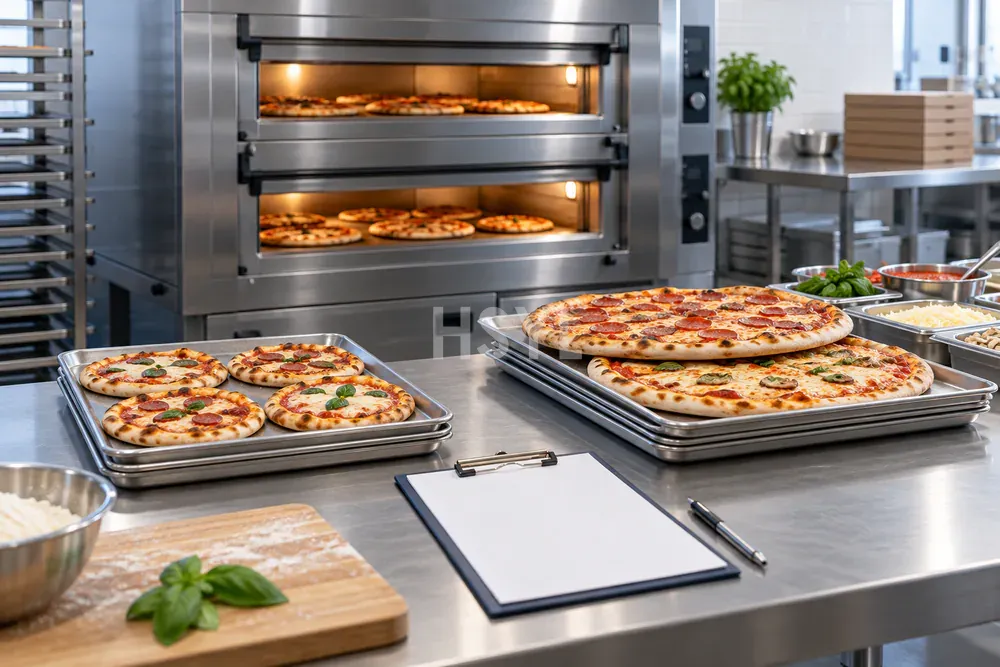
Build cooking families before creating time slots
Group products by the conditions under which they have been successfully cooked: dough specification, initial product state, topping load, pizza size, equipment mode and approved result. Products that happen to share a diameter may still need different settings. Conversely, some sizes may share a validated process when tested in the offered equipment.
Give each cooking family an identifiable recipe revision and loading sketch. Record the acceptable product result and the inspection method. Do not use diameter alone to declare that two products have the same bake time, and do not change a conveyor setting for one order without considering the products already in the cooking path.
Use footprint calculations as a layout aid
For circular products, geometric area is calculated as pi multiplied by radius squared. A hypothetical 30-centimetre pizza has about 707 square centimetres of circular area, while a 40-centimetre pizza has about 1,257. The larger example therefore has about 1.78 times the circular area.
This comparison explains why counting pieces can mislead a layout discussion, but it does not establish oven throughput. Real loading also depends on clearances, placement, product supports, the usable opening and validated cooking. Test the actual arrangement instead of filling a theoretical rectangle with circles and presenting the result as production capacity.
Separate customer deadlines from preparation convenience
Create a release list that contains order identifier, promised handover time, cooking family, quantity, preparation-ready time and packing requirements. A large delivery order may require several cooking releases but one coordinated handover. A dine-in order may have a different completion rule.
| Scheduling field | Why it matters |
|---|---|
| Cooking family | Shows which validated setting is required |
| Ready-to-load time | Prevents an empty reserved position |
| Order completion rule | Distinguishes individual releases from grouped dispatch |
| Packing load | Stops a large batch overwhelming handover |
| Recovery or changeover allowance | Makes the next release realistic |
Choose a release rule the team can actually follow
For a deck oven, the team may group compatible products within a defined loading interval. For a conveyor oven, the plan needs a stable operating setting and an agreed loading sequence. A promise-time rule, a compatible-family rule or a dedicated position for a product family can all be tested; the right choice depends on the observed order pattern.
Use a short rehearsal before a peak service. Include at least one large mixed order, a late preparation item and an interruption at packing. Observe whether staff can identify the next release without repeated verbal negotiation. A schedule that works only when the manager personally rearranges every order is not a reliable operating method.
Keep delayed products visible
Record why an item missed its planned release. Was preparation late, was the setting occupied by another family, did the product need a remake, or was the complete order waiting for a side dish? Different causes need different changes. Do not silently hide late work by moving it into the next batch and erasing the original promise time.
Review accepted output, maximum delay, incomplete orders and setting changes together. If a dedicated second oven position is being considered, demonstrate the family or order wave that would occupy it. The bakery and pizza oven comparison provides configuration context, while your release record supplies the actual scheduling requirement.