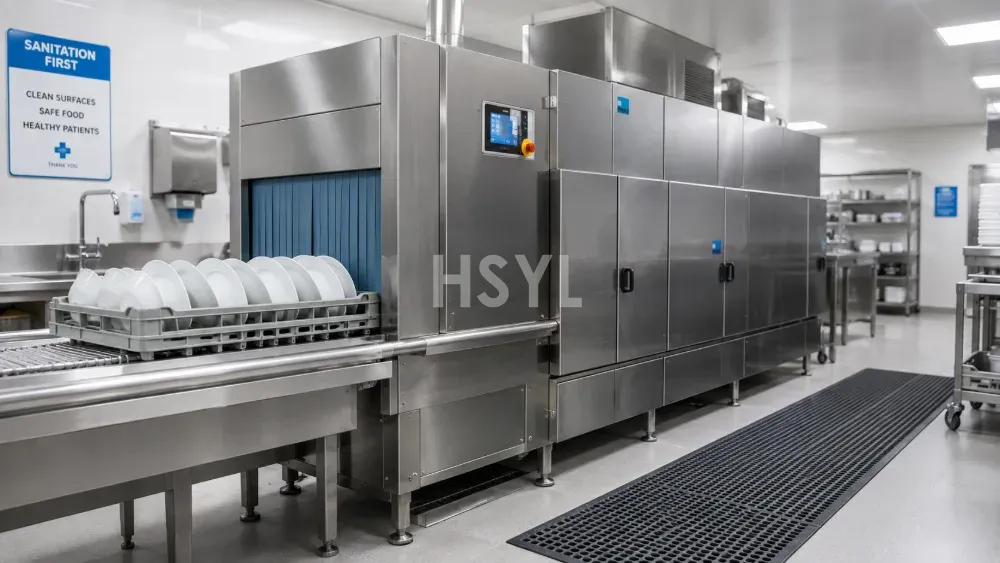
Direct Answer: Calculate commercial dishwasher capacity from the busiest return period, not from daily covers or catalogue speed alone. Convert peak meals into washable items per hour, test how many of those items fit in a real rack, divide the item load by the tested rack load, and then add a documented allowance for rack gaps, rewash and operator changeover. The selected machine must also fit the dirty-side sorting, pre-rinse, unloading, air-drying and clean-storage workflow. A washer rated for enough racks per hour can still become a bottleneck when staff cannot load, unload or store racks at the same pace.
1. Start with the Peak Dish-Return Window
Daily meal volume is not the design load. A restaurant may serve throughout the evening, while a school, hospital or factory canteen may receive most trays within 30 to 60 minutes. Record the busiest return window during an actual service or build it from the operating schedule before comparing machines.
| Input | What to Measure | Why It Changes Capacity |
|---|---|---|
| Peak meals returned | Meals or trays entering the wash area during the busiest measured period | Defines the real surge instead of the daily average |
| Return-window duration | Minutes from the first surge rack to the end of the peak | The same meal count returned in 45 minutes requires more capacity than in two hours |
| Washable items per meal | Plates, bowls, cups, trays, cutlery baskets and reusable containers | One cover is not one washable item |
| Soil and menu profile | Grease, starch, baked-on residue and mixed ware | Changes pre-scrape time, loading density and rewash risk |
| Rack mix | Plate, cup, glass, cutlery and tray racks used during the peak | Different racks hold different item counts |
Peak meals per hour = Peak meals returned ÷ Return-window hours
Use transactions, tray-return counts or a short time study when available. Seating capacity alone is only a planning proxy because table turns, takeaway orders and staggered breaks change the return pattern.
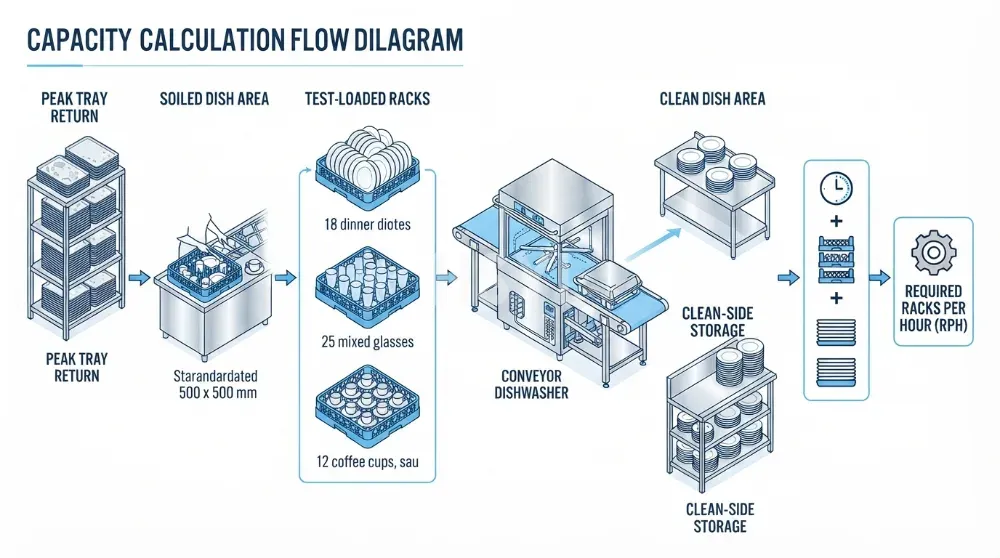
2. Convert Meals into Washable Items per Hour
Count every reusable item that passes through the machine. Separate large trays, pots and utensils if they require another washer or a manual pot-wash line.
Washable items per hour = Peak meals per hour × Average washable items per meal
Do not copy a universal “plates per diner” assumption into the final specification. Run a tray audit for representative menus. A cafeteria tray with a plate, bowl, cup and cutlery set creates a different load from a quick-service meal using one reusable plate.
3. Test the Real Rack Load
A standard rack footprint does not guarantee a fixed number of items. Plate diameter, bowl depth, cup shape, tray thickness and spacing requirements all affect loading. Build representative racks with the actual ware and record the average items per correctly loaded rack.
Loaded racks per hour = Washable items per hour ÷ Tested average items per rack
- Keep plates separated so spray reaches all food-contact surfaces.
- Use dedicated racks for cups, glasses and cutlery rather than forcing one mixed loading pattern.
- Count partially filled racks during the peak; catalogue capacity assumes a repeatable cycle, not random rack gaps.
- Track the rewash rate during a trial. A fast cycle that creates rewashes does not provide usable throughput.
4. Add an Explicit Operating Allowance
Nominal rack demand is not the final design capacity. Select an allowance with the operator and consultant for rack changeover, uneven returns, short stoppages and limited rewash. Record the chosen percentage in the equipment schedule rather than hiding it inside a rounded number.
Design racks per hour = Loaded racks per hour × (1 + Operating allowance)
A larger allowance is not automatically safer. Oversizing can increase floor space, connected load and water demand. The correct margin depends on how much dirty ware can be staged, whether a second service wave follows, and how quickly a breakdown would affect operations.
5. Worked Capacity Example
The following example is illustrative. Replace every assumption with measured project data before ordering equipment.
| Calculation Step | Illustrative Input | Result |
|---|---|---|
| Peak return | 600 meals returned in 45 minutes | 800 meals per hour |
| Washable item load | 3 reusable items per meal | 2,400 items per hour |
| Tested rack loading | 18 mixed items per correctly loaded rack | 133.3 loaded racks per hour |
| Documented operating allowance | 15% for this example | 153.3 design racks per hour |
For this example, the project team should evaluate a system that can sustain at least 154 correctly loaded racks per hour under the agreed test conditions. The final decision must also account for the ware mix, soil load, sanitation method, operator count and available accumulation space.
6. Machine Rating Is Not System Throughput
The usable capacity of a warewashing area is limited by its slowest step:
Dirty return → sorting → scraping → pre-rinse → rack loading → machine cycle → unloading → air-drying → clean storage
If sorting can prepare only 90 racks per hour, installing a 150-rack-per-hour machine does not create a 150-rack-per-hour system. The layout must keep dirty and clean sides separated, provide enough landing tables and prevent clean racks from blocking discharge. Review these interfaces together with the commercial kitchen workflow design guide.
| Machine Format | Best Fit | Capacity Check |
|---|---|---|
| Undercounter or front-loading | Bars, cafés and low-volume satellite areas | Confirm cycle time, basket size, clearance and glass or plate mix |
| Hood or pass-through | Operations with repeatable rack loading and limited floor space | Confirm whether one operator can pre-rinse, load and unload at the published cycle rate |
| Rack conveyor | Continuous rack flow with dedicated dirty and clean tables | Check conveyor speed, peak rack demand, corner layout and staffing |
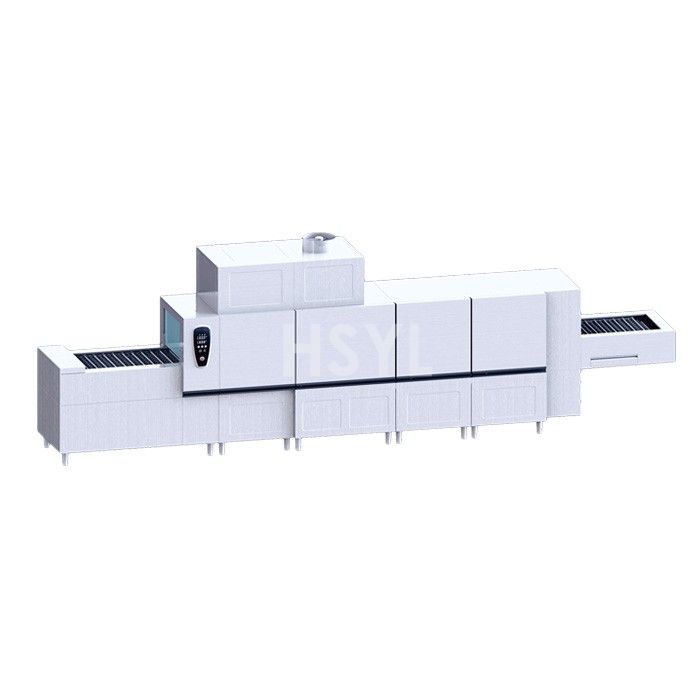
| Flight-type conveyor | Large tray-return systems with direct loading | Specify items per hour, belt loading pattern, sorting labor and discharge accumulation |
Use the Capacity & Sizing hub to keep this calculation aligned with the wider equipment schedule, and compare the available machine formats in the commercial dishwashing equipment category.
7. Check a Published Model Rating Against the Calculation
The published page for the CK-HDW-50 Commercial Dishwasher lists a 500 × 500 mm basket and a nominal washing ability of 30 baskets per hour. At the illustrative test load of 18 items per basket, that equals 540 items per hour before any adjustment for the actual ware mix, operator handling or rewash.
That model rating does not satisfy the worked example above, which requires approximately 154 racks per hour. This does not make the model unsuitable in general; it means the model must be matched to a smaller measured return load or used in a different station. Confirm the latest technical submittal because utility and capacity data can vary by configuration.
8. Verify Sanitation, Water and Utility Conditions Separately
Racks per hour measures throughput, not sanitation compliance. The machine must be operated according to its data plate, chemical instructions and the requirements adopted by the destination jurisdiction.
As a United States reference, the 2022 FDA Food Code is a model code rather than federal law. It specifies different wash and hot-water sanitizing temperatures for different machine types and requires conveyor speed or stationary-rack cycle time to match the machine data plate. Other countries and local authorities may use different adopted requirements.
- Water: Confirm dynamic inlet pressure, hardness, treatment requirement, drain capacity and hot-water recovery.
- Electrical: Confirm voltage, phase, frequency, breaker, connected load and booster-heater demand from the approved submittal.
- Chemical system: Confirm detergent and sanitizer dosing, contact conditions and verification method when chemical sanitizing is used.
- Ventilation: Confirm whether the selected machine and local mechanical code require an exhaust hood, condensing system or another moisture-control method.
- Acceptance test: Run representative racks during commissioning and record throughput, temperatures, chemical concentration where applicable, rewash and operator cycle time.
9. Procurement Checklist Before Requesting a Quotation
- Peak meals or trays returned and the return-window duration.
- Average washable items per meal, separated by plates, bowls, cups, cutlery, trays and containers.
- Photographs or dimensions of the actual ware and a test-loaded rack count.
- Expected soil profile, pre-scrape method and acceptable rewash criterion.
- Dirty-side and clean-side floor plan, landing-table lengths and staff positions.
- Available voltage, water pressure, water analysis, drainage and ventilation conditions.
- Destination country, local sanitation method and required project documentation.
- Expansion allowance, redundancy requirement and acceptable recovery time after a stoppage.
For a multi-zone project, coordinate the warewashing calculation with the central kitchen equipment and turnkey planning page. To request a model comparison, send the measured return data, ware sample and utility conditions through the HSYL technical enquiry form.