A heated banquet cart and a holding cabinet both keep food hot, but they are built for opposite ends of the same problem. A banquet cart moves hot food — across a floor, into a lift, out to a function room — and holds it warm in transit. A holding cabinet stays put and holds food at serving temperature where it is loaded. Get the two confused and you either wheel a stationary cabinet around a hotel or leave a transport cart parked in a corner doing a cabinet's job. The HSYL line carries the transport side as the E300-BCW01 banquet cart and the E234-BCW02 banquet cart.
Transport Versus Storage
The dividing line is whether the food travels. A banquet cart is a heated trolley: it rolls, it fits a lift, and it holds a plated or bulk load warm while it moves from the kitchen to a remote service point — the pattern in hotel banquets, hospital meal rounds and split-level venues. A holding cabinet is a stationary box that holds food at temperature on the line, where the food is loaded and served from the same place. The heated holding cabinet selection guide covers the stationary side in depth; the point here is that the cart's job is the journey, not the hold.
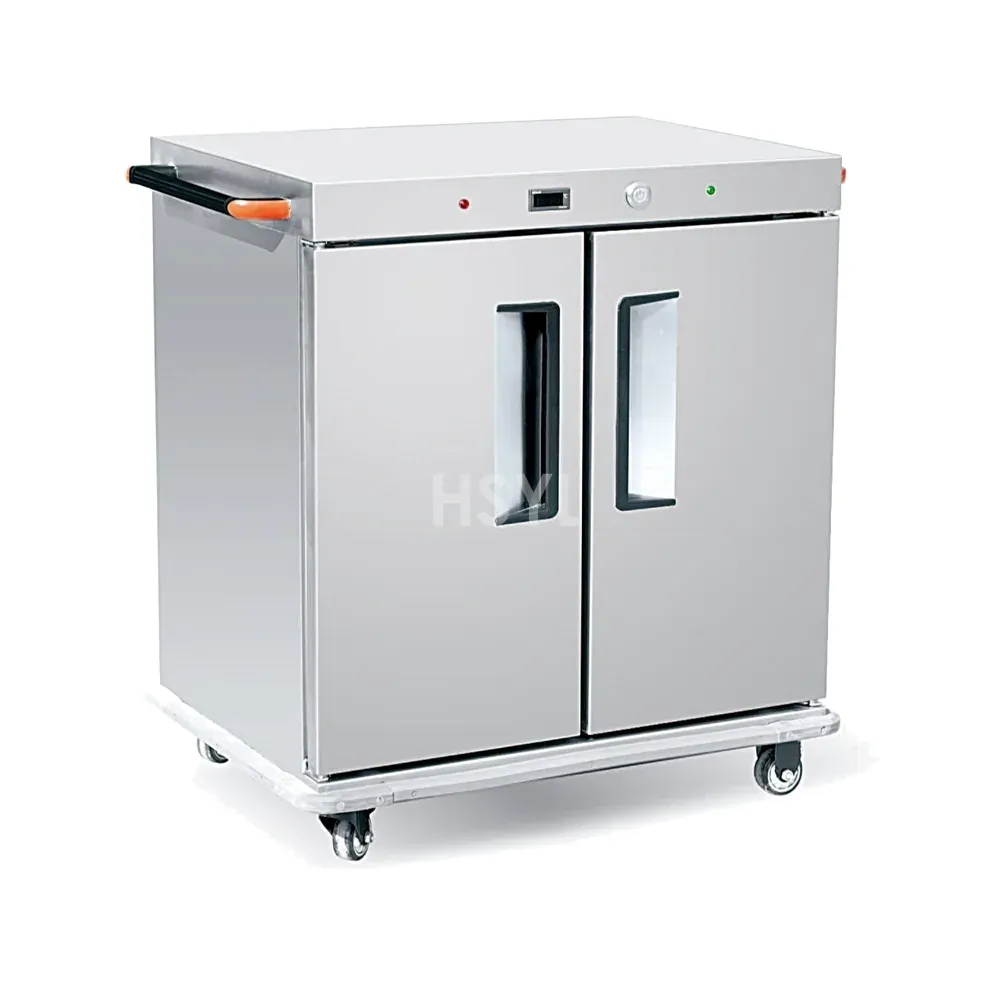
The Two Banquet Carts Side by Side
| Factor | E300-BCW01 (Cart A) | E234-BCW02 (Cart B) |
|---|---|---|
| Capacity | 300 L | 234 L |
| Power | 1.2 kW | 2.2 kW |
| Temperature range | 30–80 °C | 10–80 °C |
| Layers | 4 | 4 |
| Dimensions | 970 × 705 × 910 mm | 1055 × 745 × 1065 mm |
| Net weight | 65 kg | 82.5 kg |
The pairing is a useful reminder that capacity and power do not always run together. Cart A carries more volume — 300 litres on a 1.2 kW draw — because it is the wider, lower trolley built to move a big plated load gently. Cart B carries less volume but packs 2.2 kW, so it recovers temperature faster after the door opens, and its taller frame suits a deeper load. Neither is simply "bigger"; each matches a different transport duty.
The Unplugged Window
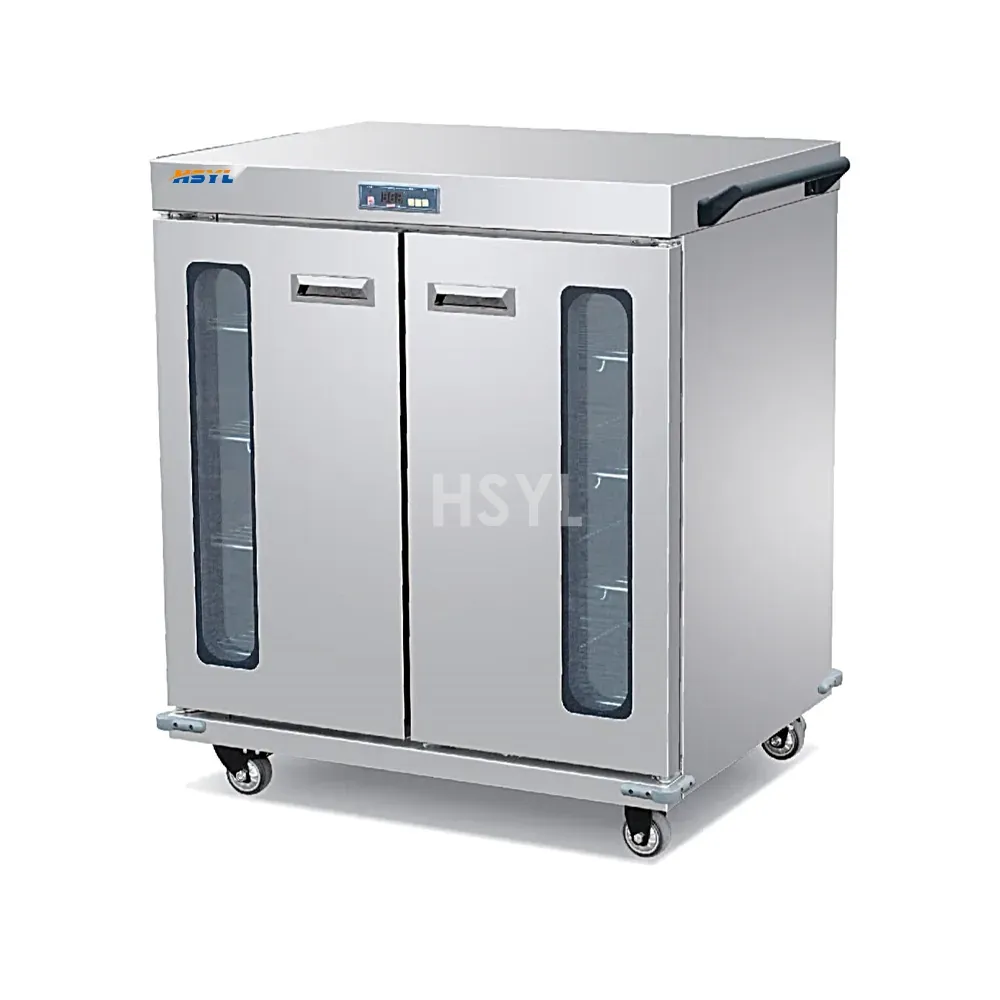
The variable that separates a transport cart from a cabinet is what happens when the power is out. A banquet cart spends part of its working life unplugged — rolling between floors, waiting in a service corridor — and its ability to hold temperature in that window depends on its insulation and the starting temperature of the load. A cabinet is plugged in and never leaves its spot, so the question does not arise. When you spec a cart, ask about the unplugged hold time at a stated starting temperature, because that window, not the plugged-in number, is what a hotel banquet or a hospital round actually runs on. The cart's documented range — 30 to 80 °C on Cart A, 10 to 80 °C on Cart B — sets the band it can hold; the insulation sets how long it holds it without power.
How to Choose
- Food travels between floors or rooms? Banquet cart — it rolls, it fits the lift, it holds through transit.
- Food is served where it is loaded? Holding cabinet — a stationary, continuously powered box does the same job cheaper.
- Both happen in one venue? Run a cabinet on the line and a cart for the outlying service points; the two are complements, not substitutes.
For a hotel or banquet operation where the cart carries the load out to the function rooms, the hotel banquet kitchen solution shows how transport, holding and service sequence together. The hot holding temperature guide sets the 60 °C floor the cart must hold on the road.