Direct Answer: Select a heated holding cabinet from the food load and service pattern it must protect. Define pan and rack interfaces, loading state, door openings, recovery, cabinet uniformity, humidity need, transport conditions and a witnessed test before comparing catalog capacity.
Define the holding job before choosing a cabinet
A cabinet can bridge production and service, support banquet transport, stage plated meals or buffer batches at a serving line. Those are different jobs. Start by documenting where food enters, its condition at loading, the approved hold window, service location, replenishment pattern and what happens after the cabinet is emptied.
List each food family and the failure mode that matters. Crisp products may soften, rice may dry, sauces may skin, meat may lose moisture and plated items may develop uneven conditions. Food safety is a mandatory boundary, while sensory quality usually determines the practical hold limit. Both must be defined by the operator and authority rather than inferred from a cabinet display.
| Load-profile input | Buyer definition | Selection consequence |
|---|---|---|
| Food family | Product, recipe, surface exposure and packaging | Dry or humidity-assisted strategy and acceptable hold window |
| Loading condition | Food temperature, pan fill, lid status and rack pattern | Recovery demand and measurement method |
| Service behavior | Door-opening sequence, pan removal and replenishment | Air distribution, recovery and door configuration |
| Movement | Stationary, corridor transfer, lift use or vehicle transport | Castors, restraint, handles, impact protection and unplugged risk assessment |
Convert menu load into pans, racks and usable positions
Catalog “pan capacity” is meaningless until the pan system is fixed. Record GN designation or other tray format, depth, lid, handle projection, loading direction and product fill. Check whether pans rest on rails, grids or removable racks. Spacing must accommodate the loaded pan and allow the designed air path; maximum rail count may not equal usable production capacity.
Use the GN pan size guide to coordinate the complete interface. Then create a loading diagram for each representative menu pattern. Mixed pan depths, plated racks and covered containers can block air differently. Confirm the diagram on the exact mobile heated holding cabinet configuration offered.
Distinguish warm-up, loaded recovery and steady holding
Warm-up describes an empty cabinet reaching a condition; it does not prove performance after a cold door opening or a full production load. Loaded recovery begins when the approved load enters and ends only when the defined measurement points return to the acceptance band. Steady holding then asks whether food and cabinet conditions remain acceptable through the service period.
Specify all three states separately. Record ambient condition, power supply, initial cabinet condition, food or simulant condition, pan map, door sequence and control setpoint. A fast display response may represent the control sensor near the heater rather than the slowest food location. Procurement should therefore require independent measurements at agreed points.
| Performance state | Test question | Evidence |
|---|---|---|
| Preheat or warm-up | Is the empty cabinet ready under the agreed starting condition? | Time-series data from defined cabinet points |
| Loaded recovery | How does the system respond to the approved loading event? | Door timeline, load map, control output and independent probes |
| Steady holding | Are all monitored locations and products within agreed safety and quality criteria? | Trend data, product observations and any moisture or yield measure specified |
| Service disturbance | What happens during the agreed removal and replenishment sequence? | Opening log, worst-location response and recovery behavior |
Evaluate temperature uniformity as a mapped result
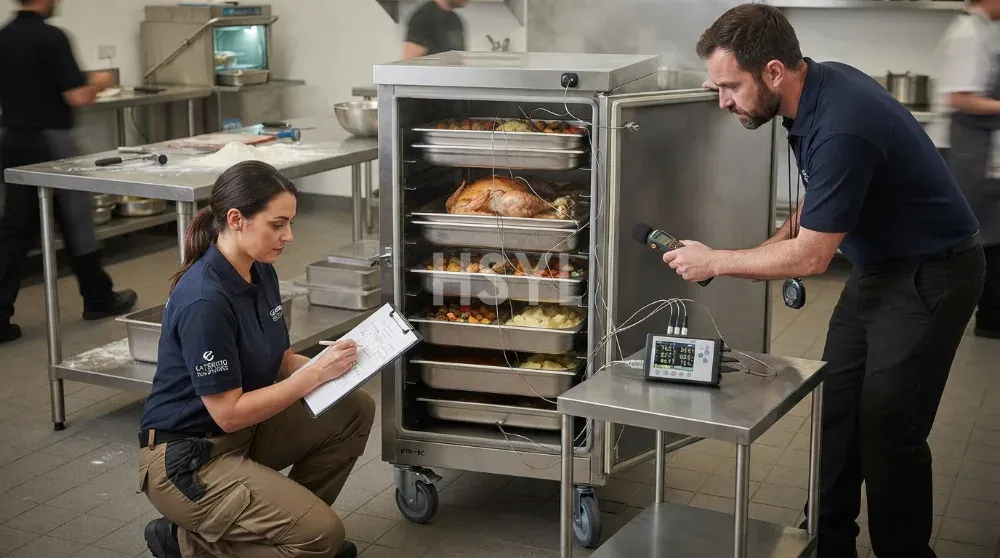
A single thermostat value cannot demonstrate cabinet uniformity. Air near the heater, door, corners and densely loaded shelves may behave differently. Create a measurement map that represents the upper, middle and lower load, door side and expected worst airflow positions. Sensor placement must be repeatable and must not interfere with normal door closure.
Measure cabinet air only if that is the agreed criterion; measure representative food or a validated simulant when product protection is the question. Note probe uncertainty, response and calibration status. The test plan should define how readings are compared and how an outlying point is investigated. Never publish a universal uniformity tolerance as an HSYL capability without model-specific test evidence.
Choose humidity control by product outcome
Humidity is a product-management variable, not an automatic upgrade. Added moisture may help reduce surface drying for some foods, while it can damage crisp textures, soften bakery crusts or increase condensation. A mixed menu may require separate cabinets, covered and uncovered pan strategies, or shorter holding cycles rather than one compromise setting.
Ask how humidity is generated, sensed or adjusted on the selected configuration; whether water quality, fill, drain or cleaning tasks are introduced; and how condensation is managed. Request a food trial that compares the agreed product outcome. Terms such as “moisture control” should be translated into observable criteria rather than accepted as a feature label.
| Design choice | Potential benefit | Trade-off to verify |
|---|---|---|
| Dry heated airflow | Simple operation and suitability for products sensitive to surface moisture | Drying, skin formation and airflow exposure |
| Humidity-assisted holding | May support moisture-sensitive foods under validated settings | Condensation, crispness loss, water service and sanitation work |
| Covered pans | Limits direct airflow and product exposure | Steam accumulation, service access and lid clearance |
| Separate product zones or cabinets | Allows different holding strategies | More floor space, transfers and operating controls |
Model door openings as part of capacity
Door behavior can dominate real service. A cabinet that performs with the door closed may struggle when staff search for trays, remove several pans, replenish from production and leave gaps in the load. Record the intended opening sequence and label positions so the operator can find product quickly.
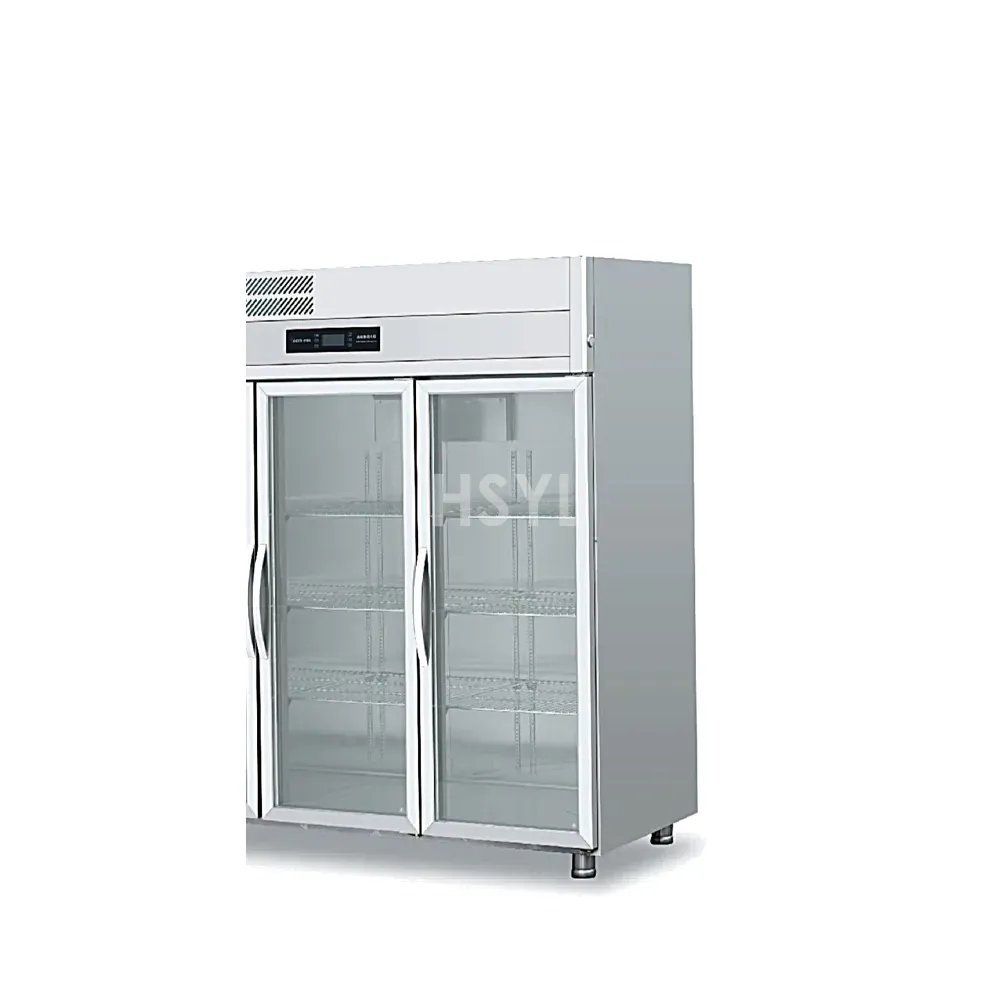
Compare solid and glazed doors on visibility, heat loss, breakage risk, cleaning and the working environment without assuming one is universally better. Consider split-door or pass-through arrangements only if they support the workflow and hygiene plan. Door seals, hinges, latches and handles should be inspected under the loaded condition and included in preventive maintenance.
Check mobility, unplugged periods and site interfaces
For mobile use, verify loaded stability, castor rating evidence, wheel brakes, push handles, bumpers, thresholds, slopes, turning space, lift dimensions and restraint during transport. Confirm the power-cable storage method and protection from wheel damage. Hot liquid loads may require additional risk controls defined by the operator.
An unplugged transfer is a process state, not a marketing claim. Test the actual loaded cabinet over the intended route and duration under approved conditions, or maintain power through a properly engineered solution. Do not claim passive retention time without data. Coordinate plug, supply, connected load and isolation with the site electrical engineer and the installation and commissioning plan.
Set food-safety criteria from the governing authority
The legal holding requirement depends on jurisdiction and adopted code. In the United States model code, the FDA Food Code 2022 specifies hot holding for time/temperature control for safety food at 57°C (135°F) or above, subject to its provisions and exceptions. Because the Food Code is a model offered for adoption, the project must verify local rules.
The cabinet should support the operator’s control plan with accessible, interpretable controls and independent food verification. A display is not a substitute for an approved food-temperature method. Define alarm, corrective action, recordkeeping and disposition of food when the criterion is missed.
Validate the offered configuration before purchase release
Write an acceptance protocol around the exact model, software or controller revision, rack set, pan map and options. Include document review, workmanship, controls, safety functions, loaded recovery, mapped uniformity, door disturbance, humidity where applicable, mobility and cleaning access. Identify which checks occur at FAT and which require the installed site.
| Acceptance item | Method | Pass basis | Record |
|---|---|---|---|
| Pan and rack interface | Load the approved pan schedule with lids and accessories | No interference; supports and clearances match approved drawings | Loading map and fit photographs |
| Recovery and uniformity | Run the agreed representative load and probe map | Project food-safety and quality criteria | Raw trends, calibration data and observations |
| Door-use challenge | Apply the approved service-opening sequence | Agreed worst-location response and recovery | Opening log and probe trends |
| Cleaning demonstration | Remove racks and clean accessible food and condensate zones | Approved sanitation method can be completed safely | Inspection and reassembly record |
Use the commercial kitchen FAT checklist to control evidence and deviations. Link the selection with food holding equipment, food warming trolleys and plate warming cabinets only after the load and service job are defined. These categories solve different operating problems.
Purchase outcomes and evidence, not feature names
The requisition should include the load profile, pan schedule, loading drawings, food-safety basis, quality limits, door sequence, humidity duty, mobility route, utilities, cleaning method, acceptance protocol, manuals, spare parts and training. Require the supplier to list assumptions and exclusions beside the offer.
Do not state HSYL temperatures, capacity, retention, efficiency, certification or lead time without exact configuration evidence. A robust purchase decision is one the operator, food-safety lead and engineer can all trace from menu load to measured acceptance.