Direct Answer: Build a canteen equipment list from the operating model, not from a generic appliance count. Map what is served, when each batch must be ready, how it moves, and what returns dirty before assigning equipment types or quantities.
Start with service waves, not daily meal totals
A daily meal total hides the condition that actually sizes a canteen: the busiest release window. The same daily volume can create very different equipment loads when diners arrive in one compressed wave, in staggered shifts, or through several service points. Record the release pattern first, then work backward from the counter to cooking, preparation, receiving and storage.
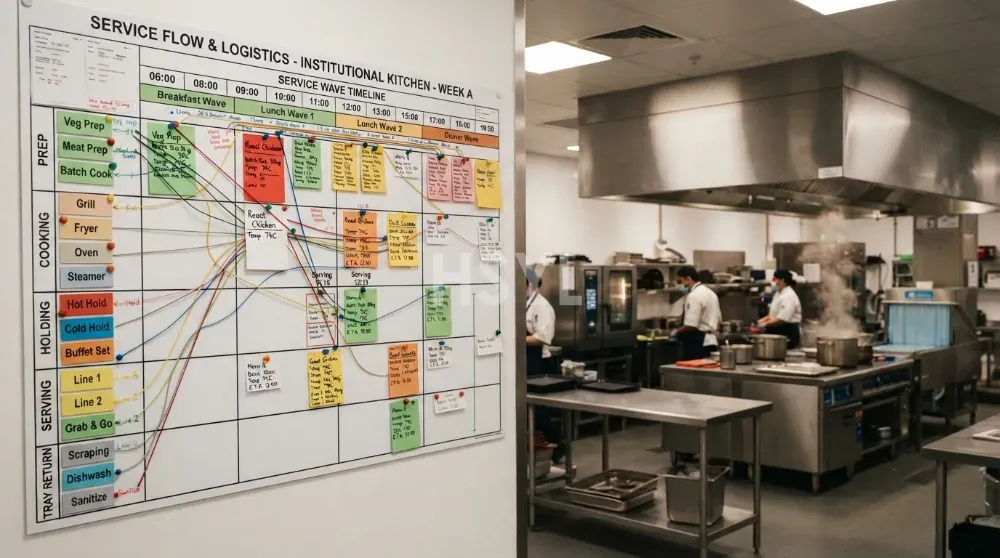
For each wave, capture menu lines, portions released, replenishment frequency, serving points, transport distance and the acceptable queue condition. Treat every quantity entered at this stage as an example input until the operator signs it off. The plan should also show which meal components can be prepared earlier and which lose quality if held.
| Planning input | What the operator provides | What it changes | Evidence to retain |
|---|---|---|---|
| Service-wave profile | Arrival pattern by shift or sitting | Counter release rate, holding load and tray-return burst | Roster, access-control data or observed service log |
| Menu cycle | Recipe families and production method | Prep machines, cooking battery and pan mix | Approved menu and recipe sheets |
| Service method | Assisted line, self-service, plated or packed | Counter modules, labor positions and replenishment route | Operating concept and annotated layout |
| Return condition | Tray type, soil mix and peak return pattern | Scrape, sorting, warewashing and clean-storage capacity | Tray audit and return-flow observation |
Translate the menu into process loads
Do not convert diners directly into appliances. Convert recipes into operations: wash, trim, slice, mix, steam, roast, fry, braise, chill, hold and portion. Then group recipes that compete for the same resource. A rice item and a steamed vegetable may both require steam at the same moment; a sauce and a soup may compete for kettles even though they appear in different menu categories.
Create a menu-load sheet with raw batch mass, finished yield assumptions, vessel or pan format, active labor time, thermal cycle, cleaning time and release deadline. Where real data is unavailable, mark the field “to be validated in a production trial.” This method exposes shared resources and avoids buying a dedicated machine for an operation that can be scheduled on an existing platform.
| Menu family | Critical operation | Equipment family to evaluate | Selection question |
|---|---|---|---|
| Washed and cut produce | Soil removal, trimming and size reduction | Wash sinks or washers, preparation machines and worktables | Can the line handle the dirtiest ingredient without contaminating ready-to-eat work? |
| Steamed staples | Batch loading, steam exposure and unloading | Commercial rice steamer cabinets and compatible racks | Does a documented load trial match the actual recipe and service deadline? |
| Braises, sauces and soups | Heating, agitation, discharge and vessel cleaning | Tilting braising pans or kettle-type equipment | Can operators discharge safely into the next container without a handling bottleneck? |
| Roasted or mixed-menu batches | Programmed cooking and pan changeover | Commercial combi ovens | Are rack format, recipe sequence and cleaning turnaround compatible with the menu? |
Draw the food flow before placing equipment
A defensible plan shows food moving from receiving through storage, preparation, cooking, holding and service without unnecessary backtracking. Dirty trays, waste and return carts need a separate counterflow. The drawing should identify door swings, cart turning areas, hand-wash access, raw-to-ready-to-eat separation, clean utensil storage and routes used during replenishment.
Use the commercial kitchen workflow design guide as a coordination reference, then walk the route with production, sanitation and maintenance staff. A line that looks compact on CAD can fail when a loaded trolley blocks an oven door or when clean racks must cross the scraping station.
Build receiving, storage and preparation around the ingredient profile
Receiving equipment depends on delivery unit, inspection practice and storage handoff. Specify weighing, quarantine, decanting and washable staging where the operating plan requires them. Cold rooms and refrigerators should be organized by ingredient risk and withdrawal frequency, not only by gross storage volume. Include space for opened packs, work-in-process and allergen controls defined by the site’s food-safety plan.
Preparation capacity comes from the heaviest simultaneous task. Compare manual and mechanical methods on labor exposure, cut consistency, product damage, cleaning access and changeover—not on a brochure throughput figure alone. A commercial vegetable preparation machine is useful only when its validated cut set, feed method and sanitation routine match the menu. Keep raw protein tools and ready-to-eat preparation controls distinct where the hazard assessment requires separation.
Configure the cooking battery as a timed system
The cooking line is a schedule of interdependent loads. Plot the start, finish, discharge and cleaning window for every batch during the peak wave. Identify conflicts for operators, extraction, steam, electrical demand, gas supply, floor drainage and landing space. Installed power is not the same as simultaneous demand, and a utility engineer must establish the design basis from the final equipment schedule.
Specify the landing and transfer method with each appliance. A tilting vessel without a safe receiving cart, or an oven without compatible loading racks, simply moves the bottleneck downstream. Request recipe-based demonstrations using representative product, agreed load patterns and the actual pan system. Record results as project evidence rather than accepting generic capacity language.
Link holding and serving to the replenishment plan
Holding is a buffer between variable cooking and fixed service demand. Size it from the number of menu lines simultaneously held, the replenishment batch, vessel footprint, door-opening pattern and maximum approved hold time for each food. Quality limits can be stricter than safety limits, so record both. The applicable authority—not the equipment supplier—determines the legal food-temperature rule.
The FDA Food Code is a useful public model for retail food protection, but projects must follow the adopted local code. For equipment choices, compare a canteen serving line, bain-marie serving counter and mobile holding only after the pan map and replenishment route are frozen.
Treat tray return and warewashing as a second production line
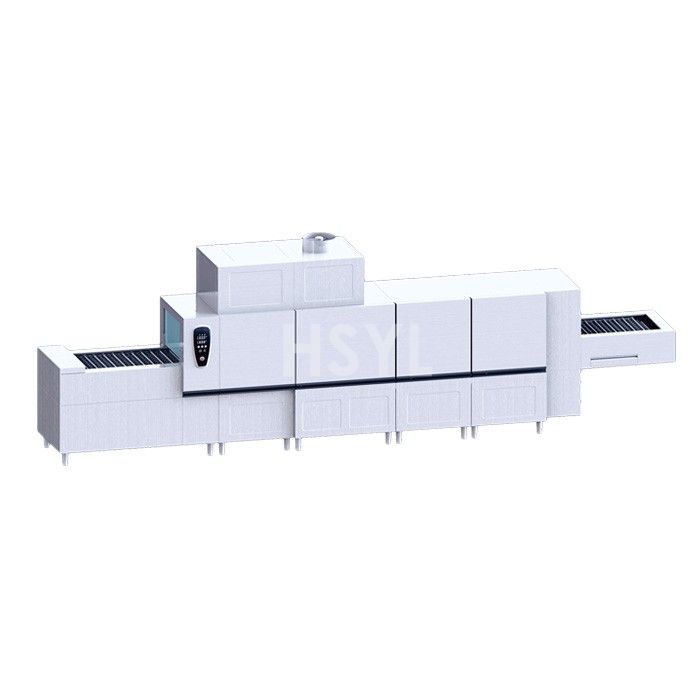
The dirty side receives a burst just after service, often when production staff are also clearing down. Map tray drop, waste removal, sorting, pre-scrape, washing, drying, inspection and clean storage. Include rejected items, chemicals, racks and waste containers. The washer nameplate rate is not an operating capacity unless loading, soil, rack handling and downstream removal can sustain it.
Validate the return line with the real tray, bowls, cups and cutlery. Check that openings, racks and conveyors accept them without nesting or shielding. Measure results against the project’s cleaning and sanitation criteria, and provide a route that prevents cleaned items from crossing waste or soiled returns.
Close the list with utilities, access and maintainability
For every listed item, record utility type, connection location, isolation method, drainage requirement, exhaust dependency, heat rejection, service clearance, largest shipping section and replacement path. Confirm floor loading and wall support with the relevant building disciplines. A concise interface schedule is more useful than scattered notes across vendor drawings.
Maintenance access belongs in the equipment list. Ask which panels are removed for routine service, what must move to reach them, which consumables are site-stocked and how cleaning chemicals affect finishes and seals. Include commissioning and operator training deliverables rather than assuming they are standard.
| Release gate | Required evidence | Owner | Decision |
|---|---|---|---|
| Operating basis frozen | Signed menu, wave profile, service method and tray-return profile | Operator | Equipment schedule may be sized |
| Flow coordinated | Annotated layout with clean, dirty, raw and ready-to-eat movements | Foodservice planner and food-safety lead | Locations may be frozen |
| Interfaces coordinated | Utility, access, ventilation, drainage and load schedules | MEP and structural teams | Site provisions may be released |
| Performance accepted | Representative load test, inspection record and closed deviations | Buyer and supplier | Shipment or handover may proceed |
For shift-based employee dining, use the factory canteen equipment planning guide to connect the meal-release schedule with cooking batches, holding, serving and tray return. Include the busiest arrival period and site utilities in the same brief so suppliers can compare equipment on a consistent operating basis.
Issue a procurement package that can be tested
The final package should contain the operating basis, equipment schedule, layout, interface matrix, pan and trolley standard, acceptance criteria, document register and deviation process. Ask bidders to state exclusions and assumptions in the same format. This makes alternatives comparable and prevents silent substitutions.
Do not specify HSYL capacities, certifications, lead times or performance unless the project receives model-specific evidence. Use the evidence center to organize requested records, then agree what will be witnessed before packing and what remains a site acceptance item.