Direct Answer / Key Takeaway: Calculate commercial dishwasher operating cost per 1,000 meals using energy, water, chemicals, labour and maintenance records, with a clear worked example.
Calculate commercial dishwasher operating cost from a complete observation period, then divide it by the meals served in that same period. Record energy, water, chemicals, labour and maintenance on one consistent basis. Daily meal count alone cannot tell you the cost of the actual wash-up work.
Choose the Boundary Before Collecting Numbers
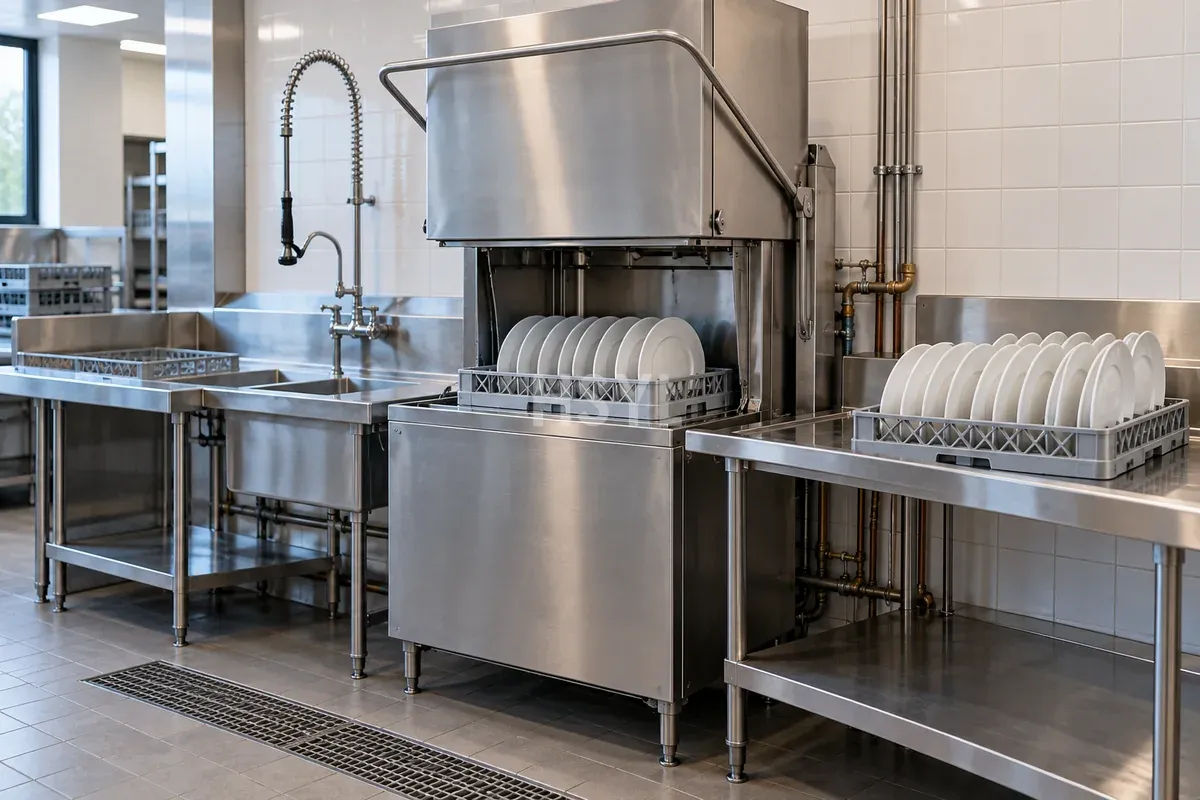
Define what the calculation includes. A machine-only calculation and a complete dishroom calculation answer different questions. The latter may include pre-rinsing, sorting, loading, unloading, water treatment, cleaning and more than one operator.
Write down the observation dates, service periods, meals served, ware types and included equipment. Identify the dishwasher, any separate booster and any gas or steam supply. Use the same boundary when comparing another period or proposal.
Purchase, delivery and installation belong in a separate investment comparison. This worksheet calculates the stated period's operating cost; it does not produce a payback claim.
Use Measurements with Clear Units
| Input | Unit or record | Boundary to check |
|---|---|---|
| Meals served | Meal count for the observation period | Keep the same dates as the consumption and labour records. |
| Wash-up output and rewash | Accepted racks or other suitable output unit; rewash and empty cycles recorded separately | Describe the ware mix and loading. Do not use one universal racks-per-meal conversion. |
| Electricity | Metered kWh × the applicable price per kWh | Include a separately supplied booster when it is within the boundary; allocate relevant additional billing charges separately. |
| Gas or steam, where used | Measured or explicitly allocated quantity × the matching unit cost | Identify the supply and allocation method; do not count the same boiler energy twice. |
| Water and wastewater | Measured m³ × the applicable combined or separate charges | State whether pre-rinse, tank fills, cleaning and treatment water are included. |
| Chemicals | Actual quantity of each product × its matching unit price | List detergent, rinse aid and any other used products separately; use a consistent mass or volume unit. |
| Labour | Total person-hours × the stated loaded hourly cost | Count each person's included time; distinguish elapsed service time from total labour hours. |
| Maintenance and treatment | Actual cost or a clearly identified allocation | State whether parts, service, treatment consumables and downtime costs are included. |
A connected electrical rating in kW describes a supply requirement; it is not a meter reading of energy consumed in kWh. Where a measured record is unavailable, label the calculation as an estimate and state the operating assumptions.
ENERGY STAR's commercial dishwasher resources distinguish machine types and energy or water metrics. Use the exact scope of a reported test result. A rinse-water-per-rack figure should not be silently treated as the complete facility's water use, and a certified model's result should not be transferred to an unverified machine.
Normalize the Result to 1,000 Meals
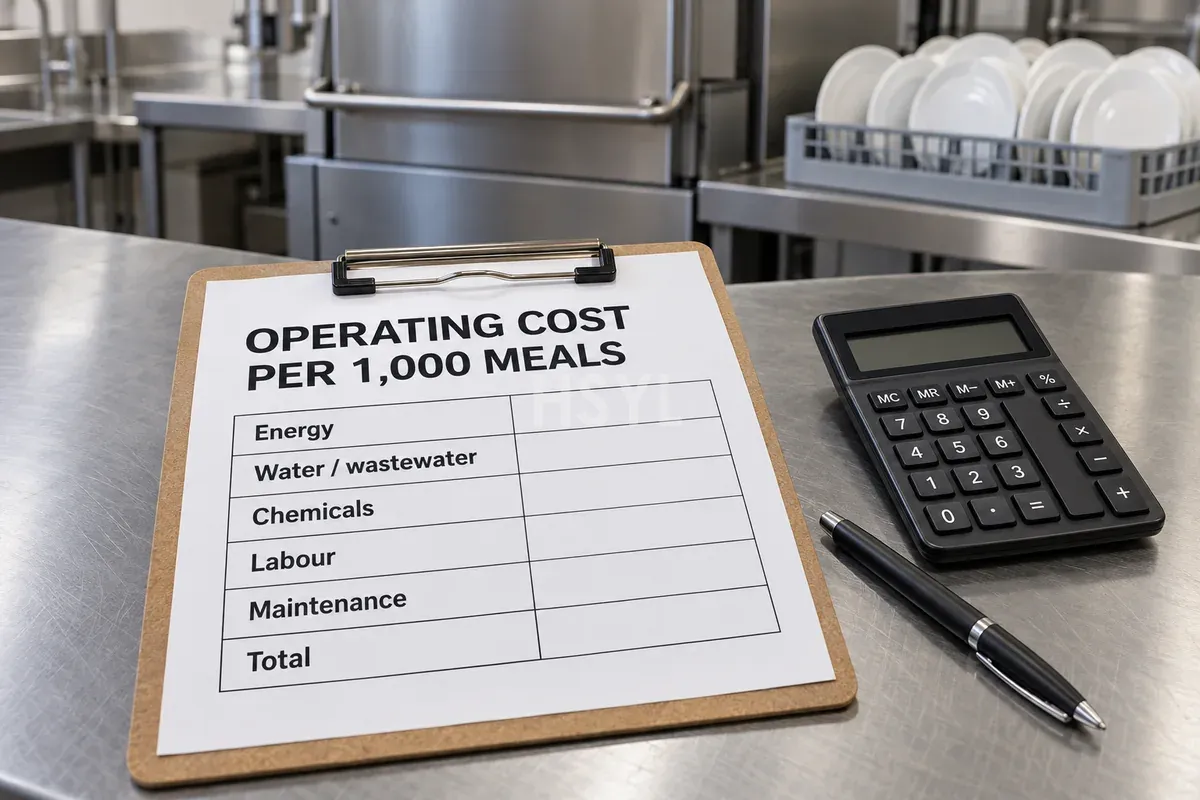
Period operating cost = energy + water/wastewater + chemicals + labour + included maintenance/treatment costs.
Cost per 1,000 meals = period operating cost ÷ meals served × 1,000.
Keep the original quantities beside the result. Record the meal count, ware mix, accepted output, rewashes, operating hours, prices and any allocations. This allows a reviewer to distinguish a change in tariffs from a change in the wash-up process.
A Worked Example with Explicit Assumptions
The following is a teaching example using an arbitrary currency unit, CU. Every quantity and rate is an assumption for demonstrating the arithmetic. These are not HSYL model measurements, market prices or promised operating costs.
The example period serves 1,000 meals. It records 180 accepted rack-load equivalents and 20 rewash cycles. Metered electricity covers the machine and booster within the stated boundary. The example includes no gas or steam use and no separately used chemical sanitizer; those lines would be added where applicable.
| Cost line | Assumed quantity | Assumed rate | Calculated cost |
|---|---|---|---|
| Electricity | 60 kWh | 0.16 CU/kWh | 9.60 CU |
| Water and wastewater | 550 L = 0.55 m³ | 4.00 CU/m³ combined | 2.20 CU |
| Detergent | 0.80 L | 4.50 CU/L | 3.60 CU |
| Rinse aid | 0.15 L | 8.00 CU/L | 1.20 CU |
| Labour | 5.50 person-hours | 9.00 CU/person-hour | 49.50 CU |
| Maintenance allocation | One stated allocation for this period | 4.00 CU | 4.00 CU |
| Total period operating cost | 1,000 meals served | Sum of the listed costs | 70.10 CU |
The normalized result is 70.10 ÷ 1,000 × 1,000 = 70.10 CU per 1,000 meals. Dividing by the 180 accepted rack-load equivalents gives approximately 0.3894 CU per accepted rack-load equivalent. The 20 rewash cycles consume resources but are not added to the accepted-output denominator.
Labour is the largest cost line in this particular example. That observation does not establish the labour share in another kitchen. Keep the wage basis, staff tasks and operating boundary visible before drawing a purchasing conclusion.
Compare One Change at a Time
If the assumed electricity price changes from 0.16 to 0.20 CU/kWh while all measured quantities and other inputs remain unchanged, the electricity line becomes 12.00 CU and the total becomes 72.50 CU per 1,000 meals. This is a tariff scenario, not a change in machine performance.
Use the same discipline for changes in the menu, rack loading, shift length or water supply. Maintain the required cleaning and sanitizing process while investigating costs. A lower cost caused by an incomplete or unverified process is not an acceptable comparison.
Track rewash separately so that repeat processing remains visible. Record its observed reason and the relevant corrective action; do not assume that all rewashes have the same cause or energy cost.
Turn the Worksheet into an Equipment Brief
Provide the supplier with the peak return pattern, ware and rack details, service window, utilities, water information and the cost boundary used. The commercial dishwasher capacity guide helps organize the sizing task; average cost per meal does not establish the capacity required during the busiest return period.
Use the commercial dishwasher water quality guide to coordinate water data and treatment questions. Compare the available commercial dishwashing equipment against the same operating brief, asking for the offered model's documented consumption basis and any exclusions.
Keep the completed worksheet with the quotation and its assumptions. Actual post-installation meter readings and labour records can then be compared with the proposal on the same basis.