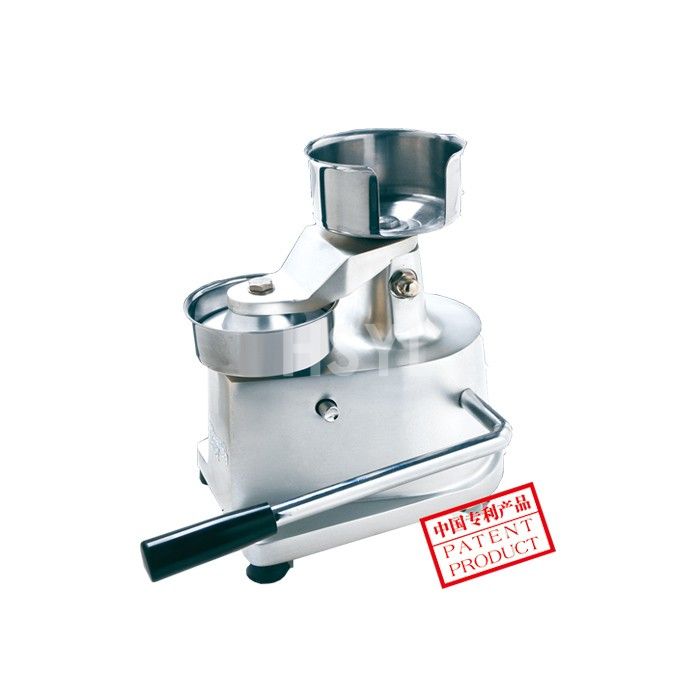
A hamburger patty press controls weight by geometry: the mold's diameter and the pressed thickness together define a volume, and the meat's density turns that volume into grams on the scale. Choose the press by the diameters it offers — the HF-100/130 commercial hamburger press in this range carries both a 100 mm and a 130 mm mold in one 290 × 210 × 275 mm hand-operated unit — and run the workflow with a scale in front of it, because the press repeats the portion; the scale verifies it.
The Weight Formula Every Operator Should Know
Patty weight is area times thickness times density. A 100 mm mold at a typical pressed thickness holds roughly a 4 oz-class (about 113 g) patty, and the 130 mm mold at its typical thickness lands in the 5–6 oz class (about 140–170 g) — the common trade pairings of diameter to weight (industry convention, NOT VERIFIED). The formula matters more than the table: with area fixed by the mold, thickness becomes the weight adjustment — the same 100 mm mold presses a lighter or heavier patty by pressing thinner or thicker, and ground meat's density (a little above that of water) does the rest. Work the formula once per blend, confirm on the scale, and the dial stops being a guess.
Two Diameters, Two Menu Items, One Press
The dual-mold configuration is the quiet economy of a manual press: one machine covers the regular and the large on the same menu, which is why the HF-100/130 ships as a 100/130 mm pair (5.24 kg and 5.62 kg net respectively). The diameters also match the buns before they match the meat — a patty that overhangs the bun edge cooks unevenly at the rim and presents badly, so the mold choice starts from the bread order, not the beef order. Where the menu runs a single patty size, the second mold stays as a spare and as the expansion path for the day the menu grows.
Thickness Consistency Is Cook Consistency
The press earns its place on cook time as much as on weight. Hand-formed patties vary in thickness, and a grill set to one time delivers one patty cooked and another raw at the rim; a pressed patty repeats its thickness to the millimetre, so one grill time fits every piece of the same spec. That consistency is also shrink management: an even patty shrinks evenly, keeping the bun coverage predictable through service.
The Workflow: Scale First, Press Second
A manual press is hand-paced, so the workflow decides the hour. The efficient station runs scale-then-press: portion the blend onto the scale in press-ready balls or scoops, then press each through the mold with a wax-paper disc above and below — the discs stop the patty sticking to the mold and to the stack, and stack-separated patties separate in the freezer without thawing half the batch. Pressed thickness is set by the portion weight in the mold, which is why the scale sits upstream: control the grams in, and the press controls the shape out. Between blends and at shift end the molds and body wash down like any food-contact surface — the unit's light 5–6 kg class makes sink cleaning realistic where a powered press would fight it.
The Upstream Half of Portion Control
Portion control starts before the press: a patty is only as consistent as the blend it comes from, and seasoning distribution, fat dispersion and particle size in the mix all carry into cooked weight and shrink. The commercial meat mixer selection guide covers the machine that standardizes the blend in batch, so the press downstream can standardize the portion — together they close the loop between recipe and plate, with the scale as referee at both ends. The wider food preparation equipment range carries the rest of the prep line.