Executive Engineering Summary: Sizing & Thermodynamic Load Management
Specifying commercial restaurant kitchen appliances requires balancing menu flexibility, peak rush-hour output, and stringent health code compliance. Unlike domestic appliances, commercial units must withstand 14+ hours of continuous daily thermal loading, frequent chemical washdowns, and intense mechanical wear while maintaining precise temperature stability. Engineering a high-performance cooking battery requires calculating simultaneous demand factors across gas, electric, water, and mechanical ventilation utilities to ensure that equipment operates without voltage drops, gas pressure starvation, or ventilation spillover.
Key Engineering Rule: Never size commercial kitchen appliances based on average daily dining room covers. Always size cookline throughput and refrigeration holding capacity against your peak 60-minute service window multiplied by a 1.25 peak surge engineering factor.
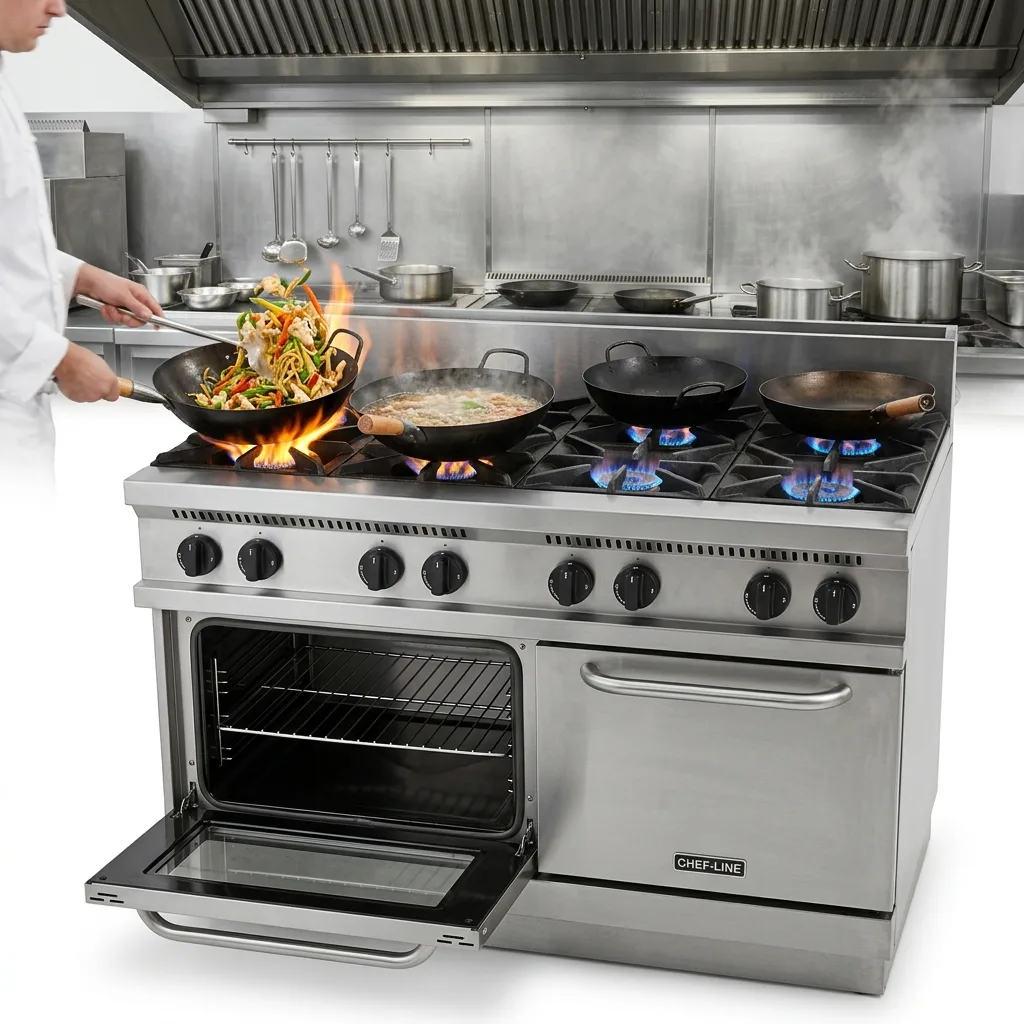
Figure 1: Modular heavy-duty cooking suite configured with high-recovery gas burners, plancha griddle, and open-top convection oven base.
Core Thermal Cooking Appliances Breakdown
The cooking suite forms the thermodynamic engine of any food service facility. Commercial kitchens deploy a combination of open-burner ranges, thermostatically controlled planchas, high-recovery pressure fryers, and multi-function combination steamer ovens arranged systematically beneath a Type I grease exhaust hood. Energy delivery must align with cooking velocity: gas appliances deliver instant visible flame modulation for high-heat wok stir-frying and rapid sauté pans, whereas electric and commercial induction equipment provide pinpoint digital temperature control and uniform surface heat distribution.
- Heavy-Duty Open-Burner Ranges: Utilizing cast-iron ring burners rated from 28,000 to 35,000 BTU/hr per head, equipped with continuous pilot systems, 14-gauge removable drip pans, and heavy-duty cast-iron top grates capable of supporting 50-liter stockpots without mechanical deflection.
- Multi-Function Combi Steamer Ovens: Combining convection dry heat (30°C to 300°C) and pressurized or boilerless saturated steam injection. Modern 10-pan and 20-pan combi units feature multi-point core temperature probes, algorithmic humidity injection, and automatic self-cleaning wash cycles to minimize chef labor.
- Split-Pot High-Recovery Fryers: Featuring insulated cold zones beneath submerged gas burner tubes or electric ribbon elements. The cold zone traps loose breading and food sediment below the active cooking zone (175°C to 190°C), preventing oil breakdown, scorched carbon flavor transfer, and premature oil degradation.
- Precision Planchas and Flat-Top Griddles: Built with 16mm to 20mm polished chrome or carbon steel griddle plates. Thick thermal plates store latent heat, preventing localized surface cooling when cold frozen protein patties or marinated steaks are loaded during peak ticket volume.
Commercial Kitchen Appliance Engineering Matrix
| Appliance Model / Category | Standard Sizing (W×D×H mm) | Utility Specification | Hourly Output Capacity | HACCP Critical Control Point |
|---|---|---|---|---|
| HS-RNG6-HD (6-Burner Range) | 900 × 800 × 850 | 180,000 BTU/hr (Gas) / 24 kW (380V) | 80–120 sauté covers / hr | Flame-out safety & grease tray containment |
| HS-CMB10-GN (10-Pan Combi Oven) | 850 × 800 × 1050 | 18.5 kW 380V 3N~ / Water 0.3 MPa | 120–180 kg roasted/steamed meat / hr | Core probe data logging (≥74°C internal) |
| HS-FRY20-SP (Split-Pot Fryer) | 400 × 800 × 900 | 2 × 14 kW / 110,000 BTU/hr | 45–65 kg french fries / hr | Daily filtration & maximum oil temp limit (195°C) |
| HS-GRD90-CR (Chrome Plancha) | 900 × 800 × 850 | 16 kW 380V / 65,000 BTU/hr | 160–220 burger patties / hr | Surface thermal variance ≤ ±5°C |
| HS-BC10-GN (10-Tray Blast Chiller) | 800 × 800 × 1650 | 3.2 kW 220V/380V R452A | 40 kg from +70°C to +3°C in 90 min | FDA §3-501.14 chilling time-temp curve |
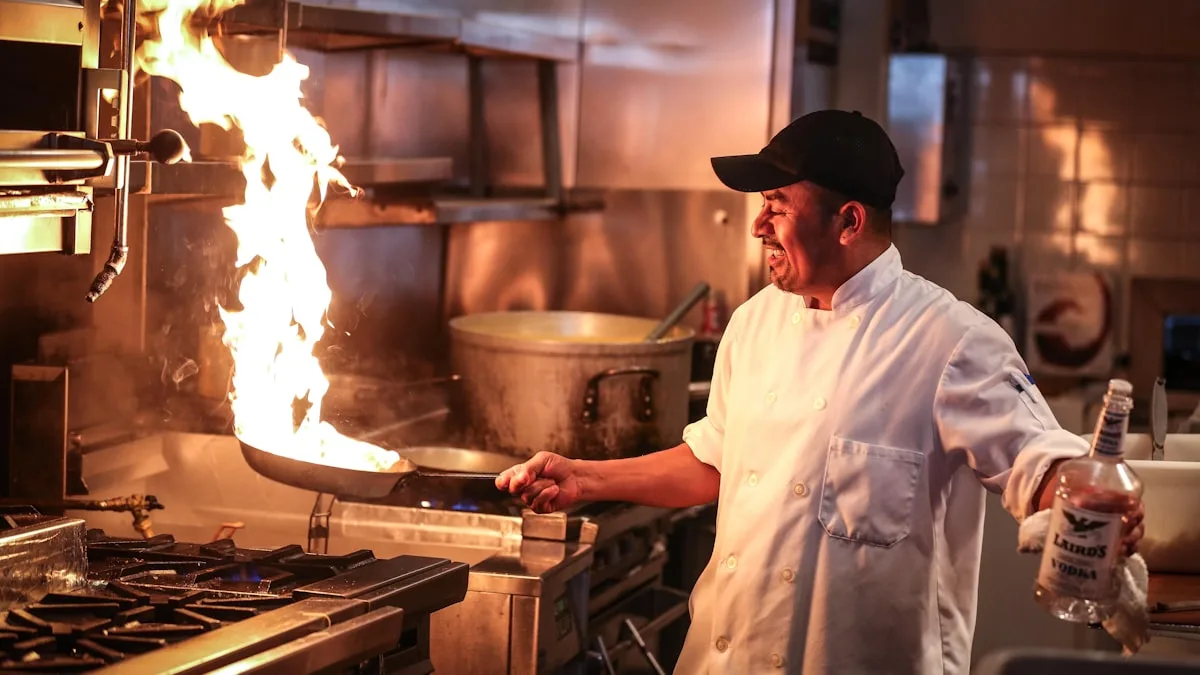
Figure 2: Linear workflow arrangement separating hot cooking, refrigerated cold-pass prep, and automated warewashing.
Cold Storage & Ingredient Staging Appliances
Refrigerated appliances must prevent cross-contamination while keeping raw prep stock within immediate arm's reach of cookline personnel. In commercial operations, refrigeration is engineered across three functional tiers to maintain uncompromised cold chain integrity:
- Bulk Cold Storage (Receiving & Quarantine): Walk-in cold rooms maintained at 0°C to +4°C and walk-in freezers maintained at -18°C to -22°C. Cold rooms require polyurethane insulation panels of minimum 100mm thickness with thermal break floor thresholds and digital datalogging alarms.
- Point-of-Use Prep Refrigerators: Under-counter refrigerated storage drawers with heavy-duty telescopic slides designed to accept 1/1 Gastronorm (GN) pans directly beneath cooking equipment. Chefs pull chilled steaks and seafood directly from refrigerated drawers to the hot griddle in seconds, eliminating time-temperature abuse.
- Rapid Blast Chillers & Shock Freezers: Indispensable for safe prep-ahead cook-chill protocols. Under FDA Food Code §3-501.14, cooked foods must be chilled from 57°C (135°F) to 21°C (70°F) within two hours, and from 21°C to 5°C (41°F) within an additional four hours. High-velocity blast chillers achieve this transition in under 90 minutes using high-volume evaporator fan arrays, preventing vegetative spore germination of Clostridium perfringens.
Commercial Kitchen MEP Utility Sizing Formula
To avoid infrastructure failures during peak meal rushes, engineers calculate the Total Connected Energy Load ($Q_{total}$) and concurrent demand using diversity factors:
MEP Peak Electrical Demand Calculation
P_demand (kW) = Σ (P_connected × DF_i)
Where:
• P_connected = Nameplate electrical rating of each commercial appliance (kW)
• DF_i = Diversity factor (0.65 for primary cooking line; 0.80 for continuous refrigeration; 0.50 for warewashing booster heaters)
• Gas pipe diameter must guarantee a minimum dynamic flow pressure of 7.0 in. w.c. (1.74 kPa) for natural gas or 11.0 in. w.c. (2.74 kPa) for liquid propane under simultaneous full-battery firing.
Ventilation, Canopy Extraction & Fire Suppression Integration
Every thermal cooking appliance generates sensible heat, latent moisture, vaporized grease particles, and combustion byproducts that must be captured at the source. Exhaust canopy design is strictly governed by NFPA 96 and ASHRAE 154 standards:
- Exhaust Air Volume Sizing: Heavy-duty cooklines require 1,400 to 1,800 m³/h per linear meter of hood length. Wall-mounted canopy hoods must provide a minimum 150mm perimeter overhang beyond the appliance cookline footprint on all exposed sides.
- Make-Up Air (MUA) Balancing: Kitchen ventilation systems must introduce 85% to 90% tempered make-up air directly into the kitchen space, leaving the kitchen at a negative pressure of -5 to -10 Pa relative to the dining room. This differential pressure barrier prevents kitchen grease aromas and cooking vapors from invading customer seating zones.
- UL 300 Wet Chemical Fire Suppression: Pre-engineered suppression manifolds featuring dedicated discharge nozzles aimed directly at deep fryers, open griddles, and duct transition throats. The system automatically interrupts gas and electrical feeds upon thermal link activation.
Preventive Maintenance & Lifecycle Operating Schedule
Commercial kitchen appliances represent significant capital expenditure. Maximizing operational lifespan requires disciplined maintenance routines:
- Daily Protocol: Boil-out and hot-drain filtration of commercial fryers; automated chemical wash cycles on combi steamers; hot soapy water wipe-down of stainless steel fabrication and drawer gaskets.
- Monthly Protocol: Vacuum cleaning and chemical degreasing of refrigeration condenser coils; deliming of combi oven steam boilers and commercial dishwasher wash arms; inspection of gas quick-disconnect hoses and safety restraining cables.
- Quarterly / Semi-Annual Protocol: Calibration of thermostat probes across refrigeration and griddle plates (must read within ±1.5°C of certified digital reference); certified inspection of kitchen fire suppression nozzles and exhaust duct grease accumulation levels.
Energy Efficiency Comparison: Gas Open-Burners vs Commercial Induction
Selecting the thermodynamic energy carrier significantly impacts long-term operating costs and HVAC capital expenditure:
| Thermodynamic Metric | Standard Open-Flame Gas Range | Commercial Induction Cooking Suite | Operational Impact |
|---|---|---|---|
| Thermal Transfer Efficiency | 35% – 42% | 85% – 92% | Induction transfers energy directly into pan base with minimal radiant losses |
| Waste Heat Released to Kitchen | 58% – 65% of input energy | 8% – 15% of input energy | Gas dramatically increases kitchen ambient temp and AC chiller load |
| Boil Time (10L Water to 100°C) | 16 – 20 minutes | 7 – 9 minutes | Induction accelerates peak rush ticket delivery by over 50% |
| Surface Cleanability & Safety | Heavy cast-iron grates & burn hazard | Ceramic glass top, no open flames | Wipe-clean in seconds, eliminates fire insurance premiums |
Water Treatment, Filtration & Boiler Plumbing Specifications
Commercial cooking appliances utilizing water (combi steamers, dishwashers, pasta boilers, ice makers) are highly vulnerable to mineral scale deposition. Calcium carbonate (CaCO₃) and magnesium scale coat heating elements, acting as thermal insulators that cause premature element burnout, boiler leaks, and voided manufacturer warranties:
- Total Dissolved Solids (TDS) Limits: Incoming water to combi ovens and steam equipment must be treated to maintain TDS below 60 ppm (parts per million), total hardness below 3 grains per gallon (50 ppm CaCO₃), and silica below 12 ppm.
- Reverse Osmosis (RO) with Mineral Blending: Standard carbon block filters only remove chlorine taste and odor, leaving dissolved limestone intact. Installing a dedicated commercial reverse osmosis system with an integrated mineral blending valve delivers neutral-pH permeate water, preventing both scale accumulation and aggressive acidic copper corrosion.
- Drainage Plumbing & Air Gaps: To prevent municipal sewer backups from siphoning contaminants into cooking cavities, combi steamer drains and dishwasher waste lines must terminate above an indirect waste receptor with a physical air gap of at least twice the diameter of the drain pipe (minimum 25mm / 1 inch clearance).