Direct Answer / Key Takeaway: Validate refrigerated prep table pan temperature with actual containers, working fill, replenishment and service access. Record food conditions separately.
Refrigerated prep table pan temperature should be checked in the arrangement used during service. Container depth, working fill, cover use, replenishment and the access pattern all belong to the trial description. A cabinet display does not independently establish the condition of every ingredient pan above it.
Start with the exact counter and its approved container arrangement. The manufacturer's permitted installation and operating conditions and the facility's food-safety requirements should define the test boundary.
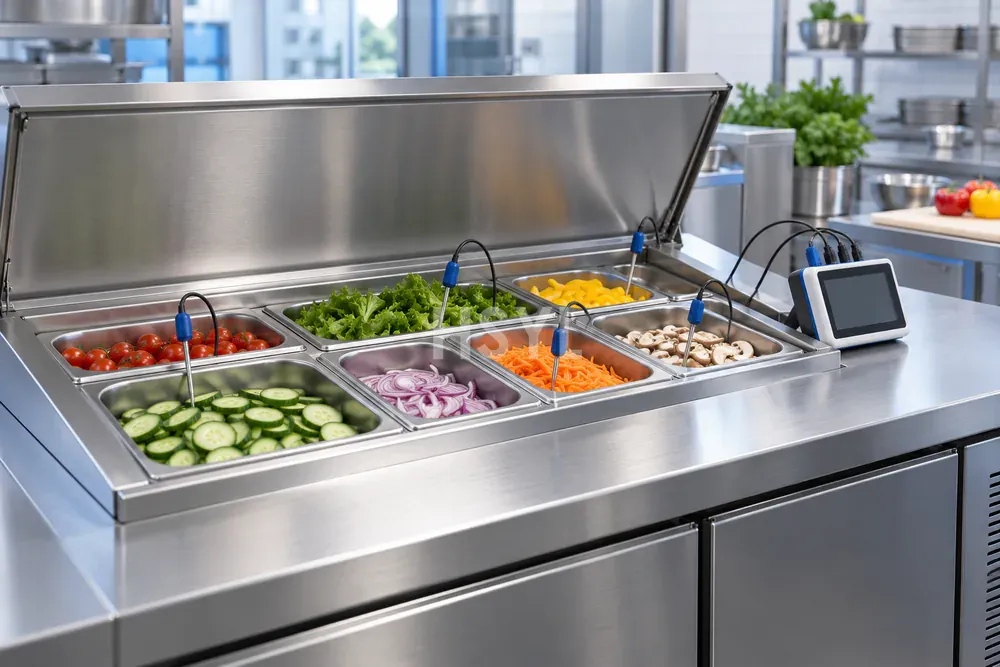
Identify the complete working arrangement
Record the offered counter, rail configuration, supported pan dimensions, inserts, covers and any storage compartment used with it. Obtain the current instructions rather than assuming that a physically fitting GN pan is an approved pan for that application.
List the ingredients, initial condition, working fill and expected replenishment. A shallow pan of one ingredient may not represent a deeper pan of another. Retain product identity and the intended service role so the observations can be connected to the actual menu.
Observe the access and refill pattern
Measure a relevant service window. Record when containers are accessed, covered, removed or replenished, and what new load is introduced. Keep refill events distinct from ordinary ingredient withdrawal. Identify whether the offered equipment is intended for the starting product condition proposed.
Record the surrounding installation and environment, including clearances and adjacent work. Use the supplied documents to establish permitted conditions. A trial with an unapproved arrangement is evidence of that arrangement, not a rated-performance demonstration.
Measure the food condition at identified locations
Agree the measurement method and representative points with the responsible team. Preserve instrument identity, verification status, position, reading interval and product condition. Distinguish the controller display, monitored air and ingredient measurement in the data file.
Government chilling guidance provides food-business background. Use the applicable requirements and approved facility method to decide whether a recorded product condition is acceptable; this guide does not assign one worldwide setpoint.
| Field | Example of useful detail |
|---|---|
| Container identity | Position, dimensions and approved arrangement |
| Product | Ingredient, working fill and initial condition |
| Service event | Withdrawal, cover change or refill |
| Measurement | Point, time, instrument and observed value |
| Decision | Approved criterion and responsible review |
Compare one changed arrangement at a time
For a controlled comparison, keep the relevant service pattern, ingredient basis, environment and measurement method compatible. If a different approved pan depth is being reviewed, state that change and preserve the rest of the comparison as far as practical.
Do not improve a displayed result by silently reducing the load or changing the access pattern. A useful trial should reveal the condition the kitchen intends to operate, including a realistic refill and the last part of the selected service window.
Record exceptions. If a container moves to another work position, its subsequent observations should retain that event. This is particularly useful when one ingredient appears to have a different result from its neighbours.
Release a pan and service plan
Keep the accepted arrangement, permitted loading conditions, monitoring method and service procedure with the equipment's operating package. Review it when pans, ingredients, fill levels, menu or counter configuration change.
When requesting commercial refrigeration equipment, provide the actual pan plan and service record. Ask the supplier to identify the exact configuration demonstrated and its operating boundary. This connects counter selection to the ingredients used by staff rather than to a generic cabinet-temperature statement.