Technical Guides & Articles
Practical guidance for equipment selection, workflow, capacity, hygiene, utilities, FAT and project planning.
Technical Guides & Knowledge Base
Technical content is organized into topic hubs—each focused on a specific decision stage, from capacity planning to FAT compliance. Choose a topic to explore the related guides.
Central Kitchen Planning
Meal demand, menu analysis, zone layout and equipment list—guides for teams planning a new central kitchen.
Explore topic →Topic HubEquipment Selection
How to match equipment models to your actual duty cycle, menu type and utility conditions.
Explore topic →Topic HubCapacity & Sizing
Calculate the right capacity—GN pan formats, dishwasher racks/hour, holding cabinet volume and refrigeration litres.
Explore topic →Topic HubWorkflow Design
Layout principles to prevent cross-contamination between raw, cooked, clean, dirty and waste flows.
Explore topic →Topic HubUtilities & Ventilation
Electrical, gas, water, drainage and exhaust—engineering interfaces that decide equipment performance.
Explore topic →Topic HubHygiene & HACCP
Hygiene zoning, clean/dirty separation and sterilization specification for audit-ready kitchens.
Explore topic →Topic HubMaterials & Fabrication
Stainless steel grade, sheet thickness, welding finish and custom fabrication specifications.
Explore topic →Topic HubFAT & Compliance
Factory Acceptance Testing, documentation packages and target-market certification requirements.
Explore topic →Essential Reading for Kitchen Project Teams
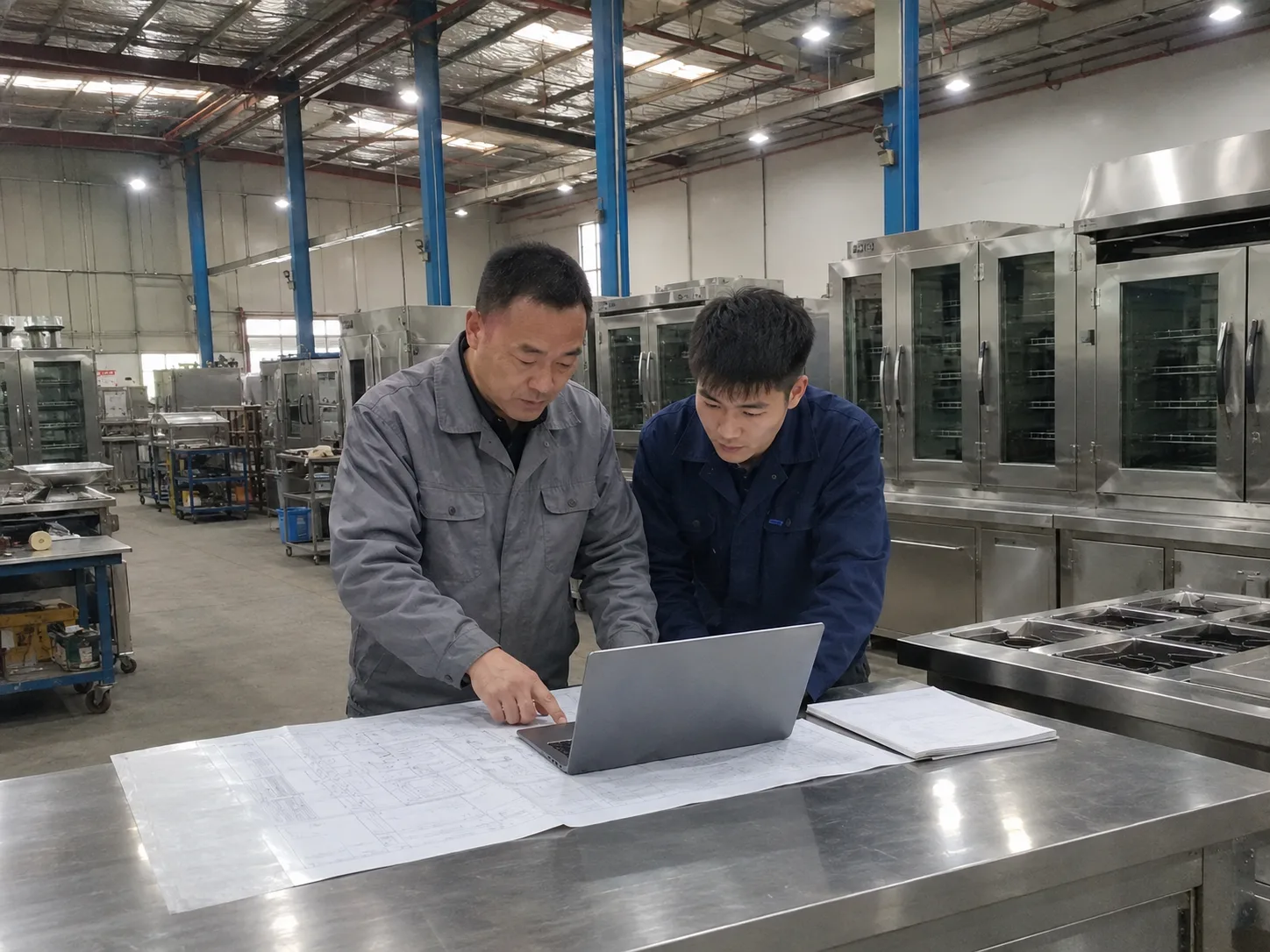
Technical articles published by HSYL engineers to help buyers clarify equipment specifications before ordering.
Commercial Disinfection Cabinet: High-Temperature vs Ozone/UV
A commercial disinfection cabinet is chosen by the tableware it has to treat, before any capacity figure is compared.
Read guide → Equipment SelectionHamburger Patty Press Portion Control: Weights, Molds, Speed
A hamburger patty press controls weight by geometry: the mold's diameter and the pressed thickness together define a volume, and the meat's density turns.
Read guide → Equipment SelectionCommercial Meat Mixer Selection: Throughput and Bowl vs Hopper
A commercial meat mixer is sized by a division, not a litre count: kilograms of mix per batch, divided by the minutes per batch cycle — loading, mixing.
Read guide → Equipment SelectionMeat Slicer Cleaning and Blade Sharpening Schedule
A meat slicer is cleaned on three triggers, and sharpened on one. The triggers: at least every four hours of continuous use, immediately when switching.
Read guide → Equipment SelectionCommercial Meat Slicer Selection: Blade, Duty Cycle, Safety
A commercial meat slicer is chosen by answering three questions in order: what blade diameter the largest product needs, what duty cycle the daily slicing.
Read guide → Workflow DesignHow to Design a Canteen Serving Line: GN Modules and Flow
A canteen serving line is designed once and walked through a thousand times a day, so its layout is decided by three things before any model is chosen.
Read guide → Equipment SelectionHeated Banquet Cart vs Holding Cabinet: Transport or Store
A heated banquet cart and a holding cabinet both keep food hot, but they are built for opposite ends of the same problem.
Read guide → Equipment SelectionSoup Kettles and Counter Warmers for Buffet Service
A soup kettle is a single-purpose warmer for a single product — soup, sauce or gravy held hot and served straight from the pot.
Read guide → Hygiene & HACCPHot Holding Temperature: Food Limits and Equipment Settings
For foods requiring temperature control, the U.S. FDA Food Code generally specifies hot holding at 57°C/135°F or above, UK government guidance specifies.
Read guide →Have a Specific Technical Question?
Send your project requirement, menu or utility conditions. Our engineering team will review the parameters and suggest the matching equipment logic.