A commercial meat slicer is chosen by answering three questions in order: what blade diameter the largest product needs, what duty cycle the daily slicing hours demand, and which safety features the local code and the staff rota require. One extra question separates the professionals: whether the job is precision slicing at adjustable thickness, or high-volume strips and cubes at a fixed cut — two different machine families that look similar in a catalogue. This guide works through all four, with the food preparation equipment range supplying the real numbers.
Blade Diameter Sizes the Product
The blade diameter sets the largest product the slicer can take, and the industry sorts them into rough tiers: around 250 mm blades suit cafés and small delis slicing 5–15 kg per day, around 300 mm is the standard deli tier for 15–40 kg per day, and 350 mm and above belongs to high-volume butchery and large whole-muscle work (industry categorisation, NOT VERIFIED). The logic is geometric, not just commercial: a bigger circle exposes a longer usable cutting arc, so taller and wider product passes without wedging. In this range the FP-HB-320 commercial meat slicer carries a 320 mm blade — above the standard deli tier, sized for larger cuts — while the FP-HB-350400 commercial meat slicer steps up to a 363 mm blade for the heavy end of that work.
Three Size Limits, Not One
Blade diameter gets the headline, but a slicer refuses product for three different geometric reasons. The blade diameter caps the cutting arc; the maximum cutting height caps how tall a piece stands on the carriage (230 mm on the FP-HB-320); and the cutting width caps how wide the product passes (335 mm on the FP-HB-350400). Specify against all three, measured on the largest product actually sliced at peak — not the average — because a slicer that cannot take the holiday ham fails on the one day it matters most.
| Model | Blade | Thickness range | Size limits | Power | Net weight |
|---|---|---|---|---|---|
| FP-HB-320 | 320 mm | 0–18 mm | 230 mm cutting height | 370 W × 2 | 87.2 kg |
| FP-HB-350400 | 363 mm | 0.2–20 mm | 335 mm cutting width | 750 W × 2 | 215 kg |
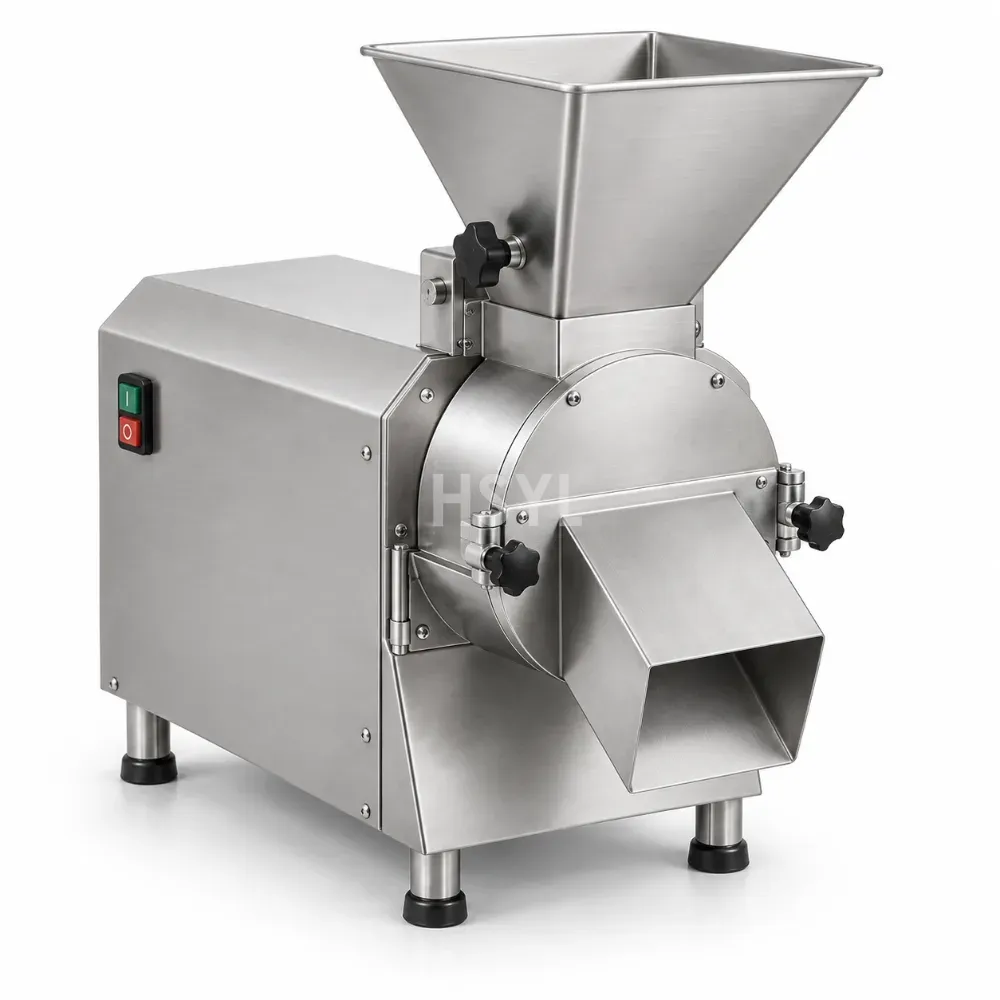
| HCS500 | Fixed-gap blades | 3.5 or 5.0 mm cut | 3.5 / 5.0 mm strip section | 0.55 kW | 50 kg |
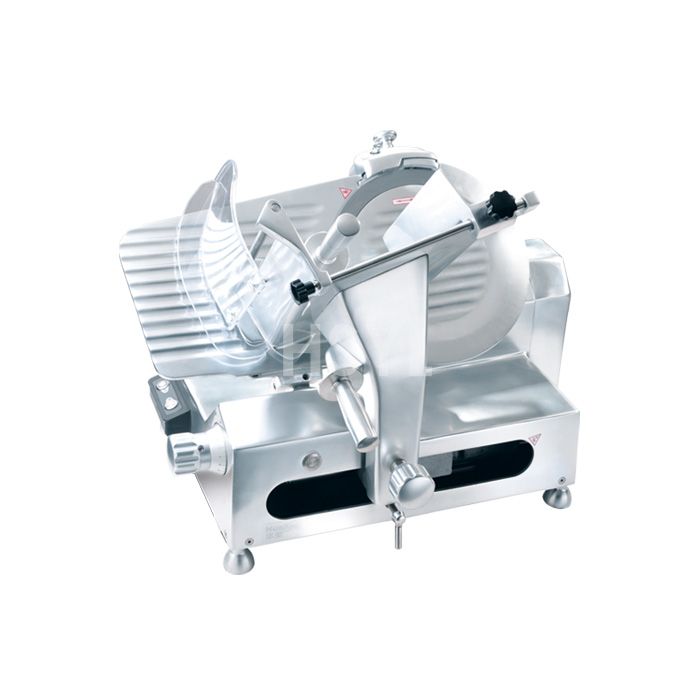
Two Families: Adjustable Slicing or Fixed-Gap Volume
Everything above describes the adjustable slicer: a dial sets thickness from near-zero to the top of the range (0–18 mm on the FP-HB-320, 0.2–20 mm on the FP-HB-350400), and the machine produces slices for deli service. The second family answers a different question entirely. The HCS500 commercial meat slicer is a fixed-gap, high-speed machine: blades set at a 3.5 mm or 5.0 mm section, running at 137 r/min, and rated at 480 kg/h on the finer gap and 240 kg/h on the coarser one. That is not a deli counter machine — it is a production machine for stir-fry strips, cube prep and central-kitchen volume, where the cut is decided once and repeated all day. Choosing between the families is the first fork in slicer selection, before any diameter is compared.
Duty Cycle Sizes the Day
Industry guidance sorts slicer duty into light (under 2 hours of slicing a day), medium (2–4 hours) and heavy (all-day production) tiers, with motor power and drivetrain weight following the tier (NOT VERIFIED). The mass tells the story here: the FP-HB-320 at 87.2 kg with twin 370 W motors is a mid-duty countertop-class worker; the FP-HB-350400 at 215 kg net on twin 750 W motors at 380 V is built to run through shifts without the thermal cycling that wears lighter machines out. Undersizing the duty is the expensive mistake — a slicer that stalls on dense product at peak does not just slow the line, it tears slices and stresses the blade.
Safety Features Are Specification Items
Three safety provisions separate commercial slicers from accidents waiting for a rota change: an interlock that stops the blade when the guard or carriage is opened, a blade ring guard sized so the exposed edge is only what the cut requires, and a thickness dial that closes fully to zero so the edge is covered for cleaning. Add a no-volt release so a power cut mid-cut does not restart the blade when power returns unseen. None of these appear on a spec sheet photograph — they have to be confirmed in the RFQ, alongside the cleaning procedure the machine actually allows, because a slicer that is hard to break down will not be broken down, and the slicer cleaning and sharpening schedule is a food-safety commitment, not an optional chore.
Related Guides
Whichever family the choice lands on, the final check is a witnessed capacity test — running the real product through the real machine before the order is signed — and the general method is laid out in the food preparation machine capacity test guide.