A commercial disinfection cabinet is chosen by the tableware it has to treat, before any capacity figure is compared. Heat and ozone/UV are the two routes: high-temperature cabinets run 120–125 °C cycles that kill by protein denaturation and suit heat-tolerant ware — ceramics, glass, stainless — while ozone and UV run at ambient temperature and exist for the plastics and composites that heat destroys. The sterilization equipment range carries both a dedicated high-temperature family and a multi-mode cabinet that spans the routes.
The High-Temperature Route: 125 °C as Standard
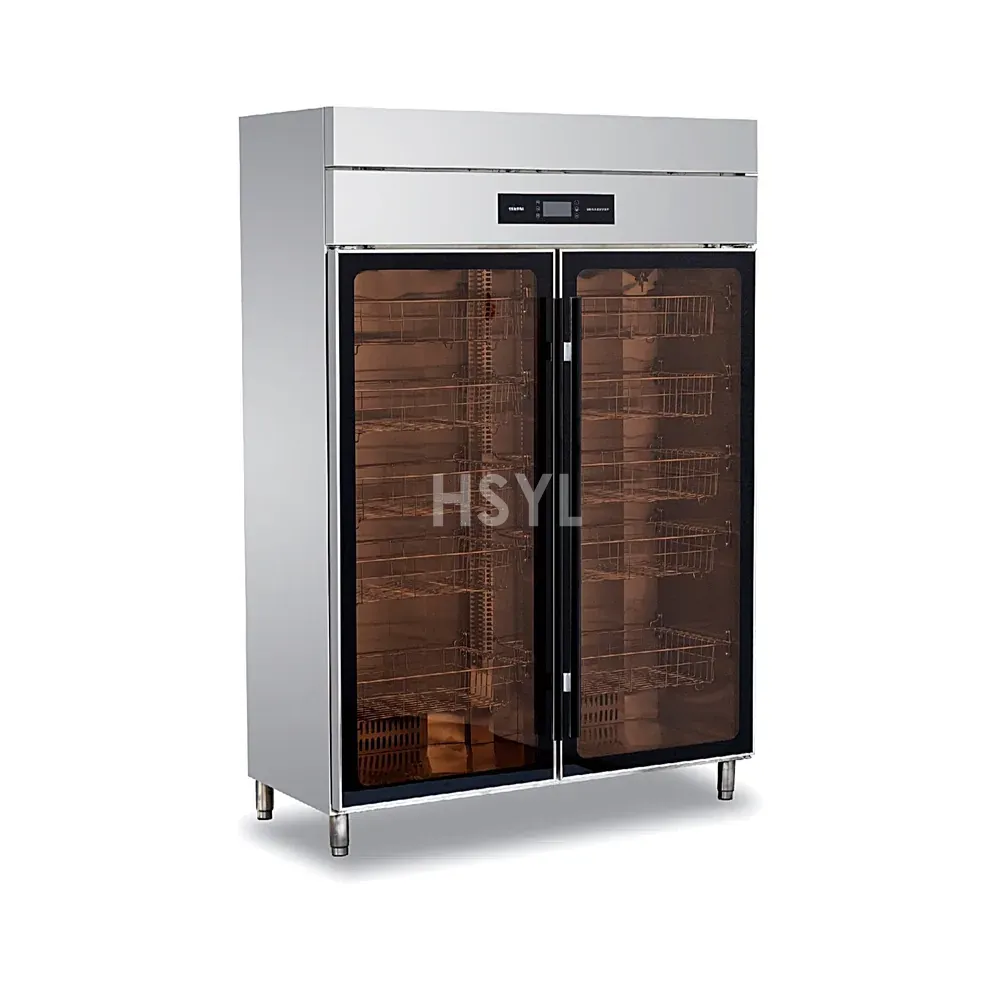
Heat is the reference route in commercial foodservice: it is total on the organisms (no shading, no gas concentration to hold), it leaves no chemical residue, and it standardizes — a fixed temperature held for a fixed time, every cycle, with no operator judgement in the kill step. Regulatory practice puts thermal disinfection at 120 °C and above, held ten to fifteen minutes (industry and regulatory practice, NOT VERIFIED — see the tableware disinfection standards guide for the market-by-market detail). The high-temperature family in this range runs exactly that duty: the Flat-Door A sterilizer cabinet and the Flat-Door B glass-door sterilizer cabinet both run a 125 °C cycle temperature across a 50–125 °C range, on 220 V power, with a 12 cm insulation layer that keeps the heat in the chamber and off the kitchen floor.
The Three-Temperature Cabinet: One Cabinet, Three Duties
Between the single-purpose heat cabinet and the ambient ozone/UV cabinet sits a third architecture: the multi-mode cabinet that runs different temperature programs for different ware. The XRTP-720 three-temperature disinfection cabinet runs cycle temperatures of 120, 80 and 60 °C across a 30–120 °C range — the 120 °C program for the heat-tolerant ware, and the lower programs for loads that cannot take the full cycle, in a 720 L, ten-layer chamber on 4.4 kW. The product pages for the range also reference UV-C and ozone provisions in their documentation — the exact configuration per model is a specification item to confirm in the RFQ rather than a property to assume.
| Model | Capacity | Cycle temp | Layers | Power |
|---|---|---|---|---|
| Flat-Door A / B (single) | 348 L | 125 °C | 4 | 2.2 kW |
| Flat-Door A / B (double) | 740 L | 125 °C | 8 | 4.4 kW |
| XRTP-720 | 720 L | 120 / 80 / 60 °C | 10 | 4.4 kW |
The Ozone/UV Route: For What Heat Would Destroy
The ambient-temperature routes earn their place on material compatibility. UV at the germicidal wavelength (around 253.7 nm — industry figure, NOT VERIFIED) kills fast and cheap but travels in straight lines: shaded surfaces — the underside of a stacked bowl, the inner wall of a cup — receive nothing, which is why UV-only cabinets demand disciplined single-layer loading and clean lamp surfaces. Ozone, by contrast, diffuses as a gas and reaches the shaded geometry UV misses, at the cost of a post-cycle airing requirement and concentration limits on room safety (industry practice, NOT VERIFIED). In commercial practice both work best as the low-temperature half of a strategy — heat for the bulk of the ware, ambient methods for the plastic and composite items heat would warp or crack.
Capacity, Loading and the Gap That Decides the Kill
Two mechanical rules apply whichever route runs. First, capacity is a throughput decision: both flat-door families ship in a 348 L four-layer single unit and a 740 L eight-layer double on the same 1960 mm height, so the step up is a doubling, not a redesign — size the chamber to the wash-up rhythm, not to the storeroom. Second, loading leaves gaps: ware goes in spaced, not nested, because both heat and ozone need to reach the surfaces, and a stacked pile disinfects only its outside. The dishwasher's role in the same hygiene chain — wash first, disinfect second — is compared in the disinfection cabinet vs dishwasher guide.