Direct Answer / Key Takeaway: Design cafeteria tray return stations around arrival waves, sorting tasks, handling geometry and the dishroom handover. Test the actual student route.
Cafeteria tray return station design should follow the way diners actually leave service. A tray rack or conveyor can receive equipment while the surrounding sorting and movement tasks still create a queue. The station needs a clear relationship with the dishroom, waste handling and the route used by the actual students.
Describe the user group and observed return wave. Have the responsible site and safety teams review access, reach, guarding and movement for those users instead of adopting a universal counter height from a generic guide.
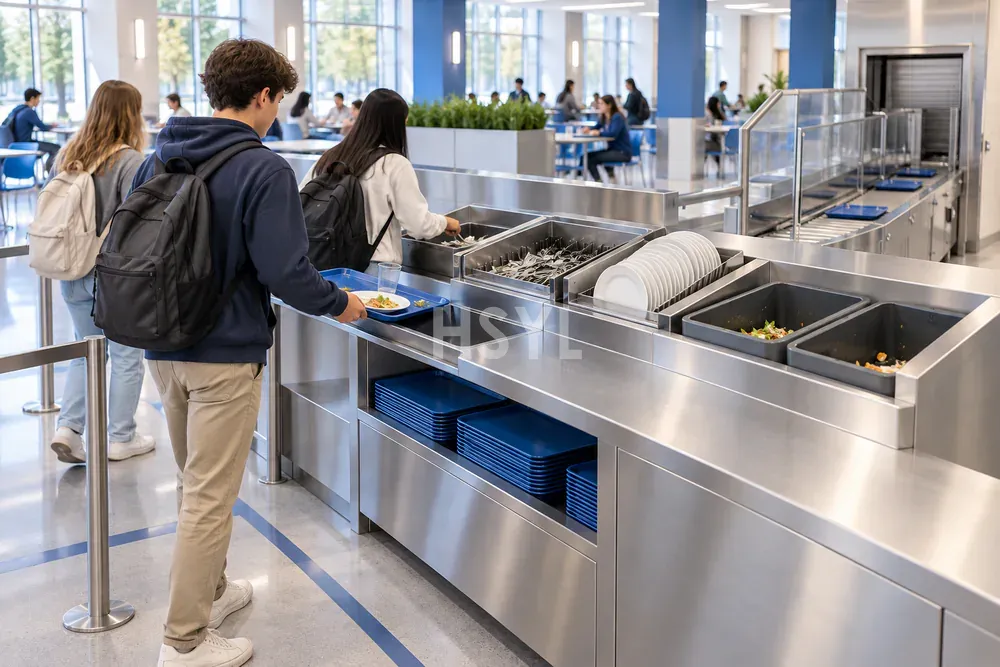
Observe the full return event
Record the arrival pattern after the relevant meal window. Note what each diner carries, the required sorting task and where delays occur. Keep exceptional or assisted use visible so the proposed arrangement does not depend on every person using the station in exactly the same way.
Map the route to and away from the station. A convenient return opening may still place waiting diners across another circulation path. Review the complete movement relationship, including nearby doors and service activities.
Give each returned item a clear destination
Identify the site's released arrangement for trays, cutlery, dishes and waste. Use practical item geometry and the approved hygiene method to determine the collection positions. Where a powered return device is offered, obtain its controlled use, guarding and access information.
Test whether users can understand the intended sequence without staff repeatedly reaching across them. A larger sign is not necessarily the answer to a physical conflict. An observation trial should record the exact task that causes the delay.
Measure the station and its receiving work together
Count arrivals and completed returns within a defined window. Record sorting errors or items needing staff correction, the queue and the downstream clearing of collected items. A station that fills quickly may stop when its receiving rack or container cannot be replaced in time.
For an illustrative comparison, a fifteen-minute return wave presents 150 diners, averaging ten arrivals per minute in that interval. If the observed complete return task handles eight per minute under the assumed conditions, the queue can grow unless the arrival pattern changes or the task is improved. These figures are planning examples, not a target or an equipment rating.
Keep observed peaks and pauses alongside the average. A short concentrated group can need another arrangement even when the full-window average appears manageable.
Include collection-container circulation
Record when each receiving container, rack or trolley is removed, emptied or processed and returned under the approved method. Identify who performs that work and whether its route intersects with diners or clean equipment.
Include the handover to the dishroom. The return station should supply the next approved task in a useful arrangement, not simply move a mixed pile farther from the dining area. Preserve clean/dirty separation through the facility's released layout.
Rehearse with a representative group
Use a safe site-approved trial with the actual user and item conditions. Observe understanding of the sequence, complete returns, corrections, queue position and the receiving team's workload. Keep the relevant menu, staffing and arrival conditions for a later comparison.
Trial one evidenced change, such as a revised sorting position or container replacement route. Assess the complete effect rather than only the speed of a powered component. The responsible team should release the arrangement before routine use.
Provide a return-station equipment brief
Include user group, item geometry, observed arrivals, sorting requirements, receiving circulation and the dishroom interface. The institutional kitchen equipment discussion can then address the actual service-return duty.
A useful return station is demonstrated through accepted handling and a workable complete route. Its proposal should identify the supported conditions and the checks needed at the site.