Direct Answer / Key Takeaway: Plan hospital meal delivery elevator scheduling with cart geometry, permitted access, queue observations and ward handover windows. Test the complete route.
Hospital meal delivery elevator scheduling needs the full route from accepted kitchen dispatch to the authorized ward handover. Elevator waiting, turning, access and recipient availability can consume time that a simple distance estimate does not show.
Use the hospital's permitted transport and service arrangements. The catering route must remain coordinated with the building's responsible operations and safety teams rather than assuming exclusive elevator use whenever meals are ready.
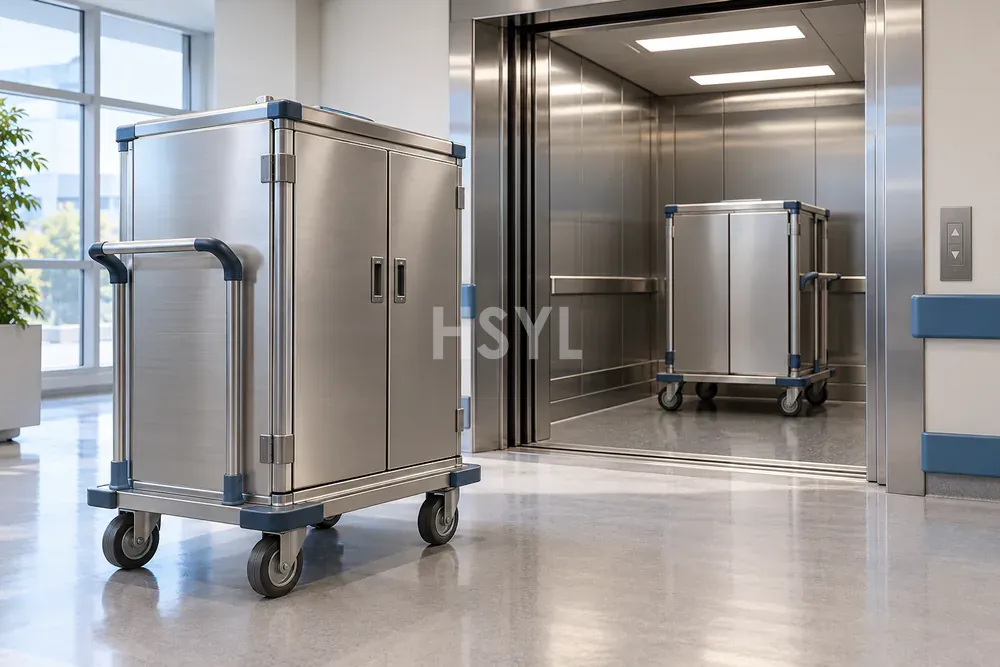
Define the accepted handover at each destination
Identify route groups, meal windows and the responsible recipient. Use the hospital's authorized meal and identification system as inputs. The route study should not create its own clinical suitability decisions or replace ward checks.
NHS England's food standards provide healthcare-service context in their stated setting. The hospital's governing requirements and released procedures control the actual meal service.
Measure the route as a sequence of events
Record kitchen departure, arrival at the elevator lobby, waiting, permitted loading, travel, unloading, movement to the ward and accepted handover. Retain each destination separately when a route serves several locations.
Observe a representative meal window rather than relying on a quiet building walk. Include the access conditions actually available during service and keep a delay or blocked route visible. Record the plan for an exception through the hospital's approved procedure.
| Event | What to confirm |
|---|---|
| Kitchen release | Identified complete load and dispatch status |
| Lobby waiting | Permitted position and actual queue interval |
| Elevator movement | Approved access, equipment fit and handling |
| Ward approach | Actual doors, turns and receiving position |
| Handover | Authorized recipient and required checks |
Verify the cart and the physical interface
Obtain the exact cart dimensions, permitted load and operating information. Have the responsible site team confirm the route, turning space, doors and elevator suitability. Installed dimensions and loaded handling conditions matter; a catalogue width alone does not establish fit.
Review which other movements share the route and how the released meal arrangement interacts with them. Any booking, priority or alternate access must come from the appropriate hospital authority. The catering team should not improvise a restriction on another building service to protect a delivery target.
Calculate the observed route, with waiting included
An illustrative route record includes six minutes to the lobby, seven minutes of waiting, three minutes for the permitted elevator and unloading sequence, and four minutes to the agreed ward handover. The recorded sequence totals twenty minutes. It is not a promised route time or an allowable food exposure period.
Repeat observations for the service conditions relevant to planning and retain variability. If two carts must take successive movements, measure the complete sequence instead of giving both the first cart's result.
Keep food condition and equipment circulation visible
Use the approved meal conditions and monitoring method through the actual route. Record the relevant recipient checks and any unresolved load. A faster journey does not remove the need for the hospital's authorized handover and food-control process.
Map the carts' return, approved cleaning and release for the next service. The outbound route and the fleet circulation are related but different requirements. Keep both in the daily plan when the same equipment is reused.
Use route evidence in equipment selection
Provide cart and container details, route observations, access permissions, recipient requirements and the complete circulation timeline. Ask the supplier to identify the exact supported configuration and what requires site confirmation.
The hospital kitchen equipment brief can then address a defined delivery duty. A credible proposal connects equipment with the accepted ward service rather than presenting an ideal corridor journey as proof of the whole route.