Direct Answer: Specify a GN pan as a complete EN 631 interface, not merely as “GN compatible.” Footprint, depth, flange, corner profile, lid, handle, rail, loading direction, temperature duty and transport restraint determine whether the system works.
Use EN 631 as the dimensional starting point
Gastronorm is a modular catering-container system standardized through EN 631. EN 631-1 addresses dimensions of containers, including flanged and perforated containers and lids. EN 631-2 addresses dimensions of accessories and supports such as trays, grids, cutting boards and dishwasher racks. Buyers should consult the applicable licensed standard rather than relying on an uncited internet chart.
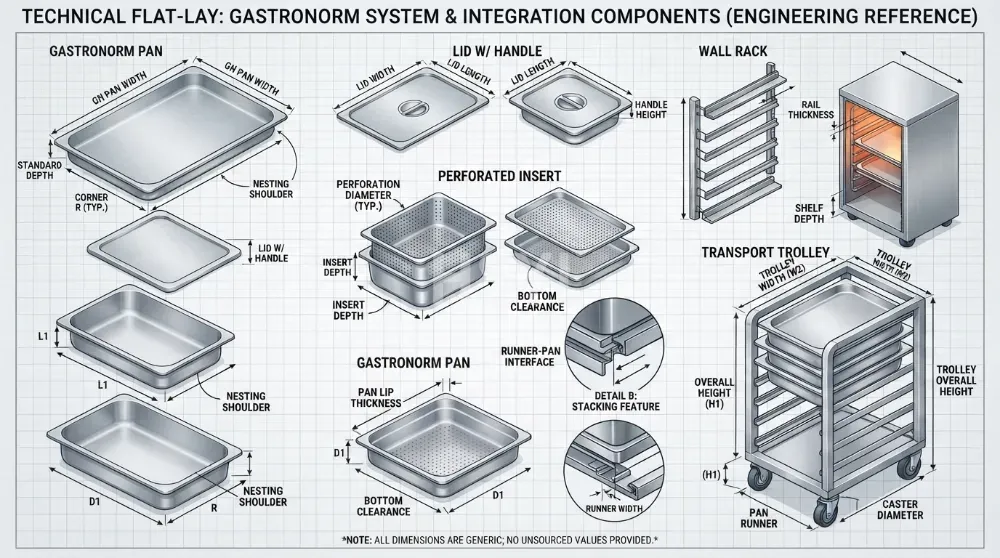
The official BSI series page lists BS EN 631 Parts 1 and 2. The base GN module is 530 mm × 325 mm, as specified in EN 631-1. This sourced dimension describes the nominal system module; it does not by itself guarantee that a particular pan will slide, seal, stack or latch in a particular appliance.
| Specification layer | What it controls | What it does not prove |
|---|---|---|
| GN designation | Nominal modular footprint relationship | Usable volume, pan depth or exact corner fit |
| EN 631-1 reference | Container, perforated container and lid dimensions within its scope | Material suitability for every food and temperature |
| EN 631-2 reference | Covered accessories and supports | Compatibility with proprietary restraints or handles |
| Supplier drawing | Selected item geometry and tolerances | Fit across a process unless mating equipment is also checked |
Read the GN fraction as a module, not a volume
A GN fraction indicates how a footprint relates to the base module. It is not a capacity rating. Two pans with the same GN designation may have different depths, corner radii, wall taper, flange construction and stated usable volume. Food density, fill line, lid intrusion and headspace further separate nominal pan size from actual batch capacity.
For procurement, state the GN designation exactly as shown on the selected pan and mating equipment. Do not calculate or publish derived dimensions from memory. Where a project needs a complete size table, extract it from the licensed EN 631 document or an approved manufacturer drawing and retain the source in the technical file.
Specify depth from process and handling risk
Depth affects much more than volume. A deeper pan changes heat transfer, steam exposure, chilling path, serving reach, center of gravity, drainage and manual handling. A shallow load may cook or chill differently from a dense deep load even when the total product mass is similar. Select depth by recipe and process validation, not by maximizing theoretical capacity.
Record product, batch mass, fill depth, headspace, utensil access and whether a lid or film is fitted. Check the deepest intended combination against appliance clearances and rack spacing. Manufacturer catalogs often offer a range of depths, but those values belong to the selected product and must be verified from its current technical sheet.
| Process | Depth-related question | Trial observation |
|---|---|---|
| Steam or combi cooking | Does the load receive even heat and vapor without overflow? | Product result, drainage and safe unloading |
| Blast chilling | Does product geometry support the validated cooling process? | Probe profile and pan placement under the approved method |
| Hot holding | Can staff portion without excessive door-open time or difficult reach? | Service recovery, product condition and handling |
| Transport | Does the filled pan remain stable with the selected lid and restraint? | Leakage, movement, stacking and lifting |
Match material to food, temperature and cleaning chemistry
Dimensional conformity does not establish food-contact suitability. Stainless steel, coated metal and polymer pans respond differently to heat, cold, impact, acidic or salty food, detergent, sanitizer and abrasion. Ask for a declaration that covers the exact material, color, article and destination-market use condition.
The European Commission’s food-contact materials legislation overview explains the EU framework for safety, inertness, documentation and traceability. It does not certify any HSYL or third-party pan. For internal planning, connect declarations to the food-contact materials page and retain model-specific records.
| Material decision | Buyer evidence | Operational check |
|---|---|---|
| Temperature use | Manufacturer’s stated use conditions for the exact article | Cooking, chilling, holding and washing exposure |
| Food compatibility | Declaration and any restrictions relevant to destination rules | Acid, salt, fat, staining and odor retention |
| Cleaning compatibility | Approved chemical and wash-method guidance | Clouding, corrosion, coating damage or distortion |
| Traceability | Article identity, batch or supplier record as required | Ability to replace like for like |
Treat lids and accessories as engineered components
A lid can alter overall height, stacking, sealing, utensil clearance and transport behavior. Flat lids, handled lids, gasketed lids and lids with utensil cut-outs are not interchangeable in every duty. Confirm whether the lid rests on the flange, nests inside the pan or needs a dedicated latch. Test removal with gloves and under the expected product condition.
Perforated inserts, false bottoms, drain plates, grids and cutting boards also consume space. EN 631-2 supports accessory coordination within its scope, but proprietary parts may introduce different interfaces. List every accessory in the pan schedule and test it as an assembly rather than approving a pan in isolation.
Verify appliance rails, loading direction and clearances
Ovens, refrigerators, blast chillers, holding cabinets and serving counters may all use GN language while differing in rail construction and loading orientation. Check whether the pan is supported by its flange, a tray, a grid or a rack. Verify lateral clearance, insertion depth, end stops, door gasket clearance and space for lids or handles.
Run a physical fit check across the actual process route. Include the commercial combi oven, commercial blast chiller, mobile heated holding cabinet and bain-marie serving counter only where those products are in the project. A drawing review should precede the fit trial, not replace it.
Plan transport, stacking and washing as part of compatibility
Loaded pans move through trolleys, lifts, vehicles and service areas. Verify stack stability, lid retention, pan restraint, trolley rail engagement, maneuvering and manual lifting. Consider product slosh and changes in center of gravity. Do not claim a transport duration or thermal retention period without a project test.
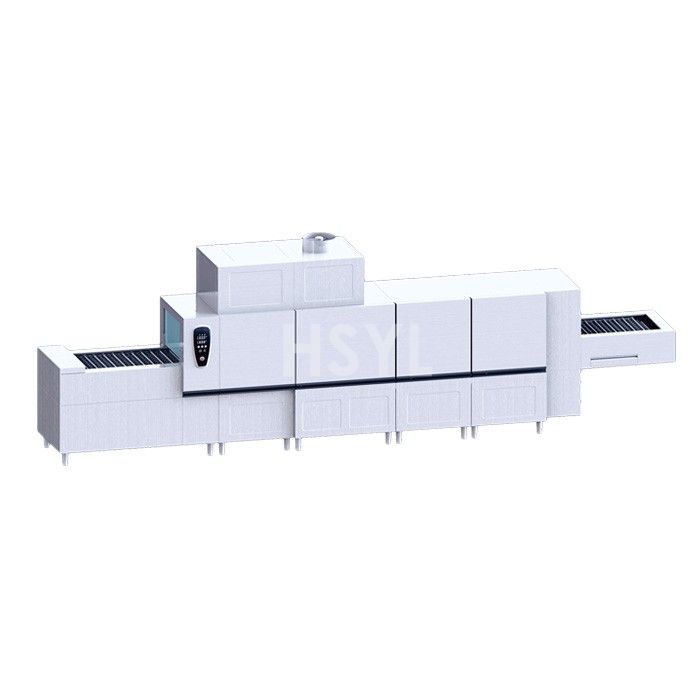
Washing creates a different interface. The pan must fit the rack or conveyor orientation without shielding surfaces or trapping water. Deep nested pans may separate poorly if the wash method is not designed for them. Coordinate with dishwashing equipment and the clean-storage plan so the standardized footprint produces a practical return loop.
Build a pan schedule that purchasing can enforce
The pan schedule should identify use point, GN designation, depth, material, construction, lid, accessory, fill condition, appliance route, trolley, wash method, quantity basis and required declaration. Attach approved drawings or catalog references by revision. Avoid generic descriptions such as “standard stainless GN pan.”
| Verification gate | Method | Acceptance evidence |
|---|---|---|
| Document match | Compare standard reference and supplier drawings | Approved pan and mating-interface schedule |
| Empty fit | Insert, remove, stack, lid and restrain | No interference; required supports engage correctly |
| Representative load | Run the agreed product or safe simulant through the route | Handling, drainage, sealing and stability meet project criteria |
| Cleaning return | Wash, dry, inspect and store using the intended system | Cleanable surfaces, drainage and stack release accepted |
For broader equipment coordination, use the heated holding cabinet selection guide and commercial kitchen FAT checklist. The procurement goal is not merely a standard label; it is a verified, traceable interface from production through service and return. Require the supplier to identify every deviation before the purchase order is released.