Direct Answer / Key Takeaway: Professional facility planning guide for Countertop Induction Warmer calculating hourly mass throughput and batch yields. Inspect engineering calculations,.
Selecting commercial kitchen appliances requires an evidence-based engineering assessment of operational loads, utility footprints, and lifecycle reliability. This specification guide analyzes Standard Duty Countertop Induction Warmer within the framework of capacity formula, providing consulting engineers and hospitality operators with rigorous technical benchmarks.
1. High-Volume Catering Scenarios & Station Architecture: Capacity Formula
Hourly Mass Throughput Formulations & Culinary Yield Calculations:
Precise capacity sizing in commercial kitchens replaces guesswork with rigorous mass-balance formulations governing food density and thermal batch time. Production throughput is calculated via the fundamental hourly formula: Output Capacity (kg/hr) = (Chamber Batch Load (kg) * Usable Pan Tiers * Finished Culinary Yield %) / ((Cooking Cycle Time (min) + Loading/Unloading Turnaround (min)) / 60). Designers establish raw ingredient bulk densities: bone-in chicken quarters average 4.5 kg per GN 1/1 hotel pan (65 mm depth); dense beef roasts achieve 8.0 kg per pan; roasted root vegetables load at 3.5 kg per pan. Furthermore, moisture loss and fat rendering impose empirical shrink factors (yields range from 75% for braised beef to 85% for steamed vegetables and 65% for high-temperature roasting). For an 8-minute turnaround cycle, a 10-tier GN 1/1 combi oven running a 32-minute chicken cycle delivers an effective processing speed of: (45 kg * 0.78 yield) / ((32 + 8) / 60) = 52.6 kg/hour of finished, ready-to-serve protein.
When sizing equipment for peak production hours, facility planners must reference verified commercial equipment selection engineering to ensure capacity reserves remain aligned with scheduled shift turnover targets.
2. Engineering Specifications & Component Material Profiles
The baseline performance data below establishes critical dimensional profiles, energetic consumption limits, and material gauges for Standard Duty Countertop Induction Warmer deployed in institutional foodservice facilities:
| Engineering Parameter | Standard Commercial Spec | Heavy-Duty Institutional Spec | Engineering Variance Threshold |
|---|---|---|---|
| Material Construction | AISI 304 (1.2 mm), 380V-415V 3N~ 50/60Hz (5-12 kW), 6 mm flat/concave ceran glass plate | AISI 304 (1.5 mm), 380V-415V (15-30 kW), Infineon IGBT module, dual cooling fans, magnetic stir assist | Energy efficiency >= 90% across commercial ferromagnetic cookware diameters 200-450 mm |
| Primary Engineering Feature | Coil Geometry: High-purity multi-strand copper litz wire coil with integrated thermal protection thermistors | Reinforced industrial assembly with seamless continuous laser welds | Zero structural deflection under maximum rated loading |
| Operational Subsystem | Electronic Controller: German Infineon IGBT half-bridge/full-bridge digital resonant inverter module | High-efficiency heavy-duty components with dynamic feedback telemetry | Energy efficiency index within top 10% commercial benchmark |
| Sanitary & Safety Rating | Surface Plate: Heavy-duty micro-crystalline ceramic glass capable of withstanding thermal shocks up to 800 deg C | IPX5 washdown protection with NSF/ANSI cleanability rating | Hermetic perimeter sealing preventing microbial colonization |
3. Core Operating Physics & Mechanical Subsystem Analysis
High-Frequency Electromagnetic Eddy Current Induction: Commercial induction cooking operates by passing high-frequency alternating current (20 to 40 kHz) through planar copper induction coils located beneath heavy-duty Schott Ceran glass ceramic plates. The resulting oscillating magnetic field penetrates the ferromagnetic base of cookware, inducing closed-loop eddy currents (Foucault currents). Joule heating (I2R) occurs directly inside the metal base of the pan with thermal efficiencies exceeding 90%, compared to 40% for open gas burners. Solid-state IGBT power modules regulate energy delivery with sub-second response times while keeping kitchen ambient temperatures cool.
In institutional catering environments, equipment longevity is heavily governed by surface passivation and corrosion resistance. Units fabricated from high-grade austenitic stainless steel must maintain an uncompromised chromium oxide passivated boundary layer. Regular chemical cleaning with non-abrasive detergents prevents pitting attack from chlorinated sanitizers and atmospheric chlorides.
Understanding these thermodynamic and mechanical principles allows consulting engineers to optimize cycle times, reduce utility peak draw, and eliminate premature component fatigue.
4. Production Yield Calculations & Mathematical Capacity Models: Induction Electromagnetic Coupling Efficiency
Kitchen throughput modeling relies on proven dimensional formulations to balance batch turnaround against meal wave surges. The calculation below defines nominal capacity requirements:
Power Delivered (kW) = [Vessel Water Mass (kg) * 4.184 kJ/kgK * Delta-T (80K)] / [Boil Time (sec) * Induction Efficiency (0.92)]
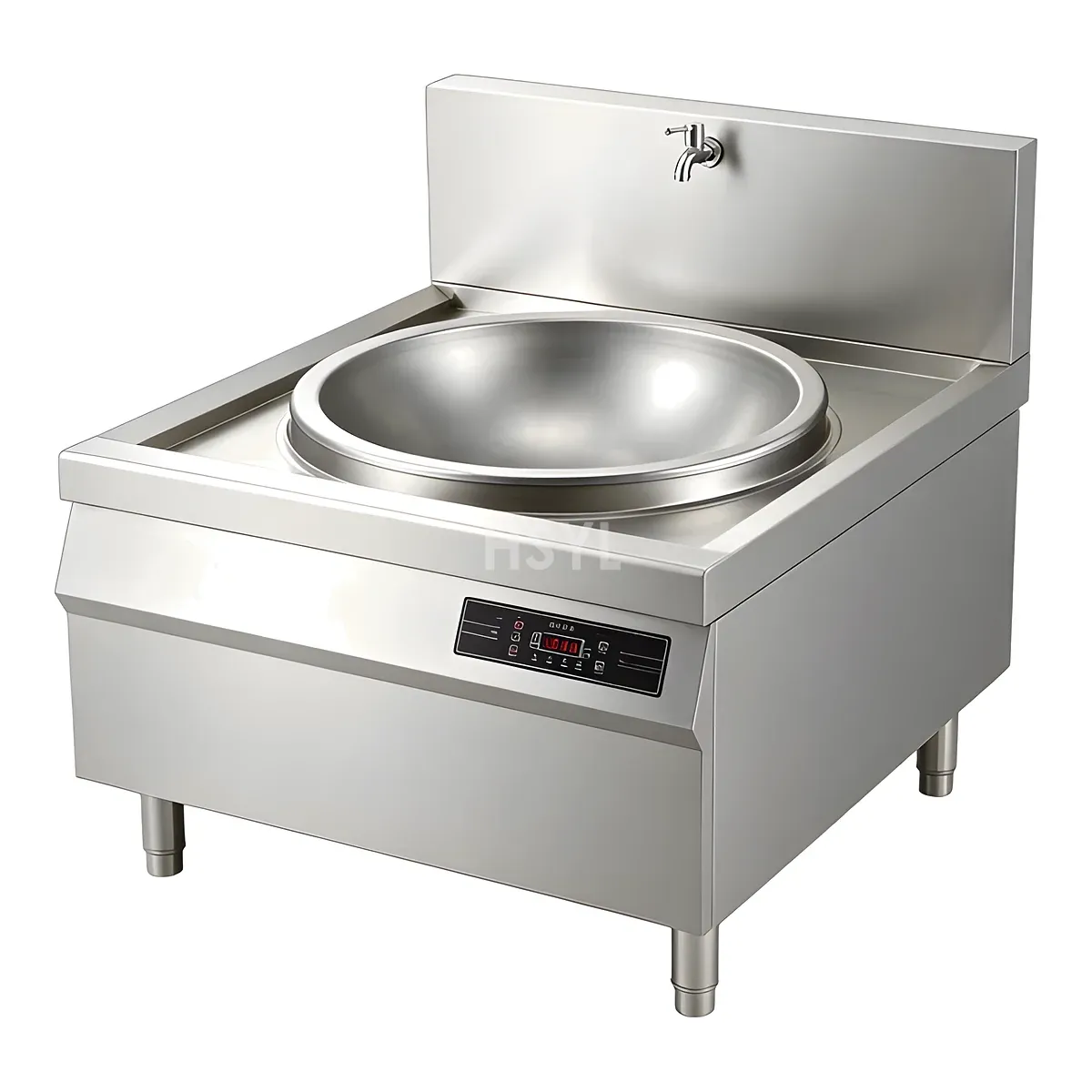
Heating 15 Liters of water from 20 to 100 deg C in 6 minutes: Theoretical heat = 15 * 4.184 * 80 = 5,020 kJ; Power rating = 5,020 / (360s * 0.92) = 15.1 kW (specifying a 15 kW commercial induction wok range).
Practical sizing engineering requires accounting for the hidden ware factor. Beyond customer dining covers, back-of-house food preparation items (hotel pans, sheet trays, mixing bowls, and prep utensils) contribute an additional 15% to 20% to total kitchen processing loads. Furthermore, thermal transfer times for bulk foods follow the transient conduction square-law relationship (t is proportional to x^2), meaning doubling product depth from 50 mm to 100 mm in pans roughly quadruples core pull-down or heating times. Sizing calculations must incorporate these empirical variables to ensure uninterrupted kitchen workflow.
Employing this sizing method protects the kitchen from meal bottlenecks, prevents premature thermal and mechanical failure, and guarantees compliance with HACCP time-temperature critical control points (CCP).
5. Utility Demands, MEP Rough-Ins & Architectural Coordination
Facility MEP coordination requires precise interface alignments to guarantee operating safety and code compliance. Verify the following site preparation standards for Standard Duty Countertop Induction Warmer:
- Power & Electrical Connection: 3-phase 380V-415V connection with zero phase imbalance; requires clean electrical feed with low harmonic distortion.
- Water Supply & Treatment: No water connection; requires clean intake air filter with minimum 150 mm chassis rear ventilation clearance.
- Wastewater & Drainage Air Gap: Discharges must connect to temperature-resistant indirect waste lines with an unobstructed physical air gap, conforming to FDA Food Code Chapter 4 backflow mandates.
- Ventilation, Clearances & Environment: Air intake filters beneath unit must have min 150 mm unobstructed clearance; ambient kitchen intake air temperature strictly under 40 deg C.
Critical Field Installation Redlines & Contractor Pitfalls: During jobsite rough-ins, engineering teams must enforce the following compliance boundaries to prevent premature equipment failure and voided warranties:
- Intake Air Filter Cleaning: Ensure intake grease filters beneath the cooktop are cleaned weekly; choked filters starve IGBT heatsinks, triggering automated thermal derating.
- Ambient Air Limit: Never install induction generator chassis in enclosed cabinet bases where ambient air exceeds 40 deg C (104 deg F).
- Cookware Base Planarity: Do not use warped or dented pan bottoms; air gaps between vessel and Ceran glass cause electromagnetic decoupling and high IGBT switching stress.
6. Manufacturing Standards, FAT Compliance & Safety Dossiers
Rigorous factory acceptance testing (FAT) guarantees that Standard Duty Countertop Induction Warmer satisfies all mechanical, electrical, and sanitary benchmarks prior to marine container loading. Review factory acceptance testing and compliance verification against these criteria:
- Electrical Efficiency & Thermal Transfer Audit: 15 Liter water boil test verifying energy efficiency exceeds 91.5%.
- Ceramic Glass Impact Resistance Test: 500g steel ball dropped from 50 cm onto plate verifying zero cracking or structural fatigue.
- Electromagnetic Compatibility (EMC) Radiated Emission: Verified meeting EN 55014 limits with zero interference to kitchen controls.
- High-Voltage Dielectric Withstand Test: 2000V AC applied for 60 seconds between primary power conductors and chassis.
To satisfy commercial health department and third-party food safety audits, modern commercial appliances incorporate automated HACCP data logging. The onboard microcomputer logs real-time time-temperature decay profiles, cycle durations, and sanitizing rinse parameters with cryptographic timestamps. Facilities personnel can export encrypted audit logs via USB or Modbus/Ethernet IoT interfaces, providing verifiable compliance dossiers to satisfy municipal health inspectors during unannounced regulatory audits.
7. Field Fault Diagnostics & Corrective Maintenance Logic
Resolving field service disruptions requires systematic root-cause diagnostics. Technicians should consult the following error code matrix to troubleshoot Standard Duty Countertop Induction Warmer:
| Fault Code | Root Cause Diagnostic | Corrective Maintenance Procedure |
|---|---|---|
| E01 | IGBT Heat Sink Temperature Exceedance | Heat sink thermistor exceeded 85 deg C; clean air intake filter and verify cooling fan RPM. |
| E02 | Non-Ferromagnetic Cookware Material Alert | Pan material magnetic permeability insufficient; replace with 430/304 induction-compatible vessel. |
| E04 | Supply Voltage Phase Surge / Sag Fault | Incoming line voltage outside allowable +-15% window; check facility phase balance and breaker panel. |
8. Preventive Maintenance Protocols & Lifecycle Management
Operational reliability over a 10-year design horizon demands routine mechanical and electrical verification. Execute the following preventive maintenance schedule for Standard Duty Countertop Induction Warmer:
| Maintenance Interval | Inspection Scope & Component Target | Acceptable Operating Standard |
|---|---|---|
| Daily Post-Shift | Wipe ceramic glass surface with specialized scraper, check grease filter intake | Ceramic surface free of baked-on food stains, air intake mesh clean of oil film |
| Weekly Operational | Wash removable aluminum grease mesh filters in warm soapy water | Air filters completely dry and clean ensuring maximum cooling airflow to electronics |
| Quarterly Inspection | Inspect chassis internal cooling fan bearings and measure capacitor ESR | Fans spin silently at full rated RPM, filter capacitors show zero swelling or ESR rise |
| Annual Servicing | Clean internal circuit boards of airborne grease dust, verify IGBT thermal paste | Heat sink thermal compound fresh, all terminal screws torqued to manufacturer spec |
All mechanical maintenance interventions must utilize NSF H1 certified food-grade synthetic lubricants on drive bearings and moving pivot hinges. Electrical connections, magnetic contactors, and grounding continuity must be re-torqued and tested annually using calibrated digital multimeters to prevent thermal resistance hot spots.
Recommended First-Year Commissioning & Preventative Spares Kit: For international projects and remote institutional complexes, maintaining an on-site critical spares inventory avoids catastrophic service interruptions:
| Part Description | Recommended Quantity | Engineering Maintenance Function |
|---|---|---|
| Solid-State IGBT Power Switch Module | 2 Pieces | High-frequency power switching transistor driving planar electromagnetic coils. |
| High-CFM Heatsink Blower Fan | 1 Piece | Cools internal inverter electronics, preventing thermal shutdown under full-duty boiling. |
| Ceran Glass Thermal Expansion Seal | 1 Set | Food-grade elastic silicone gasket preventing liquid ingress between glass and chassis. |
| Glass Surface Thermocouple Sensor | 1 Piece | Monitors cookware base temperature to prevent dry-pot boil-off damage. |
9. Industrial Export Packing, Moisture Barriers & Freight Protection
Marine transit across international shipping corridors requires engineered protective packaging to safeguard delicate electronic controls and stainless assemblies. Dispatch protocols for Standard Duty Countertop Induction Warmer include:
- Ceramic Glass Surface Foam Shield: High-density 25 mm EVA foam plate bonded over glass to prevent shipping fracture.
- Electronic Inverter Chassis Bracing: Inverter module brackets secured with locking hardware against road vibration.
- Hermetic VCI Moisture Barrier Bag: Sealed protective foil packaging shielding sensitive electronics from salt spray.
- ISPM-15 Certified Wooden Crate: Reinforced export crate marked with Fragile Glass and Do Not Tip symbols.
For comprehensive wiring schematics, spare parts exploded diagrams, and maintenance schedules, consult the official technical documentation and installation manuals provided by HSYL engineering.