Direct Answer / Key Takeaway: Plan stuffing work from usable charges and the complete sausage-making sequence. Include casing handling, refill work, recipe changes and downstream capacity.
A stuffer's cylinder volume tells only part of the sausage-making workload. The usable charge depends on the actual machine and mixture, while each charge also requires loading, casing handling, removal and eventual cleaning. Plan the complete session before selecting a larger cylinder.
Use actual charge mass rather than a litre-to-kilogram assumption
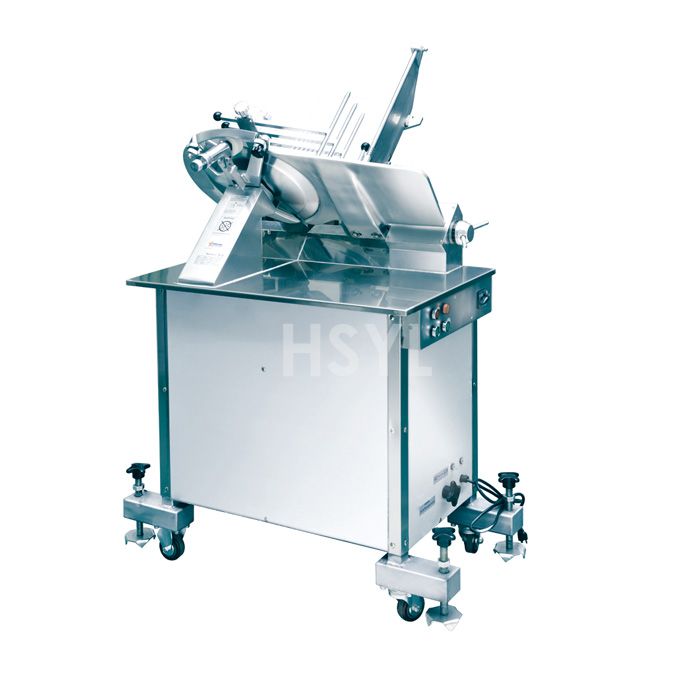
Define the recipes, quantities and casing requirements that the kitchen intends to run. Keep coarse and fine mixtures separate in the plan where their working behaviour or finishing steps differ. A nominal litre capacity is a volume statement; it does not establish the mass of every formulation that may be processed.
Have the proposed supplier demonstrate a permitted charge with the actual product and approved procedure. Record how much enters the cylinder or hopper and how much acceptable product emerges. Identify material remaining in the tube or other areas under the kitchen's approved product-handling plan rather than counting every loaded kilogram as finished sausage.
For a hypothetical 12 kg recipe, a demonstrated permitted charge of 4 kg means at least three charges. That arithmetic does not establish hourly capacity: the preparation and completion of each charge still take work. Neither number is a rating for an HSYL machine.
Include the work between charges
Observe loading, casing preparation, filling, linking or other finishing, transfer to the next approved step and the return to readiness for another charge. Identify who performs each task. A faster filling stage may simply move the queue to casing handling or linking.
Use the actual tube and casing arrangement in the assessment. Manufacturer F. DICK supplies distinct filling-tube options, illustrating why an accessory must be matched to the product task. Its component sizes and permissions do not define those of another stuffer. Do not assume a purchased tube will suit the casing merely because it fits the outlet.
Compare one long run with several short recipes
A kitchen producing one recipe in repeated charges has a different schedule from a butcher preparing several small batches. In the second case, include the approved emptying and cleaning work between products, together with the staging space required to keep batches identified.
Map those movements within the raw-preparation route review. Keep food handling and time-temperature controls under the kitchen's validated plan. A larger cylinder is not permission to stage more mixture outside those controls.
Assess the full session against the available staff and downstream capacity. Compare a manual, powered batch or other proposed arrangement only where the supplier supports that exact configuration and product. Choose from measured charge work and acceptable finished output; avoid universal claims that a drive type eliminates an operator or doubles production.