The number in a cooking-line series is a depth, not a model year and not a marketing tier. 600 mm is the countertop depth for compact bench equipment, 700 mm is the standard floor depth for everyday restaurant and canteen duty, and 900 mm is the heavy floor depth for hotels and central kitchens that cook at sustained high output. Depth sets the cooking surface area and the workspace behind it, which is why the right question is not "which brand" but "which depth fits my menu volume and my floor plan". HSYL runs all three depths as modular lines — the 600-series countertop cooking equipment, the 700-series combined western kitchen stove and the 900-series combined western kitchen stove — so the comparison below is the same factory, three depths, isolated by design.
The 600 Series: Countertop Depth for Benches and Snack Lines
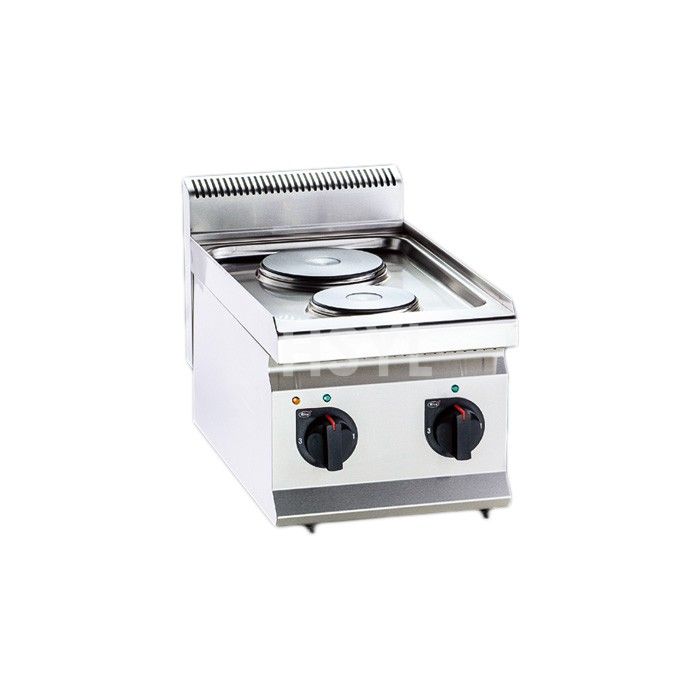
The 600-series is the countertop tier: a 415 mm working height sitting on a bench, built in 350 × 600 and 600 × 600 mm footprints. Documented power spans the range of compact cooking duty — the HS6035E countertop unit runs 2.5 kW on the 350 mm model and 5.0 kW on the 600 mm model at 380 V, the 600-series countertop electric oven runs 4.5 kW, and the gas modules like the 600-series desktop gas barbecue grill carry the same footprint.
This depth exists for lines that serve at the counter — a noodle or snack station, a café pass, a concession outlet — where the equipment sits on a bench and every millimeter of the 600 mm depth is a cooking surface. The practical ceiling is set by power per module: once the menu demands several modules running at full draw simultaneously, the countertop depth stops being enough and the line moves to the floor. The pasta cooker and fryer guides in this series cover those single-module selections in detail.
The 700 Series: Standard Floor Depth for Restaurant and Canteen Duty
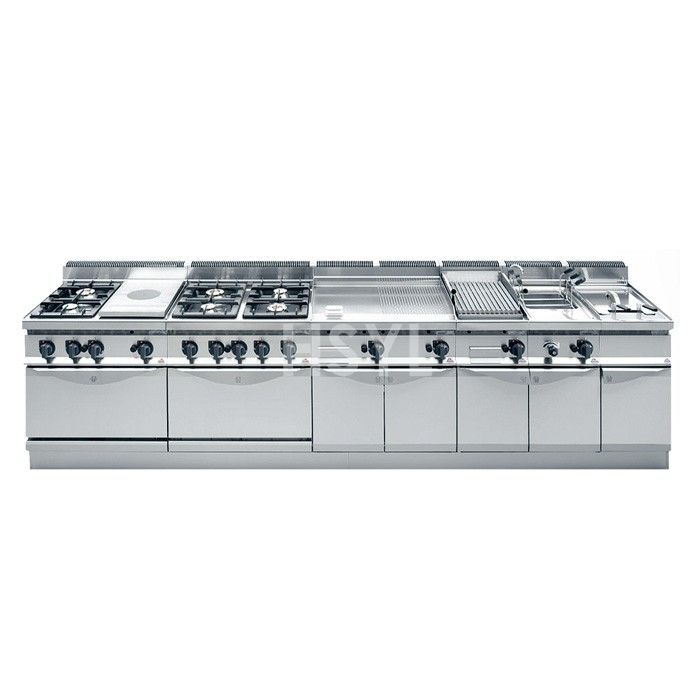
Stepping to the floor, the 700-series is the everyday workhorse depth. On the HSYL line the 700-series combined western kitchen stove is documented in heavy-gauge AISI 304 stainless with HACCP-compliant seamless joints, and it is offered in electric at 380 V three-phase 50 Hz, high-efficiency LPG, or natural gas at 20 mbar — so one series covers the utility mix a normal restaurant or canteen presents. The documented quality gate matters as much as the material: every unit carries a 100 percent pre-shipment gas pressure leak test and an electrical safety insulation log before dispatch.
This depth suits the controlled, steady service of cafés, restaurants, school and staff canteens — enough cooking surface and behind-burner workspace for a full menu, without the extra footprint a 900 mm line demands. Where space is the binding constraint, the 700 mm depth is the one that fits the room; where output is the constraint, it is the step below that you outgrow.
The 900 Series: Heavy Floor Depth for Hotels and Central Kitchens
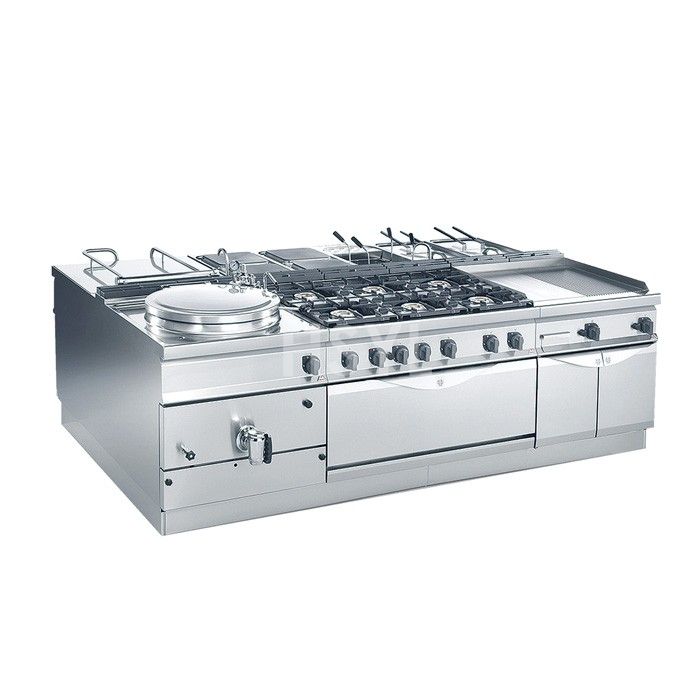
The 900-series is the heavy tier: a deeper cooking surface and higher per-module output for kitchens that run hot all service long. The HSYL 900-series combined western kitchen stove carries its own product code (CK-BERTO-2) and is specified for the high-volume environments — hotels, banquet lines and central kitchens — where the extra depth buys continuous output rather than occasional headroom. Where the 700-series serves a menu that peaks in waves, the 900-series serves one that stays at peak.
One honesty note that the category rarely gives you: on this line, exact dimensions, per-module power and capacity are confirmed on the specification sheet against your product code at quotation time, rather than published as a fixed table. Treat the 900-series as a configuration to be quoted against your menu and floor plan, not an off-the-shelf box — which is also how the modular widths (400, 800, 1200 mm and up) are assembled into a continuous line.
How to Pick: Match Depth to Menu Volume and Floor Plan
Depth is a first filter, not a final answer. Run it in this order:
- Menu volume first. A café menu that peaks gently lives happily on 700 mm. A hotel banquet line or a central kitchen that cooks hundreds of covers back to back needs the 900 mm output. The 600 mm countertop tier is for stations, not whole kitchens.
- Floor plan second. Depth is the dimension that eats into aisle space. A 900 mm line in a tight kitchen steals circulation; a 700 mm line in a warehouse kitchen leaves output on the table. Measure the room before you upgrade the series.
- Utilities third. All three depths span gas and electric, but the load scales with depth. Confirm phase and capacity — the 700-series documents 380 V three-phase, and the gas modules run natural gas at 20 mbar or LPG — against what the building actually delivers, using the connection-by-connection checklist in the utility schedule guide.
Three Depths Side by Side
| Series | Form | Depth / Height | Documented Power Range | Utility Options | Fits |
|---|---|---|---|---|---|
| 600 | Countertop modules | 600 mm deep, 415 mm high | 2.5–12 kW across modules | 380 V electric; gas on grill modules | Snack lines, cafés, counters |
| 700 | Floor-standing stove | 700 mm deep | Confirmed on specification sheet | 380 V 3P / LPG / NG 20 mbar | Restaurants, canteens, education |
| 900 | Floor-standing stove | 900 mm deep | Confirmed on specification sheet | Quoted to configuration | Hotels, banquets, central kitchens |
Where a field is confirmed on the specification sheet, that is the page's own stated practice — the 700 and 900 series are configured to order against the product code rather than sold from a fixed table. The full modular lineup sits under commercial cooking equipment.
Three Mistakes That Come from Ignoring Depth
- Buying a 900-series line for a 700-series kitchen. The output is welcome; the stolen aisle and the oversized utility draw are not. Depth is a footprint decision before it is a power decision.
- Mixing countertop and floor depths on one run. A 600 mm countertop module dropped between 900 mm floor units breaks the working surface and the service layout. Pick one depth per line and keep the countertop tier on the bench where it belongs.
- Reading the series number as a quality tier. 600 is not "worse" than 900 — it is shallower. A snack counter that runs 12 kW of countertop modules is correctly specced, not under-bought.
Related Equipment & Systems
Once the depth is set, the individual modules are the next decision. The pasta cooker selection guide and the gas vs electric fryer guide both live on the 600-series countertop depth and work through those modules one by one. For central-kitchen and hotel projects where the 900-series line anchors the hot section, the central kitchen solution shows how the cooking line, holding and blast chilling sequence together.