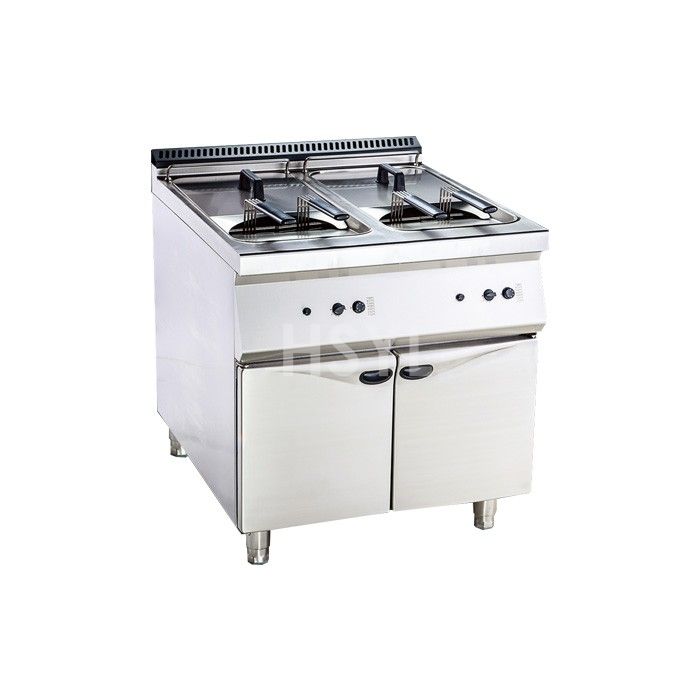
Choosing between a gas and an electric commercial fryer is a three-step decision: confirm which energy source your site can actually deliver, compare recovery power per liter of oil — not the fuel label — and then run the operating cost against your own tariff, not against someone else's national average. HSYL builds the same 23 L and 28 L tank in both gas and electric configurations on the Commercial Deep Fryer CK-YZL-02 platform, which makes the comparison unusually clean: identical tank geometry, two energy routes, published power ratings for each. This guide uses those paired figures — plus the HF7040-3G three-tube gas deep fryer and the HF countertop electric fryer range — to settle the gas-vs-electric question on data instead of dealer folklore.
Why Published Recovery-Time Claims Contradict Each Other
Read three dealer guides on fryer recovery and you will find three incompatible answers. One says electric fryers recover 40 to 60 percent faster than gas. Another says gas recovers in 60 to 90 seconds while electric needs 90 to 150. A third sells induction electric as the fastest of all. All three can be simultaneously true, because none of them is comparing fuel — they are comparing machines with different installed power.
Recovery is governed by how much heating power sits behind each liter of oil: kW per liter. Divide the rated input by tank capacity and the fog clears. On the CK-YZL-02 platform the same tanks ship in both configurations:
| Tank | Gas Input | Gas kW per Liter | Electric Input | Electric kW per Liter |
|---|---|---|---|---|
| 23 L single | 12 kW | 0.52 | 9.0 kW | 0.39 |
| 23 L × 2 double | 24 kW | 0.52 | 18.0 kW | 0.39 |
| 28 L single | 15 kW | 0.54 | 12.0 kW | 0.43 |
| 28 L × 2 double | 30 kW | 0.54 | 24.0 kW | 0.43 |
In this product family the gas configuration carries 25 to 33 percent more installed power per liter than its electric twin, so within these models the gas fryer recovers faster after a frozen load drops in. That does not make gas universally faster — it makes this comparison specific. An electric machine with a higher kW-per-liter rating than a gas one reverses the result, which is exactly why the dealer guides disagree. When a supplier quotes recovery performance, ask for the rated input and the tank volume, divide, and compare like with like.
Where Recovery Actually Comes From: Tube Design and the Cold Zone
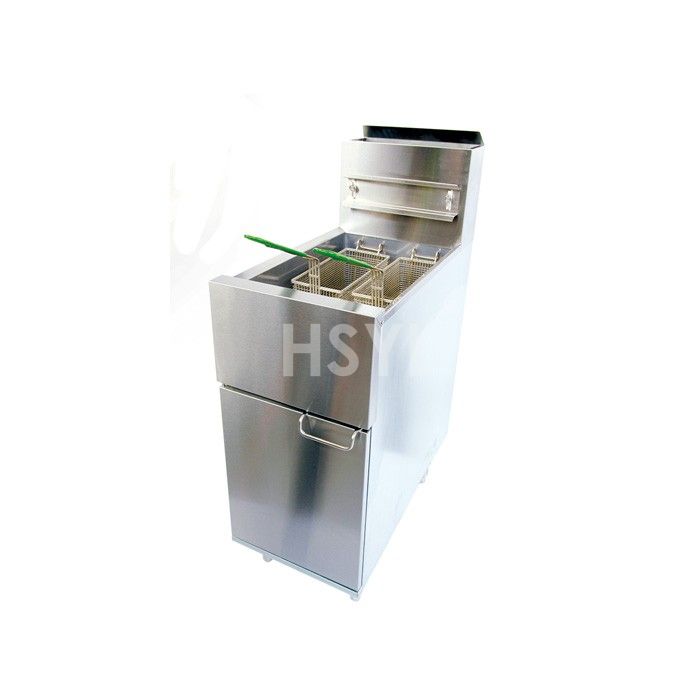
Fuel is only half of the recovery story; heat transfer design is the other half. The HF7040-3G heats oil through rapid-recovery heat exchanger tubes — submerged tube passages that put combustion energy directly into the oil instead of against a tank wall — and the documented behavior is a return to the set 175–185 °C frying window within seconds after a frozen batch goes in. A gas fryer with efficient tube geometry can out-recover a poorly designed electric element, and the reverse also holds. Judge the machine, then the fuel.
Two more documented design points affect what recovery is worth in daily service. First, the V-shaped oil well creates a cold zone beneath the heating tubes where loose batter and breading settle at lower temperature instead of burning — which extends usable oil life by up to 30 percent and keeps the oil behaving consistently across the shift. Second, an independent high-limit safety thermostat cuts gas or power automatically if oil reaches 230 °C, on top of the primary operating thermostat. Both protections run on either energy route; neither is a reason by itself to pick one fuel over the other.
Operating Cost: Run Your Tariff, Not a National Average
Every dealer cost table you will find online is anchored to one country's utility prices, which is why they disagree as loudly as the recovery claims. The honest method is a three-line calculation you can run in a minute:
- Hourly energy draw = rated input × duty factor. A fryer holds temperature with thermostat cycling; it draws full power mainly during heat-up and recovery bursts, so an 8-hour frying day at moderate duty might see the elements or burners at full draw for a fraction of that.
- Energy into the oil = input × transfer efficiency. Elements submerged in oil transfer most of their energy to the oil; open-flame and tube systems send a meaningful share of combustion heat elsewhere. Use the efficiency figure for the specific machine, not a class average.
- Hourly cost = energy drawn × your unit price, gas and electricity priced separately.
As a worked example with placeholder rates — not market data, insert your own tariffs — suppose gas at 0.04 per kWh-equivalent and electricity at 0.15 per kWh, with 40 percent transfer efficiency for the gas tubes and 90 percent for the elements. The 23 L gas tank at 12 kW costs 12 × 0.04 ÷ 0.40 = 1.20 per hour at full draw; the electric twin at 9 kW costs 9 × 0.15 ÷ 0.90 = 1.50 per hour at full draw. Swap in a region where electricity is cheap relative to gas and the electric unit wins; where gas is cheap it wins bigger. The arithmetic takes a minute; the tariff sheet is the only part you cannot download.
One structural point the averages hide: the gas and electric twins are not the same machine at the same power. The gas versions carry more installed kW per liter (see the table above), so in heavy-duty service they burn more energy per hour of full draw — but they also move more product per hour. Cost per hour and cost per kilogram of finished food are different numbers, and the second one is the one that matters.
Site Utilities Decide Before Economics Does
The cheapest fryer to run is the one your building can actually feed. Four utility gates from the documented specification settle the question before any cost math:
- Gas pressure and calibration. The floor-standing gas fryers are specified at 2.8 kPa gas supply. Export units are factory-calibrated for natural gas at 20 mbar (7 in. W.C.) or LPG propane at 28–30, 37 or 50 mbar — order the calibration that matches the site's registered gas, and treat a mismatch as a re-order, not a field fix.
- Electrical supply. The electric configurations run on 380 V / 50 Hz. Export builds can be configured across 380–415 V three-phase, 220–240 V single-phase, 208–240 V three-phase 60 Hz, and 110 V markets — but a 9 to 24 kW electric fryer is a dedicated-circuit appliance, not a plug-in. The installation spec calls for an isolated breaker within 1.5 m of the machine.
- Ventilation and clearance. Minimum 150 mm rear service clearance with unobstructed airflow, and exhaust capacity matched to the fryer bank. A gas fryer without adequate flue and exhaust flow loses both performance and safety margin.
- Water and drain for oil management. Fryer stations pair with filtration and disposal workflows; a floor plan that ignores the oil-handling route pays for it every change cycle.
For a full connection-by-connection checklist across all cooking equipment, the commercial kitchen equipment utility schedule maps every discharge and hookup that contractors should verify before positioning day.
Gas and Electric Model Data Side by Side
| Model | Configuration | Power | Supply | Tank | Net Size (mm) |
|---|---|---|---|---|---|
| CK-YZL-02 gas | Single tank, floor | 12 kW gas | 2.8 kPa | 23 L | 400 × 820 × 920 |
| CK-YZL-02 gas | Double tank, floor | 24 kW gas | 2.8 kPa | 23 L × 2 | 800 × 820 × 920 |
| CK-YZL-02 gas | Single tank, deep well | 15 kW gas | 2.8 kPa | 28 L | 400 × 900 × 920 |
| CK-YZL-02 gas | Double tank, deep well | 30 kW gas | 2.8 kPa | 28 L × 2 | 800 × 900 × 920 |
| CK-YZL-02 gas | Single tank, raised well | 20 kW gas | 2.8 kPa | 25 L | 400 × 820 × 1163 |
| CK-YZL-02 electric | Single tank, floor | 9.0 kW | 380 V / 50 Hz | 23 L | 400 × 820 × 920 |
| CK-YZL-02 electric | Double tank, floor | 18.0 kW | 380 V / 50 Hz | 23 L × 2 | 800 × 820 × 920 |
| CK-YZL-02 electric | Single tank, deep well | 12.0 kW | 380 V / 50 Hz | 28 L | 400 × 900 × 920 |
| CK-YZL-02 electric | Double tank, deep well | 24.0 kW | 380 V / 50 Hz | 28 L × 2 | 800 × 900 × 920 |
| HF6035E | Countertop electric | 6.0 kW | 380 V | — | 350 × 600 × 415 |
| HF6060E | Countertop electric, twin zone | 12.0 kW | 380 V | — | 600 × 600 × 415 |
Fields marked "—" are not published for that model; confirm tank volume on the specification sheet before freezing a layout. Countertop electric units like the HF range suit concession counters and snack lines where gas routing is impractical — the same decision logic, scaled down. The full cooking lineup sits under commercial cooking equipment.
Related Equipment & Systems
Energy route is the second decision in fryer selection, not the first. Start with sizing the frying duty — order waves, tank count and the station around the vat — then apply this guide to choose gas or electric within the size you have settled. For buyers specifying the full serving line, the fryer configuration is quoted together with the rest of the station so utilities, exhaust and oil handling land on one coordinated drawing.