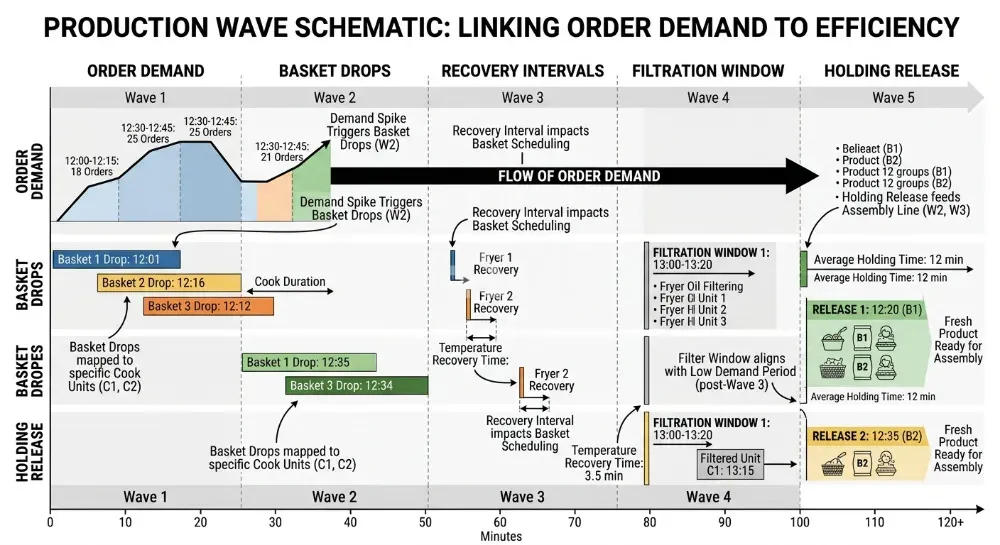
A fryer can hold a large volume of oil and still miss the service duty. The decisive question is not “How many litres?” It is whether the complete station can accept the real product, restore the agreed cooking condition between drops, release acceptable food at the required rhythm and let staff filter, clean and handle oil safely.
Start with the most concentrated order wave
Take the menu and reconstruct the busiest credible order wave. List each fried item, portions ordered, pieces per portion, frozen or chilled state, breading or batter, target finish and maximum time between cooking and service. Then arrange the drops in the sequence the kitchen will actually use.
This exposes constraints that a daily-meal total hides. Two kitchens may sell the same number of portions, but one receives a sharp lunch wave while the other cooks continuously. Products may also be incompatible in the same oil because of flavour transfer, allergen controls, crumbs or different cooking conditions. Separate vats can be an operating requirement rather than spare capacity.
| Drop record | What to state | Why it affects selection |
|---|---|---|
| Product condition | Product identity, starting condition and preparation method | Changes heat demand, oil disturbance and crumb load |
| Basket load | Actual mass and piece arrangement, not basket volume | Overloading can change cooking consistency and recovery |
| Release rule | Approved endpoint, sensory standard and hold limit | Defines when a batch is genuinely available for service |
| Next drop | Required interval and allowable variation | Turns peak demand into a recovery requirement |
| Oil separation | Allergen, flavour and product-family restrictions | May determine number and arrangement of vats |
Do not invent a loading percentage to complete the worksheet. If the batch has not been tested, mark it as a trial condition. The useful output is a timed drop schedule with assumptions visible.
Translate the wave into a fryer arrangement
A single vat, split vat and multiple independent fryers solve different problems. A single vat concentrates duty but can make incompatible products compete. Split vats create separation and control flexibility, although each section must still pass its own product load. Multiple fryers add redundancy and menu separation but also add line length, utilities, exhaust load, cleaning work and oil inventory.
Review basket geometry with the food. Long products, delicate coatings and floating items may not suit the same basket or vat shape. Confirm the usable cooking area, sediment zone where relevant, drain path and how staff lift, drain and transfer a basket without crossing another station.
Energy labels can support a comparison only within their scope. The ENERGY STAR commercial fryer criteria use heavy-load cooking energy efficiency and idle energy rate for eligible products. Those metrics do not prove that a model fits a particular menu, passes destination requirements or achieves the kitchen’s batch rhythm. Compare exact, documented models after the duty is defined.
Design the station beyond the vat
Make oil handling part of the operating cycle
Map oil delivery, filling, skimming, filtering, top-up, change-out, waste-oil transfer and cleaning. State who performs each task and when. An integrated filtration system can reduce manual handling, but the buyer still needs to confirm filter capacity, consumables, access, cycle time, hot-oil routing and what happens when filtration is unavailable.
Locate the fryer so that wet traffic and washdown do not pass through hot-oil work. Provide a stable landing area for baskets and product containers. Confirm how crumb, packaging and waste-oil containers leave the station. Oil-management claims should be evaluated from operating records under a defined menu; a universal oil-life promise is not credible.
Treat utilities, exhaust and fire protection as one interface
Gas or electric selection affects more than the purchase price. Obtain the exact proposed model’s input, connection, isolation, clearances and service requirements. Compare them with the site’s verified gas or electrical capacity, destination voltage and frequency, ventilation design and operating plan.
The fryer, hood, grease removal, make-up air, fire-suppression arrangement and shutdown/interlock logic must be coordinated by competent parties under the applicable jurisdiction. Do not assume that a fryer can be added beneath an existing hood because physical space appears available. The live commercial kitchen ventilation guide helps organize the questions, while the final design and approvals remain project-specific.
Specify a witnessed product trial
Use representative food—not an unspecified surrogate—at the agreed starting condition. Record model and configuration, oil type and starting condition, setpoint, batch mass and arrangement, time of each drop, observed recovery indication, cooking time, product endpoint, quality findings and the interval to the next acceptable drop. Repeat the pattern that represents the peak wave.
The trial should also expose workflow: loading, basket drainage, transfer, filtration, restart after filtration and clean-down access. Record deviations rather than silently reducing the batch. A successful single drop is not evidence of sustained peak performance.
Before ordering, turn the result into a fryer duty sheet: menu allocation by vat, peak drop schedule, tested batch, required release rhythm, basket and accessory list, oil-management procedure, utilities, exhaust/fire interfaces, cleaning access and acceptance criteria. Use that sheet to compare the commercial serving-line and fryer category and to request a model-specific proposal through the HSYL project inquiry.