A commercial dishwasher price should identify the machine, its configuration and the items required to put it into service. The appliance price alone may exclude racks, tabling, water treatment, connections or installation. Compare quotations against the same return load and site conditions before deciding which offer represents better value.
For a restaurant or canteen buyer, the first question is not simply “What does a dishwasher cost?” It is “What complete wash-up arrangement does this quotation provide?”
Choose a duty before comparing a price
Record the busiest return period, the types of plates, bowls, cups, trays and utensils, and the space available for dirty and clean items. Identify items that need a separate pot-wash or specialist process. A general meals-per-day figure does not describe the actual loading work.
Use the commercial dishwasher capacity calculation guide to translate the return peak into a practical requirement. Then compare the undercounter, hood and conveyor machine formats against that duty. Choosing the format first makes the price comparison more meaningful.
What changes the quoted equipment package?
| Package type | Scope to describe | Costs that need a separate check |
|---|---|---|
| Undercounter installation | Usable rack format, opening clearance, wash duty and loading position | Suitable racks, water connections, drainage arrangement and any specified treatment |
| Hood-type workstation | Machine orientation, loading and unloading positions, rack movement and operator access | Infeed and outfeed tables, pre-rinse arrangement, racks and service connections |
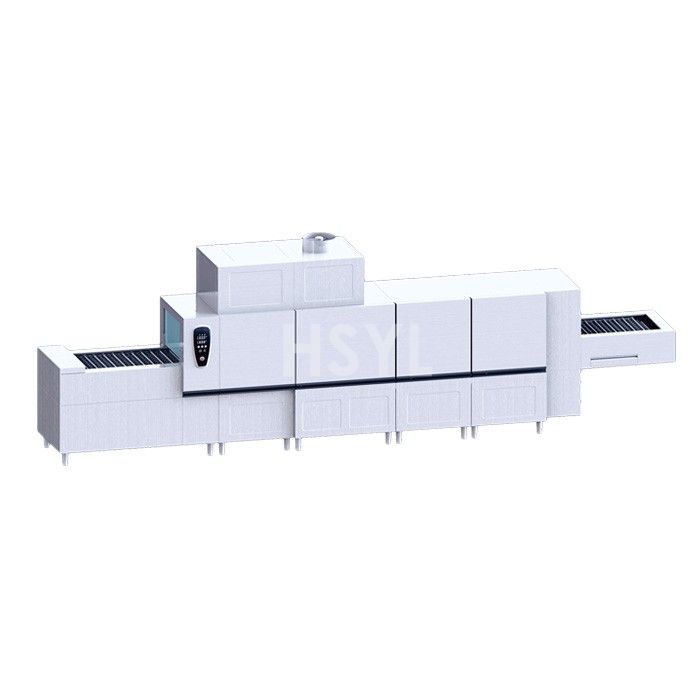
| Conveyor wash-up line | Ware format, loading system, process zones and clean-side discharge arrangement | Tabling, accumulation space, specified heating services, ventilation interfaces and installation work |
These are comparison categories, not universal price bands. Options and included accessories differ by model and supplier. A machine's name or frame length does not establish the complete offered configuration.
Ask suppliers to separate five parts of the commercial dishwasher price
- The machine: model, quantity, configuration, controls and stated supply requirements.
- The working accessories: rack types and quantities, baskets, tables and items needed for loading and unloading.
- The water and service interfaces: required inlet conditions, drainage, electrical connection and any specified heating, dosing or treatment equipment.
- Delivery and installation: packing, delivery point, positioning, connection work and the party responsible for each task.
- Start-up and support: agreed performance checks, operator instruction, documents, warranty terms and service arrangements.
Mark each item as included, excluded, optional or supplied by another party. A blank line leaves an uncertainty that will eventually become a purchasing or installation decision.
Resolve the items most easily counted twice or missed
Water treatment: request the machine's inlet-water requirements and compare them with the site supply. Do not automatically add a generic softener or assume treatment is unnecessary. If treatment is required, identify its scope, connection work and ongoing consumables.
Heating and electrical services: distinguish the offered machine configuration from site-provided hot water or steam. State which connection components and service work are included. Have the responsible installer confirm the available supply against the selected model.
Tabling and racks: check what the machine will actually receive. A low machine price can exclude the racks or tables needed for the proposed workflow; buying extra standard racks does not help if the actual trays do not fit them correctly.
Chemicals and dosing: identify any equipment included with the machine, the items provided by a chemical supplier, and the responsibility for setup and replenishment. Keep those arrangements visible in both the equipment offer and the operating budget.
Normalize the quotations before comparing totals
Prepare one row for every required supply or service. Give each supplier a column, record the quoted amount in a common currency and identify exclusions before calculating a comparison total. Where an excluded item is necessary, obtain its cost from the party that will provide it.
For example, one offer might include a machine and two racks, while another includes a complete loading workstation. This does not demonstrate that either machine is cheaper. First establish the same usable workstation in both columns, then compare the resulting supply and installation totals.
Keep quotation validity, destination charges, payment terms and delivery scope with the comparison. The phrase “commercial dishwasher machine price” should refer to a dated, defined offer rather than a number detached from its configuration.
Separate purchase cost from cost in use
Commercial dishwasher cost in use can include energy, water, chemicals, labour, cleaning and maintenance. Compare these under the same operating schedule and load. A nameplate power figure describes a connection requirement; it is not by itself a measured energy cost per rack.
Where both configurations are available for the project, the steam-heated versus electric dishwasher guide provides a separate discussion of utility choices. Keep that assessment distinct from the equipment purchase quotation so an apparent operating benefit does not hide an unpriced site conversion.
What to send with a price request
- Actual ware and rack dimensions, with photographs where helpful.
- Peak return quantities and the available wash-up window.
- A layout showing sorting, loading, discharge and clean storage.
- Available electrical, water, drainage and heating services.
- Delivery location and the installation scope you want priced.
- Required documents, performance-check conditions and support arrangements.
Send the brief through the HSYL warewashing equipment enquiry and ask for an itemized response. A useful commercial dishwasher price lets you see both the selected machine and the work still needed to make the wash-up area function.